
Let me sit heavy on thy soul to-morrow!William Shakespeare, Richard III
Taken one word at a time, heavy metal music meaning is a small puzzle with a long shadow behind it. The adjective that did the hardest work in the English of 1968 was heavy, a word the young leaned on for anything that pressed down on them, and the noun with the most danger in it was metal, the stuff of shell casings, guitar strings and slow poisons. Each arrived already loaded. The music was named twice before anyone named it once.
How the phrase itself travelled, from a drug novel through a biker single to the record reviews of 1970, is laid out in the chapter it belongs to. What the two words meant once they landed on a riff is another question, and it has a better answer, because the answer sits inside the words themselves and not in anybody's claim to have coined them.
Heavy, the word 1968 leaned on
In 1968 heavy came down on the youth vocabulary of Britain and America the way a summer storm front comes down on a field of ripe barley, beating every stalk flat in the same direction, so that a film, a mood, a political argument, a friend's divorce and a slow blues in E all lay under one word and meant, roughly, serious, dense and hard to shift. Nobody defined it. Everybody felt it.
The San Diego band that sold the mood straight back to its audience gave its first album the bare title Heavy, and Iron Butterfly put it out on Atco in January 1968, months before the title track of its second album turned the band into a radio fixture. The word on that sleeve promised weight rather than a style. There was no style yet to promise.
In the music papers the word worked almost as a physical measurement. A heavy record carried its weight in the low strings, in a bass drum felt through the floorboards and in a riff that landed square on the beat instead of dancing round it. Heavy rock and heavy blues became working shorthand for acts built the same way, Cream, Vanilla Fudge and the Jeff Beck Group among them; one later appraisal called the Jeff Beck Group's 1969 record Beck-Ola an unfocused heavy blues jam, long before anyone fastened a noun on behind the adjective. Heavy described the foundations. It said nothing yet about the building material.
Metal, the edge on top of the weight
The noun came with two older meanings already attached: the gunner's heavy metal, the largest ordnance a fort or a ship of the line could bring to bear, and the chemist's, the dense and poisonous end of the periodic table where lead, mercury and cadmium sit. Both stuck to the music without anybody asking them to. A sound that is hard to carry and harmful in quantity is not a bad description of a stack of amplifiers at full volume in a hall built for four hundred people.
The better meaning is the one a listener actually hears. The electric guitar is metal from end to end, steel strings vibrating over magnetic pickups and driving valve amplifiers until they distort, and distortion lays a bright rasp of upper harmonics over the low fundamental, a scraping top the ear files as metallic on top of a bottom it files as heavy. Heavy is the mass. Metal is the edge. Put together, the two words describe the sound more exactly than most genre names ever manage, which is one reason the phrase outlived every attempt to replace it.
Heavy is the mass. Metal is the edge.
Nothing in that pairing is about speed, costume or subject matter. A slow record can be heavy metal and a fast one can fail to be, depending on whether the mass and the edge are both present, and that is why the phrase stretched without breaking across records as far apart as a doom dirge and a twin guitar gallop. The meaning was in the sound from the start. The arguments came later.
Heavy metal music meaning, from a sneer to a flag
For most of the seventies the phrase was an accusation more often than a badge. Critics reached for it when a band was loud, long haired and unwelcome; writing in Rolling Stone in November 1970, the critic Metal Mike Saunders dismissed Humble Pie as a heavy metal leaden shit rock band, and the musicians on the receiving end tended to push the label away. The bassist who spent the rest of his life introducing his trio from the stage with the words "We are Motörhead, and we play rock and roll," and who never accepted the other label however heavy the records got, was Lemmy, and Motörhead went on sounding louder than almost everything that did accept it.
Then the audience took the insult over. The generation that came of age on those records between 1976 and 1980 did with the phrase what a hill farmer does with the stones the frost heaves up through his pasture every winter, prising each one out of the turf, hauling it to the edge of the field and laying it into a dry stone wall that stands long after the man who built it has gone. By 1980 the faithful were singing the words back at the stage.
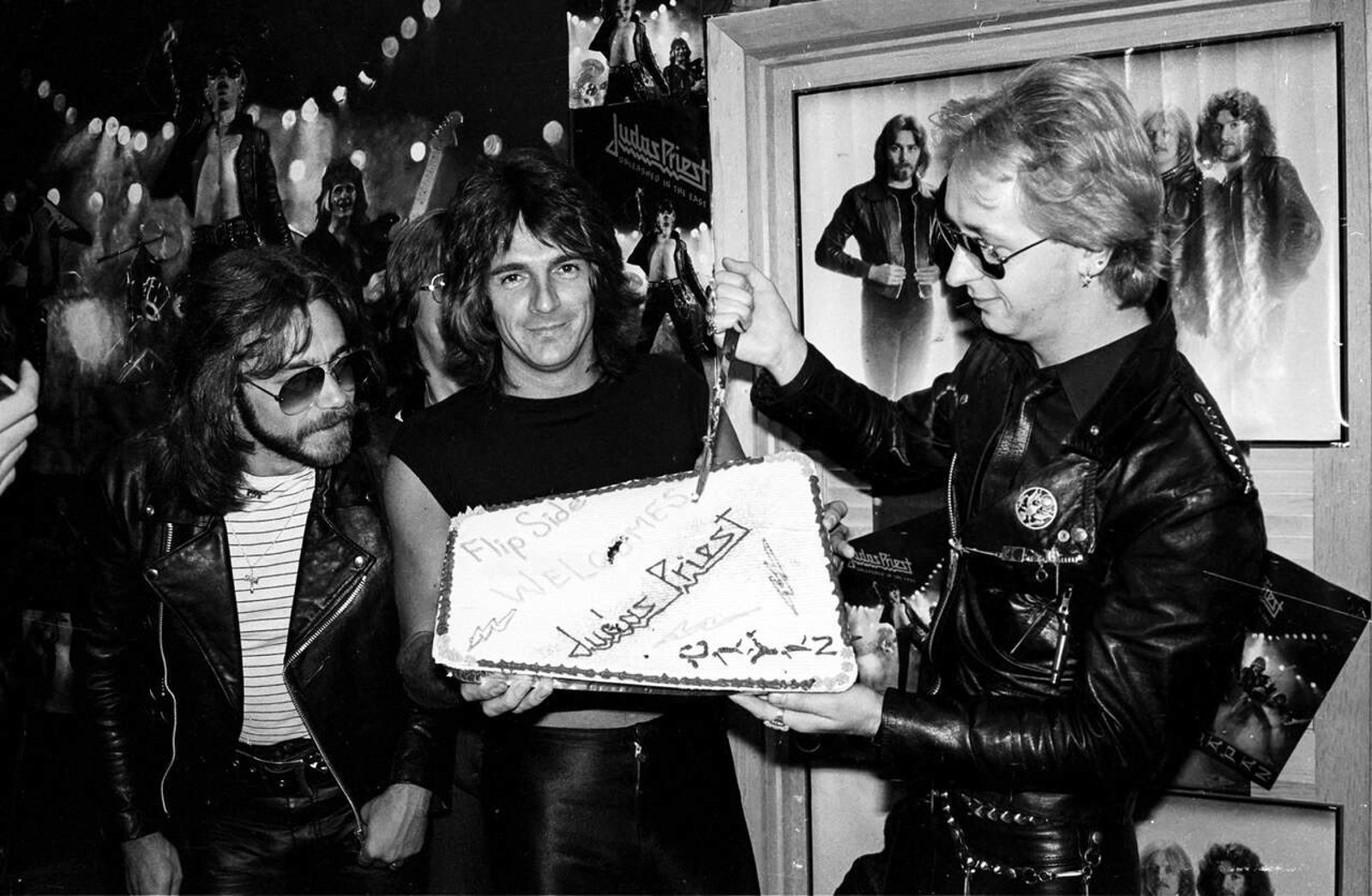
The band that by common consent had done more than any other to define the style in the seventies was Judas Priest, and "Metal Gods", recorded early in 1980 and released on British Steel that April, put the noun into a song title on a Top 5 album. When CBS pressed the song onto the flip side of "Breaking the Law," released as a single on 30 May 1980, the word went out on seven inch vinyl to every record shop in the country. The band had stopped apologising for it.

The South Yorkshire five who had worked the northern clubs under a coarser name before a label would touch them were Saxon, and by the end of 1980 they had put two albums into the British Top 20, Wheels of Steel at number five in April and Strong Arm of the Law at number eleven in November. Strong Arm of the Law, released by Carrere on 7 November 1980 and produced by Pete Hinton with the band, opens with the phrase itself written into the title of its first track, the plainest statement of allegiance any band of the period ever pressed.
"Heavy Metal Thunder" is the point at which the insult becomes a battle cry, a gallop at full tilt with the genre's name bellowed over the top of it, and Byford wanted the phrase for the album's own title before the label settled on Strong Arm of the Law instead. He was proud of heavy metal, he has said, unlike some bands who shied from the label. Forty years of festival crowds have shouted the song back at the same speed.
When the heavy wore away
Within a few years the noun was travelling on its own. Venom had already put Black Metal on a sleeve in 1982. The Kerrang! writer who put a name to Anthrax's fury on 23 February 1984 was Malcolm Dome, filing "Metal Thrashing Mad" as thrash metal in print, and death metal was the title of a Possessed demo the same year. Each new style kept the noun and threw the adjective overboard. Metal became the family name. Heavy was left to the parents.
Erosion did to the phrase what the Atlantic does to a headland of mixed rock, working the soft layer out from under the hard one storm after storm, hollowing an arch through the cliff, dropping its roof into the surf one winter night and leaving the harder stone standing offshore on its own, a stack of metal with the waves breaking white around its foot and the heavy long since washed out to sea. What stands is harder. It is also narrower.
Today the full phrase does two jobs at once. In ordinary speech heavy metal still covers the whole family, from the first Black Sabbath album to the fastest death metal band ever pressed, while among the people who file records for a living it means one style in particular, the twin guitars, the clean high voice and the gallop of the late seventies and early eighties, the sound of the heavy metal bands of the 70s and of the British wave that followed them. The two meanings rarely collide. When they do, the specialists win.
The narrow sense even acquired its own qualifier. Record shops and catalogues began filing the older style as traditional heavy metal sometime after the genre split into its faster and heavier offshoots in the mid-1980s, a phrase that would have baffled every band it describes. The young bands of the last twenty years who play in that manner have been gathered under a new wave of their own, the new wave of traditional heavy metal that took hold from the mid-2000s on, borrowed wholesale from the one Sounds named in 1979. The name keeps being reused. It keeps fitting.
Both meanings trace back to the same few records, and the line that runs from them to the present is followed in heavy metal from the first record on. The words were borrowed from gunners, chemists and a mood that swept through one summer. What they describe was not borrowed from anyone, and a riff with the mass underneath and the edge on top has never once needed a better name.
