
Both words are right, which is the entire trouble. Heavy metal vs metal is not a quarrel between a correct term and a sloppy one: it is a quarrel between two jobs that one phrase has been doing since about 1980, because heavy metal is the name of the whole family and also the name of one trade inside it, and nothing in English stops a word doing both at once. The argument is never about the music. It is about which job the speaker meant.
Wine has the same wound and has lived with it for a century. A district takes its name from the best village in it, the label law then allows every grower for thirty miles to print that name on a bottle, and the boundary drawn to settle it runs straight through somebody's vines, so that one row is worth three times the row on the other side of a farm track. Two bottles, one word, two entirely different things in the glass. The buyer who does not know where the line falls is the one who pays.
The evidence is not a matter of taste. It sits in four places, all of them checkable: the catalogues that file the records, the titles the bands printed on their own sleeves, the racks the shops built, and the way each of the two words behaves when it is dropped into an ordinary sentence. Taken together they say the same thing. The shorter word won the shop floor, and the longer one kept the workshop.
What the catalogues do with heavy metal vs metal
Start where the filing is done in public. Every band entered on Metal Archives carries a genre string, and in that field the words Heavy Metal sit beside Thrash Metal, Death Metal, Black Metal, Doom Metal and Power Metal as one option among many, which means the largest register this music keeps of itself treats heavy metal as a sibling of thrash and not as its parent. Saxon carries the string NWOBHM, Heavy Metal. Slayer carries Thrash Metal alone, with no heavy metal in it anywhere.
The shops did the opposite, and for a plain commercial reason. A rack has to be read from across a floor by somebody in a hurry, so the sign above it says one word, and every subdivision underneath it happens alphabetically rather than by lineage, which is how a teenager buying a Saxon album and a teenager buying a Cannibal Corpse album ended up standing in front of the same three letters. One word on the sign. Fifty styles behind it.
What the bands printed on their own records
The clipping can be dated, and it happened inside the music rather than in the press. The Birmingham band that cut the phrase down to one syllable and made a hymn out of the short form was Judas Priest, whose "Metal Gods" went out on British Steel in April 1980 with no adjective anywhere near it. The bare word was already a title by then. It has never needed the other one since.
The Yorkshire five who put the full phrase in a song title the same year, and meant it as a boast rather than as a category, were Saxon, and Carrere shipped "Heavy Metal Thunder", the song that kicks the doors off Strong Arm of the Law, into record shops on 7 November 1980. All three words in that title were still doing work: heavy as an adjective a listener could feel, metal as the material, thunder as what the pair of them made in a hall. Four years later no band bothered with the adjective. By then the short word carried the whole thing.
The New York four who swore on the bare noun and printed the oath across their sleeves were Manowar, and Kings of Metal, which Atlantic put out in 1988, is the point at which one syllable stops describing a sound and starts being a faith with heretics attached, five years after the band had already nailed the words Death to False Metal to the sleeve of Into Glory Ride. A style does not acquire heretics. Only a faith does, and by the late eighties the faithful had one word to swear on rather than two.

One band refused the whole transaction. The trio whose leader told theartsdesk.co.uk in November 2011 that metal was merely "the bastard son of rock'n'roll" was Motörhead, and "Killed by Death", one of four new songs cut for the 1984 compilation No Remorse, is filed under metal in every shop on earth and under rock and roll by the men who made it. The refusal changed nothing. A word this useful does not ask permission of the people it is applied to.
The test that takes four seconds
In the naming of species a handful of animals carry the same word twice, once for the family and once for themselves, so that the bison is Bison bison and the whole genus is named after the one animal everybody pictured first. Heavy metal is in exactly that position. It gave its name to everything that came out of it and then kept the name for itself, and the zoologists solved the collision with a second word in italics while the record shops never solved it at all.
A style does not acquire heretics. Only a faith does.
When I use a word, it means just what I choose it to mean, neither more nor less.
Lewis Carroll, Through the Looking-Glass (1871)
Which leaves a test anyone can run in a sentence. Swap the word: if metal in the sentence could be replaced by thrash, death metal or doom without producing nonsense, the speaker meant the family, and a listener who says he listens to metal is telling you the shelf he stands at. If the sentence is drawing a line against one of those, as in the phrase that is not thrash, it is heavy metal, the speaker means the trade: the clean voice, two guitars in harmony, the verse and the chorus and the minor modes. Ask which one is being ruled out. That is the whole method.
| The sentence | What is meant | How to tell |
|---|---|---|
| "I mostly listen to metal." | The family, all of it | Thrash or death could be substituted and nothing breaks |
| "Saxon is a heavy metal band, Slayer is a thrash band." | The trade, narrowly | A line is being drawn against a named subgenre |
| "The metal section is at the back." | The family, as retail | A rack sign has room for one word |
| "That riff is pure heavy metal." | The trade, narrowly | It names a technique, not a shelf |
| "Metal was huge in 1988." | The family, as an industry | Sales figures never divided by subgenre |
What the narrow word is worth keeping for
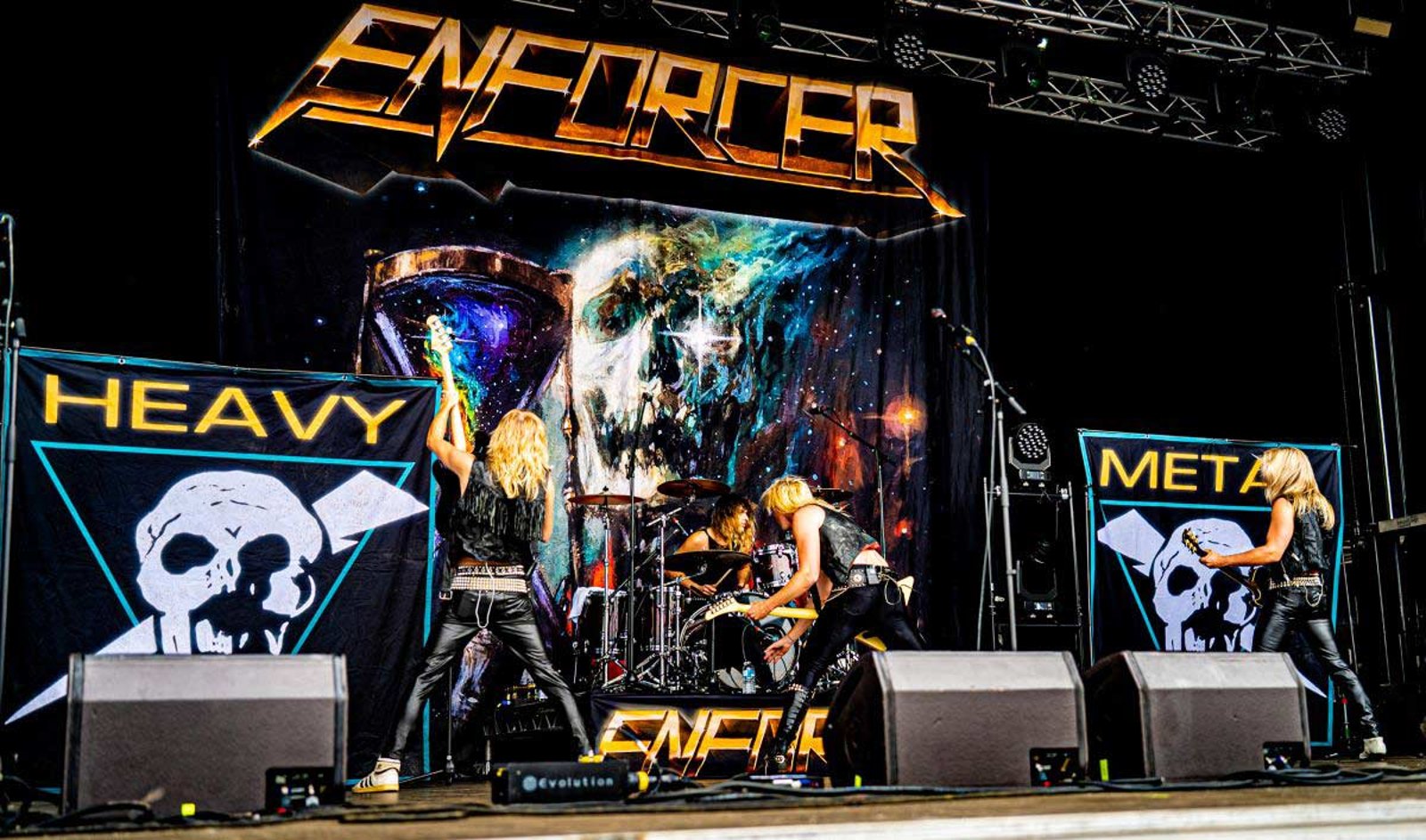
There is a reason to defend the long form, and it is not nostalgia. A vocabulary that has only the family word cannot describe the difference between Accept and Morbid Angel without a paragraph, while the narrow sense does it in two words, and the bands that answer to the narrow sense and to nothing else, among them Manilla Road, Cirith Ungol and the Swedish exponent of the old rules Enforcer, would otherwise have no name of their own at all. Precision costs a syllable. It buys a whole argument.
The border with hard rock is a different question entirely, fought over amplifiers and the drummer's right foot rather than over vocabulary, and it is set out in heavy metal versus hard rock. The confusions further out, where a scream is mistaken for a pedigree, run to their own arguments, the nearest of them being heavy metal vs screamo.
Beyond dispute, then, and settled: the family is metal, one of its trades is heavy metal, and the phrase that names the trade is also the one the family was christened with, which is a schism that will never close because it was never a mistake. How the family grew large enough to need the distinction is the main article. The word did not change. The thing it named got bigger.
