
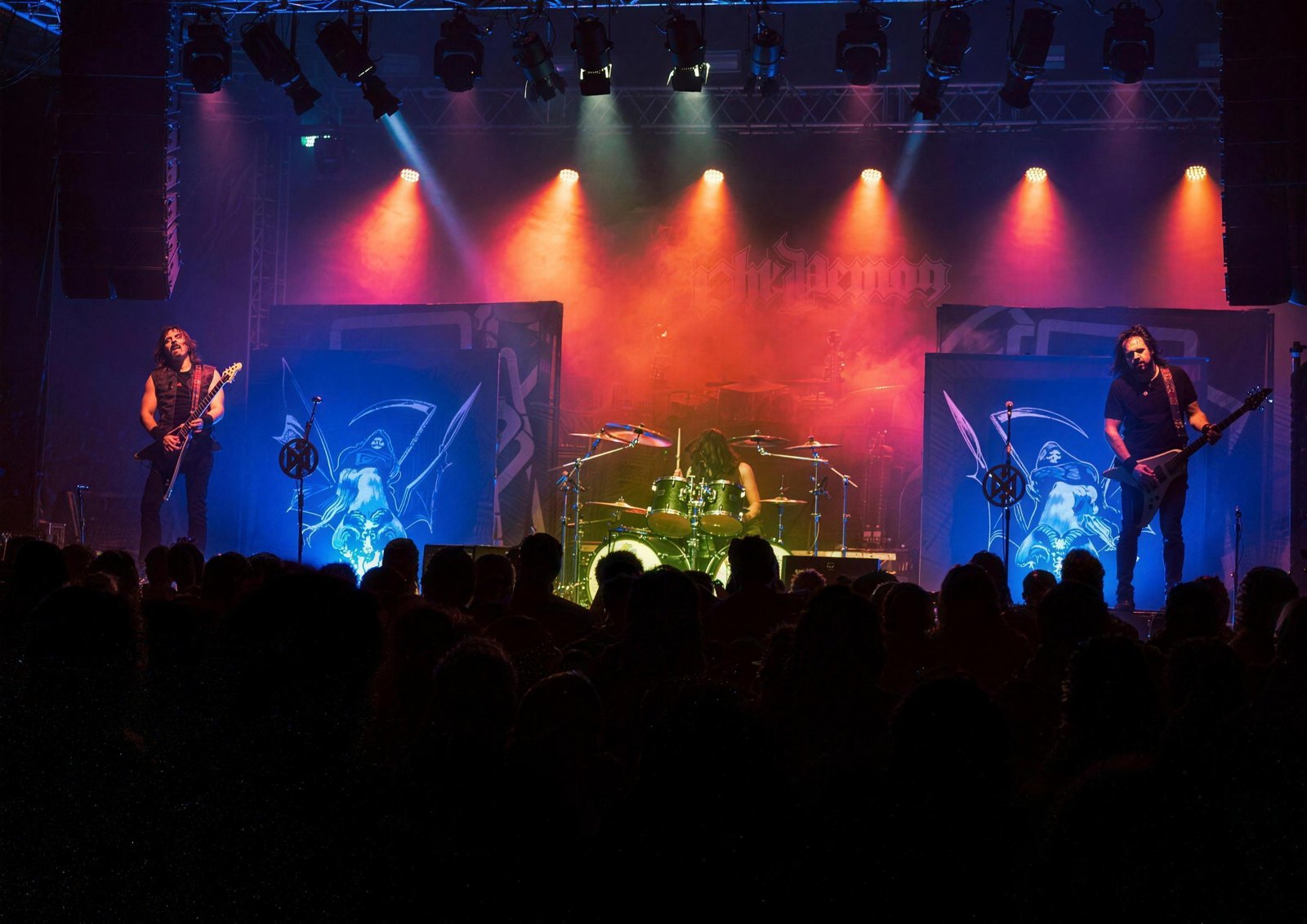
Traditional heavy metal is the one corner of the music where a band that broke up in the middle of the eighties can come back a quarter of a century later and find a bigger room waiting for it. The Newcastle five whose only album of the decade, Court in the Act, came out on Neat Records in 1983 and went nowhere near a chart, agreed in 2011 to play one reunion show at a German festival and nothing else, and the band that walked back on stage in April that year, twin guitars tearing the dust sheets off songs nobody had played live since the Thatcher years, was Satan. One show became a second career. Nobody planned it.
Every large limestone cave has a fossil passage somewhere above the water. The river that carved it found a lower route through the rock long ago and abandoned the upper level, which stayed dry while the stream went on cutting new galleries beneath, so that a caver climbing up into it finds a floor nobody has disturbed, formations still growing in perfect silence and the scallops the old current left on the walls, every one of them pointing the way the water used to run. Thrash, death and black metal are the active streamway. This is the dry gallery above, and the scallops still point the same way.
Traditional heavy metal brought its own dead back to the stage
The reunion that made the case was Satan's. All five members of the Court in the Act line-up, Brian Ross singing, Russ Tippins and Steve Ramsey on guitars, Graeme English on bass and Sean Taylor on drums, came back for Keep It True on 30 April 2011, and in April 2013 Listenable Records released Life Sentence, a record that sounded as if twenty six years had simply not happened. The riffs run long and twist the way the old ones did. The guitars still answer each other in harmony rather than doubling.
Around that festival a whole garrison of the forgotten reassembled. Bands whose pedigree amounted to a single album, a demo or a split single on a label that had folded before the Berlin Wall came down found themselves headlining over younger groups who had learned the songs off cassette copies of cassette copies. A second exhumation took place in print. Small labels such as High Roller Records in Germany and No Remorse Records in Greece went through the same catalogue with a trowel, reissuing on vinyl what the majors had never bothered with.
The Ventura band named after a mountain pass in Mordor had played its last show in 1991, and the quartet that walked back on stage on 8 October 2016 at a festival in its own home town was Cirith Ungol, with a set that covered all four of its old albums. The records were the ones a younger generation had been hunting for years. Forever Black, a new album, followed on Metal Blade in 2020. Tim Baker still sounds like nobody else alive, a voice scraped raw at the top of its range, and the guitars under him still move at the pace of a procession rather than a charge.
The young bands who went down the old shafts
Behind that reunion stood a younger musician. The bassist and singer who had founded a traditional metal trio in Ventura in 2011, built a festival called Frost and Fire in the same town and then joined Cirith Ungol on bass was Jarvis Leatherby, and his own band, Night Demon, plays short, hard songs with the speed of a 1982 single and a chorus the room can shout.
On "Screams in the Night", from Darkness Remains on Century Media in 2017, the trio does what the whole revival does best: a gallop at full stretch, a bass that runs up the neck like a second lead guitar, and a vocal hook built to be shouted back by a small club and a festival field alike. No keyboard. No irony. No wasted bar.

Swedish traditional heavy metal took the darker road. The Kristianstad band that heard in the early Mercyful Fate records a whole language rather than an influence, and wrote seven and eight minute songs of twisting riffs under a singer who climbs into a falsetto without warning, is Portrait, and Crimen Laesae Majestatis Divinae, released by Metal Blade in 2011, is where that language was spoken most fluently. The riffs turn corners the way a cave passage does. The creed is 1983. The playing is not a copy.
At the other end of the speed scale stood the Toronto quartet whose debut album, Head Öf the Pack, arrived in 2011 on a flood of shrieked high notes and riffs taken at speed metal pace, on NoiseArt Records, and the name on the sleeve was Skull Fist. The title track spends its whole length at a sprint. It is the sound of a band that learned heavy metal from Judas Priest's "Exciter" and Accept's "Fast as a Shark" and decided the brakes were optional.
The creed is 1983. The playing is not a copy.
The sound of a revival, and who sets it
A revival needs a sound of its own or it is only a tribute night. The Philadelphia guitarist who played in a traditional metal band called Sumerlands and then went on to produce records for a whole shelf of the new bands, giving them drums that land like a boulder dropped down a dry shaft and guitars left raw at the edges, was Arthur Rizk, who also produced records for Power Trip and Cavalera Conspiracy. Sumerlands, the band's debut on Relapse in 2016, is the model: mid-tempo, a voice riding high above the riff, and a production that sounds recorded in a room rather than assembled on a screen.
The rule of thumb follows from that sound. A band can arrive at traditional heavy metal from doom, from thrash or from hard rock, but it cannot arrive there by adding things. It gets there by taking things away until what is left would have made sense in 1982.
The old guard and the new share bills, labels and an audience, and at the big summer festivals a teenager in a denim vest can see the men who wrote the songs and the band that learned them on the same afternoon. The style keeps its elders on the stage for as long as they can stand there, which is not true of every corner of this music.
What the revival kept, and what it replaced
The rules are old and few, and the fullest account of how the genre divided around them belongs to heavy metal sub-genres. A riff that carries the song on its own. Two guitars in harmony. A clean voice that aims high. Tempos from march to gallop, never so slow that it turns to doom and rarely so fast that it turns to thrash. Songs about myth, the road and the night, and a chorus a room can learn on first hearing.
What changed is the hardware. When a wheelwright rebuilds an old wheel, he knocks out the perished spokes a previous hand fitted decades back and drives new ones into the same hub, so that the line of the wheel stays exactly where its builder set it while every piece of wood holding it together is new. The young bands did the same to the old songs. Better drums, cleaner recordings, players who learned the solos note for note from a screen, all hanging from the old line.
The border with its neighbours is thin. Where the chorus climbs higher and the guitars soften, the style shades into melodic heavy metal, and where the tempo and the choir take over it becomes power metal, a subject of its own. Traditional heavy metal stays on the older side of both lines. Its standard-bearer is still the twin lead.
How the music got here, from the Birmingham blueprint to the bands filling the Tauberfrankenhalle every spring, is the full story, and it is a long one. The revival is only its latest page. What the reunions proved is simpler: a record that sold next to nothing in 1983 can wait thirty years for its audience, and the audience will turn up.
