
On 27 June 1997 a German independent that had spent the decade selling death metal put a Swedish band's debut album onto the shelves of Europe. The quintet that had spent the previous year playing other men's songs at a regional band competition called Rockslaget, two of its players on loan from a melodic death metal group and a session musician behind the drums, was HammerFall, and the record it put on sale that Friday was Glory to the Brave. It entered the German album chart at number 38 in its first week, and by the turn of the year it had sold a hundred thousand copies. Nothing on it was new.
A house that has decided a kind of music is finished never says so out loud. It lets the chef de claque go. The man draws a wage for years with twenty hired hands in the cheap seats, a printed sheet of cues telling each of them which bar to start clapping on and a fee counted out at the stage door, and the season the management stops buying its own applause, that sheet goes into a drawer. Then comes a night when the noise starts anyway, in bars nobody marked, out of seats nobody paid for, loud enough to split the oak rail along the front of the gallery. The last week of June 1997 was that night. Not a miracle. A count.
What the week measured had been sitting in the building for years, and the long stretch before it, in which small labels went on paying for studio time while the trade looked away, belongs to the account of how this music got from grunge to the charts. What had not happened before was a week in which somebody counted. One record forced that, on one independent, with nine tracks of which one was another band's song.
Inside Glory to the Brave HammerFall put on sale in June 1997
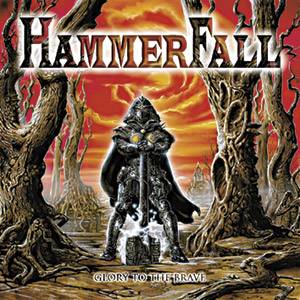
Cut between February and April 1997 at Studio Fredman in Gothenburg with Fredrik Nordström producing, the record runs to nine tracks and about forty-five minutes, and six of those tracks carry the same three names on the credit: Oscar Dronjak, Jesper Strömblad and Joacim Cans. After a year of playing from other men's scores, the band scraped the title pages clean and wrote its own names over eight of the nine songs, Dronjak alone on "Steel Meets Steel" and Cans with Peter Stålfors on "I Believe", while Andreas Marschall painted the armoured knight on the sleeve.
One of the nine belongs to someone else, and the choice points backwards on purpose. "Child of the Damned" came off Deliver Us, the EP Warlord put out through Metal Blade in April 1983, and when the single from the title song went into the shops on 20 October its second track was "Ravenlord", a song Stormwitch had cut for Stronger Than Heaven in 1986. A debut that gives a slot of its nine to a song from 1983, and the back of its single to one from 1986, is not hunting a gap in the market. It is a catechism, and it files its claim of succession in public, on the sleeve.
The Warlord original is the tell, a Californian song from 1983 that the Swedes claimed as their forebear. What AllMusic heard in the result was a record with no frills and no progressive elements, speed and melody and grandiose anthems about honour and slaying dragons, nothing in it that had not been done before and played with enough fire to feel like the New Wave of British Heavy Metal the first time round. A band that wanted to be new would not have made that record.
Who bought it, and in which country
The first count of the record came from Germany, and the chart columns say so without any help. The German list took it at 38. Austria gave it 40. Sweden, the country that made it, gave it nothing at all: no position, no week on the list, nothing to show that a hundred thousand people somewhere had bought a Swedish debut. An audience across the water from the band is still an audience, and it was the only one anybody was in a position to count.
The chart did not make the audience. It located it.
A hundred thousand copies is not a critical opinion. It is a plant. A glass master is cut once, a nickel stamper is grown off it, a mould closes on a slug of polycarbonate every few seconds, and the rejects go straight back into the grinder. What the label put its name to sits in its own paperwork: a four album covenant for Europe, offered early in 1997 to a band that had been a side project for years, and a single lifted from the title track on 20 October that year.
Sweden came to it late and then came to it formally. The Grammis of 1998, the Swedish industry's annual award, put the album among four nominees in its hard rock category, on the strength of a record its own national chart had never carried.
One label, two records, four weeks apart
The firm that put it out was running hard in the opposite direction at the time, and the dates make that point better than any argument about taste. On 30 May 1997 Nuclear Blast released Enthrone Darkness Triumphant by Dimmu Borgir, which reached 75 in Germany. Four weeks later the same company released a Swedish band playing clean-sung melodic metal, and that one reached 38. The black metal record was the name in gilt on the season's poster. A clean-sung Swede from the same stable tore that poster off the wall by charting almost twice as high.
In the darkest days of the 90s of death and black metal HammerFall spearheaded a glorious revival of classic melodic metal and they are now bigger than ever before.
Marcus Hammer, managing director, Nuclear Blast, 2 January 2023
That is a label man's sentence, and the label's own tally gives its second half some ground, putting the band's catalogue with Nuclear Blast, 1997 to 2014, past one and a half million copies worldwide. The first half flatters everyone involved. Nothing was spearheaded. A company with a working distribution network in Germany discovered that a kind of record it did not specialise in charted higher than the kind it did and behaved accordingly, which is the whole business of signing bands and the subject of Nuclear Blast and the labels behind the power metal boom.
The eighteen months that followed
| Released | Record | Band | Chart peaks |
|---|---|---|---|
| 27 June 1997 | Glory to the Brave | HammerFall | Germany 38, Austria 40, Sweden none |
| 14 April 1998 | Better Than Raw | Helloween | Finland 7, Germany 19 |
| April 1998 | Nightfall in Middle-Earth | Blind Guardian | Germany 7, Sweden 44 |
| 28 September 1998 | Legacy of Kings | HammerFall | Germany 15, Sweden 15 |
| 5 October 1998 | Destiny | Stratovarius | Finland 1, Germany 89 |
Helloween went to 19 in Germany with Better Than Raw, Blind Guardian took a Tolkien concept album to number 7 there that May, and Stratovarius held the top of the Finnish chart for the first time that autumn, seventeen weeks on the list and gold at twenty thousand copies. None of the three was a newcomer, and every one of them charted after the Swedes had.

The first record had a sequel. Produced again by Nordström, this time with Dronjak at his shoulder, Legacy of Kings went out on 28 September 1998, fifteen months after the debut, and entered at 15 in Germany and 15 in Sweden, with a single, "Heeding the Call", at 48 on the German list. The country that had ignored the first album put the second one in its top twenty. Nuclear Blast had meanwhile issued the debut by Primal Fear within seven months of the debut's chart entry, which is about as fast as a label can move.
So the hinge is narrow and it holds. One conservative album of nine tracks, one of them inherited, cut in a room known for melodic death metal and sold by a label built for the same thing, showed inside the year that a demand the trade had written off was worth a hundred thousand copies. Fifteen months later its own follow-up entered the Swedish top twenty, with three older bands charting in Germany inside the same eighteen months. What was already standing behind that record in 1997 is laid out in the full story.
