
Behind a pawnbroker's counter an instrument hangs on its nail with the ticket still looped round the scroll, pledged one winter against a week's rent and never redeemed, the varnish going grey along the strip where the window light falls on it and the strings rusting down into the fingerboard while the shop sells it to nobody at all. The makers across the street know it by sight. They take their rubbings off the arching through the glass, cut their own bellies to a curve not one of them has heard sounded, and put the failures through the bandsaw and into the grate. Twenty years of that and a whole district has a house tone, copied out of copies, every bench in it confident about an instrument none of them has played.

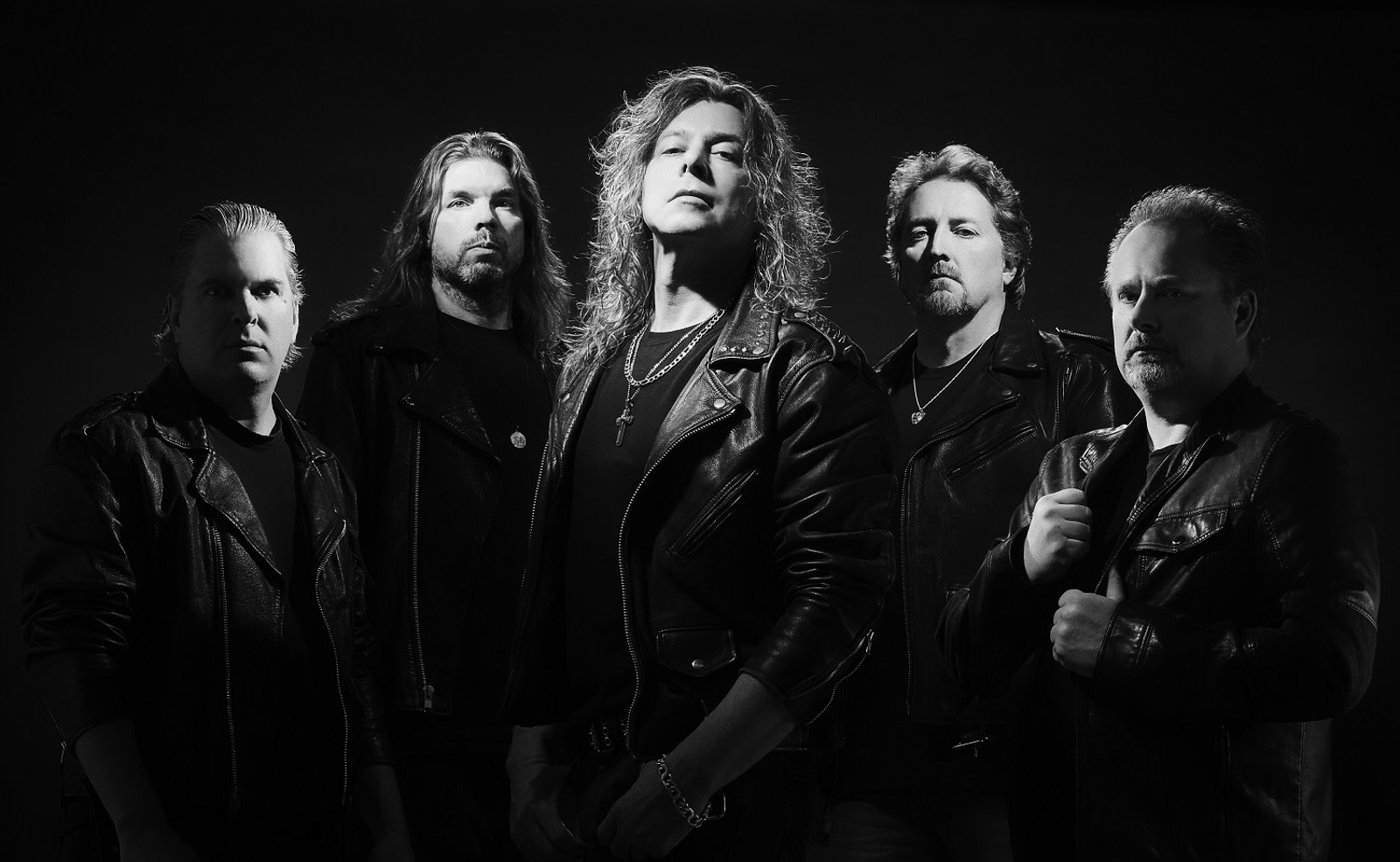
The five men who cut nine songs in a Colorado Springs room and then watched a label do almost nothing with them were Jag Panzer, and Ample Destruction, recorded at Startsong Studio and pressed by the small Iron Works operation in August 1984, has stood in that window for four decades. Ask what early American power metal sounded like and the answer comes back as a band and a title, Jag Panzer Ample Destruction, from listeners who have mostly never handled a 1984 copy and have never felt the lack. The album is attested everywhere and was distributed almost nowhere.
Both halves of that matter, and the second half explains the first. The American branch fixed its habits early and then lost its distribution, so the style travelled as a description of itself rather than as a sound. Nine songs, roughly forty minutes, two guitars, next to no keyboard and no second voice stacked behind the first: that is the specification the rest of the US chapter gets measured against, and a good deal of the measuring was done by people working from a tape of a tape.
What Jag Panzer Ample Destruction does with a voice
Gut strings are twisted wet on a frame in a drying loft, sulphured, rubbed down to a gauge by hand, and the lengths that will not come up to pitch are cut off the frame with a knife and thrown to the yard, because the one that holds has to sing at a tension the belly of the instrument is only just carrying and will carry for a few months at most. Harry Conklin, the singer the Colorado scene called the Tyrant, is strung at that tension for the length of the record. Nothing about it is comfortable.
Two readings a long way apart agree on what he is doing. Writing at The Metal Crypt in November 2007, Larry Griffin described a deep and charismatic bellow and called the closing song the strongest vocal performance on the album; the critic autothrall, returning to the record in 2010, heard an acidic bite and a bark set hard against the high notes. Neither of them hears anything smooth. Both hear the effort left audible, which is exactly the quality a European producer of the next decade would sand off a take so that eight of them could be stacked into one voice without blurring at the seams.
The Watching gives the argument its clearest case, opening on clean guitar, bringing the band in underneath and sending the voice up over it without a moment of sweetness, onto notes it has audibly had to climb for. The version embedded above streams under that title today as the 2003 re-recording from Decade of the Nail Spiked Bat, not the 1984 take, a fact about what happened to the record afterwards rather than about the singing.
Two guitars holding the floor and the tune at once
Licensed to Kill opens the album at a gallop and shows what this build asks of two guitarists. Mark Briody and Joey Tafolla voice the riff low and lock it together so tightly that the part is the floor of the song and the thing a listener comes away humming at the same time, and there is no gap anywhere in the arrangement where a keyboard could be slid in later. Griffin heard that tone as galloping and muscular, and wanted it heavier still.
The riff is the floor and the tune together, and nothing in the arrangement is waiting for a keyboard to arrive.
The lead playing is the other half of it, and its discipline is what dates the record least. The solos are cut to the length of the song and stop when the song stops, with none of the display that the branch would take up within five years and then be mocked for. Whose hands take the lead is not settled: the credit splits between Briody and Tafolla, and no sleeve note ever closed the question.
A production that two careful listeners hear two ways
On the recording itself the admirers do not converge at all, and the disagreement is worth more than a consensus would be. Griffin heard a tape that is neither the clearest nor the most polished of its year and thought it strong work for 1984 regardless. autothrall heard a rich and full production that has barely dated. They were describing the same forty minutes.
What sits underneath the quarrel is a room that gives nothing back: a hall stripped of its drapes and its carpet for a refit, the chairs carried out, the boards bare, and an orchestra brought in anyway and made to play into the dust, the brass taking the plaster off the cornice because there is no soft surface left in the building to absorb it. There is no reverb halo on the snare, no bloom on the cymbals, no hall behind the voice. Every attack arrives dry and the playing has to carry the mix alone, which one listener hears as thin and another hears as honest.
The record that could not be bought
The distribution failed at once and never recovered. The standard account records poor marketing by the label and a debut that became an underground success by being bootlegged over and over. What the band did next is the harder evidence: the sessions cut at Avalanche Studios in Denver in 1987 with a different singer at the microphone sat unissued for seventeen years while bootlegs of them went round from 1988, until Century Media put them out as Chain of Command on 21 June 2004 in a run of five thousand copies.
| Year | Release | What it is |
|---|---|---|
| 1984 | Ample Destruction, Iron Works | The original pressing, badly marketed and repeatedly bootlegged |
| 1988 onward | The 1987 Denver sessions | In circulation as bootlegs for sixteen years before any official issue |
| 2003 | Decade of the Nail Spiked Bat, Century Media | Twenty re-recordings, made because no reissue deal could be struck |
| 2004 | Chain of Command, Century Media | The 1987 tapes, remastered, new artwork, five thousand copies |
A genre normally takes its standards from records that people own. This one took a founding standard from an album its own makers had to play again from memory before it could be bought in a shop, which is an odd thing to put at the head of a succession and changes what influence can mean in this corner of the music. Anybody working out where to start on record meets a milder version of the same problem.
What the branch made of it

The shelf around it split within a year. The Los Angeles band that took the high voice and the dry attack and spent both of them on velocity was Agent Steel, whose Skeptics Apocalypse arrived on Combat in 1985 and ran the tempo up until there was no longer room in the songs for a chorus of the kind Conklin had been handed. Speed was one answer to the problem. It was not the only one.
The other answer tightened the same parts instead of accelerating them. The Connecticut band that spent three albums grinding the looseness out of its rhythm playing was Liege Lord, and Master Control, on Metal Blade in 1988, put a hard, quantised riff under a singer still asked to work without a safety net, which is the Colorado method with the tolerances closed up. The record shows how fast the branch learned. It shows just as plainly how few people were listening.
What the 1984 album settled is narrow and durable. A heavy song can be built on one throat and two guitars with nothing underneath to help either of them, and the strain it costs the singer is not a defect in the method but the method working as designed. The branch's most complete statement of that idea comes four years later, and Transcendence and the high point of US power metal is where the case for it belongs. The tape cut at Startsong Studio is still the measure, and no American album in the style has displaced it since.

