
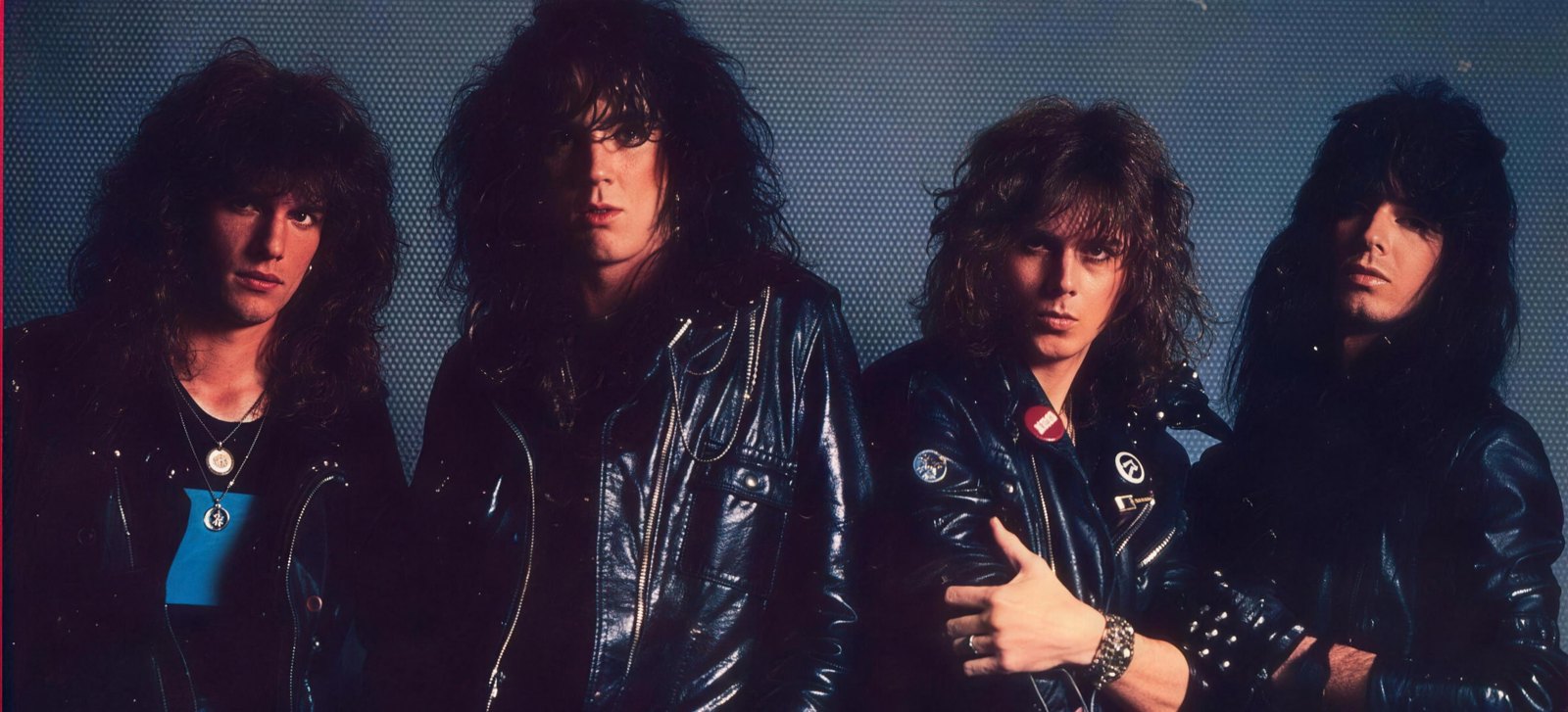
One point seven miles. The ribbon of asphalt that runs along Sunset Boulevard from the Los Angeles city line near Marmont Lane to the Beverly Hills border at Phyllis Street goes by the name of the Sunset Strip, and between 1981 and the end of the decade more heavy metal bands tried to become famous on it than on any other stretch of road on earth. Most failed. A few took the whole genre with them when they left.
The sunset strip metal scene worked like a fireworks pontoon, a hundred mortar tubes lashed shoulder to shoulder on its deck and a hundred bands packed into them, and every Friday the clubs put a flare to the fuse line, blowing shell after shell into the night over the Whisky a Go Go, the Roxy and Gazzarri's, while the record companies watched from the hills for the bursts worth paying for. Plenty went off in the tube.
How the street fitted among the other rooms and cities of the music is set out in the chapter it belongs to. The Strip was different from all of them in one respect. It was not a city at all.
A county island with its own rules
Left outside the city of Los Angeles as unincorporated county land, where gambling that was illegal a few blocks east stayed legal under county law, the Strip had grown its nightclubs long before it grew guitars, and Ciro's, the Mocambo and the Trocadero were pouring drinks for film stars through the thirties and forties while the city police could only watch from the far side of the line. The habit of noise was old.
So was the friction. In November 1966 young club-goers and the police fought along the same pavement over a curfew, the curfew riots that gave Buffalo Springfield "For What It's Worth", and the clubs survived it. In November 1984 the voters of West Hollywood chose to incorporate, and the Strip became part of a city of its own at the very moment the metal bands were crowding onto it. Nobody asked the bands.
The sunset strip metal scene before the hairspray set
The early years were harder than the photographs remember. The four young men who cut a three-song demo to talk their way onto the Whisky's stage and opened for Saxon there on 27 March 1982, at only their second show, were Metallica. Ron McGovney played bass that night and Dave Mustaine played lead guitar. The Yorkshire guitarists Graham Oliver and Steve Dawson picked them out of a pile of cassettes from local bands, running through the tapes the way a cattle buyer at a livestock ring runs a hand along a line of steers, feeling for bone under the hide and bidding on the one that would still be standing in ten years. "Metallica were far and away the best," Oliver said of the pile of cassettes years later.
Metallica did not stay. The quartet found the Los Angeles clubs more interested in eyeliner than in downpicking and moved north to the San Francisco Bay Area in early 1983. The Strip kept the bands it could photograph and exported the ones it could not. Thrash grew up four hundred miles north.
The Strip band that briefly held the fastest pair of hands in America was Steeler, fronted by Ron Keel, whose only album, released on Mike Varney's Shrapnel label in 1983, carried a Swedish teenager called Yngwie Malmsteen, flown in by Shrapnel's Mike Varney and gone again within months, to Alcatrazz and then a solo career. On "Cold Day in Hell" his runs go through the verses like a router bit through soft pine, leaving splinters all over a perfectly ordinary party song. The song stayed ordinary. The guitarist did not.
Behind them came the garrison that never cared for the costume. Lizzy Borden put stage horror and blood onto Metal Blade records, Great White started out as a straight hard rock band before the ballads found it, and the Pasadena five who wore actual armour on stage and played something closer to the British bands than to their neighbours were Armored Saint.

Signed to Chrysalis after an early track on a Metal Blade compilation and released in 1984, March of the Saint sets John Bush's chesty voice on top of riffs that stamp through "Can U Deliver" and the title song like a muster of hobnailed boots on a parade ground, the vanguard of a heavier Strip that the major label never knew how to sell. The band had already appeared on Metal Blade's Metal Massacre II in 1982, two years before Chrysalis came calling. It sold modestly. It has aged better than most of its neighbours.
Most of those bands scattered before the decade was out. The Strip trained players. It rarely kept them.
The Strip kept the bands it could photograph and exported the ones it could not.
The furniture that stayed
A scene is also its tables and chairs. The bar and restaurant next door to the Roxy, opened in 1972 and kept in business through every change of fashion since, is the Rainbow Bar and Grill. For a quarter of a century its most famous regular was Lemmy Kilmister of Motörhead, who lived near the Strip from 1990 and spent his evenings at the bar and at a video game machine in its corner. He died on 28 December 2015. A crowdfunded, life-size bronze statue of him was unveiled at the Rainbow in August 2016.
A few blocks east stood the shop that armed the whole street. The record store at the corner of Sunset and Horn Avenue, opened in 1970 and shut in 2006 when the chain went bankrupt, was Tower Records, and its import racks sold the British singles and the German pressings that the Strip's bands learned their riffs from before a single American label would press them. The education cost the price of a single.
The club that set the late eighties' tone was not a building at all. Founded in 1986 by Riki Rachtman and Taime Downe of Faster Pussycat, the Cathouse was a roving club night rather than a fixed room, where the bands of the Strip drank when they were not playing, and Rachtman went on to host MTV's Headbangers Ball from 1990 until its cancellation in 1995. The street had its own television presenter. Beyond dispute, no other scene could say that.
What the street kept
The glitter side of the story, the lipstick and the hairspray and the collapse that followed, belongs to the earlier chapter. The metal side ended more quietly. Through the nineties the Whisky and the Roxy booked whatever the street wanted next, the rents climbed, and the spectacle of a thousand bands fighting for one Friday night thinned to a handful of tribute acts and touring packages.
Gazzarri's went first. Bill Gazzarri, the owner who had billed himself the godfather of rock and roll and put Van Halen on his stage through the seventies, died on 13 March 1991, and the club at 9039 Sunset closed in 1993, its room reopening under other names for other music. The Whisky and the Roxy outlasted it by decades.
The rooms are still there, which is more than most scenes can say. The Whisky still books heavy bands, the Rainbow still pours for them, and the same mile and seven tenths of road carries tourists who photograph the signs. On any given night the loudest thing on it is a bus. The strangest contrast of all lies half a world away, where bands of the same years played under the eye of the state rather than the market, the story of heavy metal behind the Iron Curtain.
