
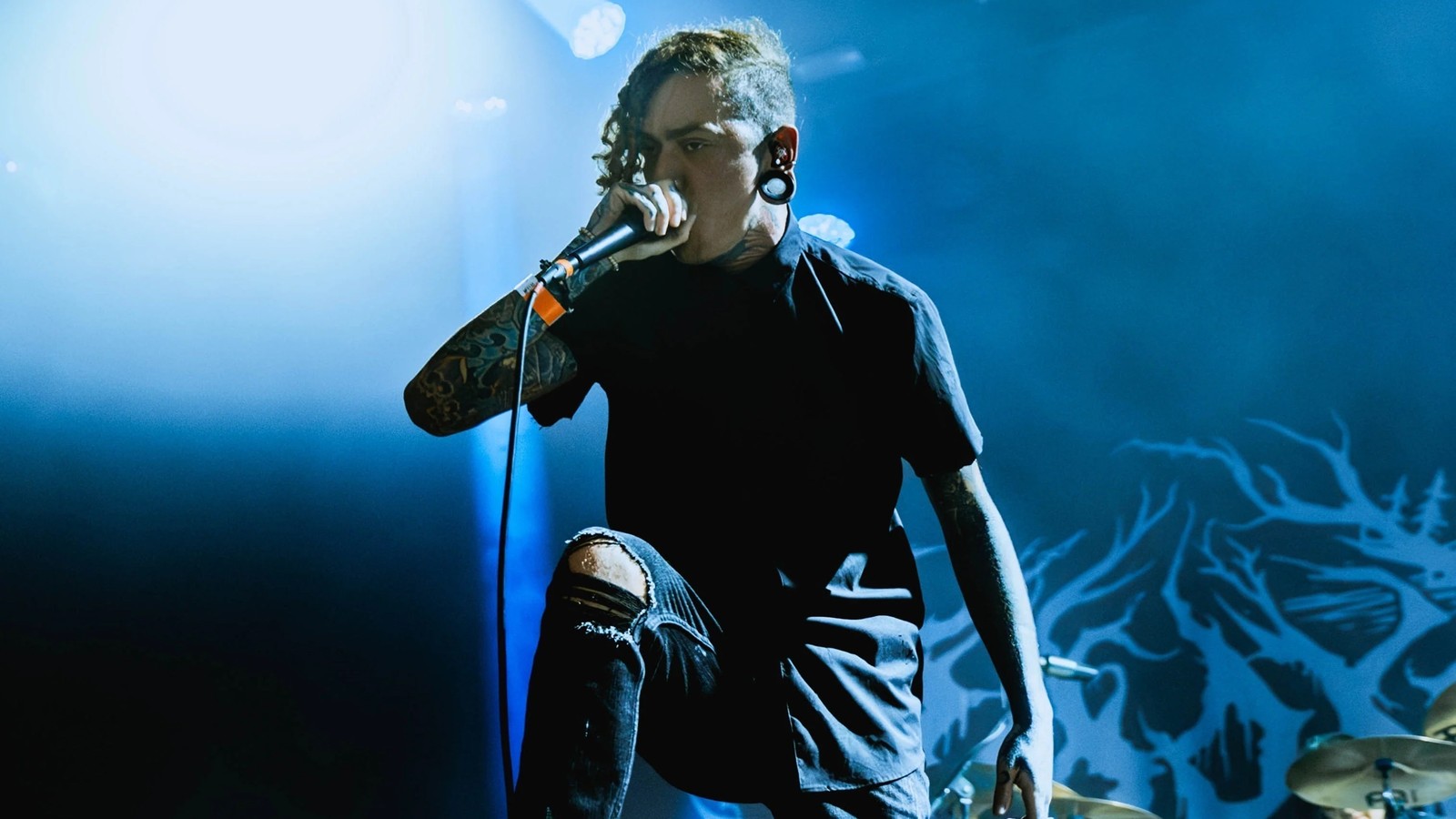
Filed as symphonic deathcore on Metal Archives, printed under deathcore on every festival poster that has carried the name since 2012, and argued over in every comment thread that has ever watched Will Ramos open his throat, the New Jersey five who taught a string section to stand on top of a blast beat are Lorna Shore, and the answer to what genre is Lorna Shore is symphonic deathcore with blackened elements.
Deathcore is the noun. The rest are adjectives.
The adjectives matter, though, and you can hear each one arrive on its own record. Across five full lengths, from Psalms in 2015 to I Feel the Everblack Festering Within Me in 2025, the band bolted black metal leads onto the deathcore chassis, stacked a bigger orchestra on top of the whole thing with each record, and never once pulled out the breakdown, the half time slam that folds a crowd barrier at its hinges and the one part that would have to go before any other label could fit.
Two men carry that through every change at the microphone. Adam De Micco has played lead guitar since 2010 and Austin Archey has held the drum stool since 2012, which means the lead guitar and the drum stool never changed hands while three singers took the microphone in turn. Follow those two and the genre question answers itself.
Psalms and Flesh Coffin, the blackened years

Released on 9 June 2015 through Density Records, with Will Putney producing and Tom Barber at the microphone, Psalms is the record on which the young deathcore band started tearing its leads out of black metal and laying them over thrashy, melodic riffing, while every breakdown stayed exactly where a deathcore record of that year keeps it. Angry Metal Guy later filed it under grimy blackened deathcore, and that is a fair description.
The leads are the giveaway. Reviews of the day heard breakneck blackened leads beside creeping breakdowns, and they come at you like a band's MySpace page autoplaying through a laptop whose speakers are already rattling out of their housing, which is precisely the job a black metal lead does: it turns the riff into weather rather than into a punch. The orchestra was already in the room too, in places, with synth orchestrations behind the ambient guitars and a symphonic reach on the opener.
Signed to Outerloop Records on 21 September 2016 and recorded at Atrium Audio with Carson Slovak and Grant McFarland, Flesh Coffin arrived on 17 February 2017 and pushed the same barrage further, with Fvneral Moon as its calling card and a slick, blackened, melodic course under it, a symphonic side that reviews of the day found in the tension of songs like Denounce the Light and Black Hollow, and the breakdowns still scattered through the record where the genre keeps them.
Black metal was the accent. Deathcore was still the language.
Immortal, where the orchestra moved in
CJ McCreery replaced Barber in 2018 and sang on the third album. The band dismissed him on 23 December 2019 after allegations of sexual abuse were made against him. Immortal came out on 31 January 2020 on Century Media, which had signed the band in October 2019.
The record went out as finished. What changed on it was the arrangement.

Opening on a swelling orchestra and choir before the band come tearing in, with the clean guitars on the title track miming the timbre of choral and string synths, Immortal is where the orchestral layer stopped decorating the songs and started leaning on them, a record that piles layers of orchestration and atmosphere onto everything Flesh Coffin had built. That layering is the mechanism of symphonic deathcore. The guitars and drums keep the floor. The orchestra builds the room above it.
Listen to where the choir goes. Distorted Sound heard it mashed up with the screamed vocals on Hollow Sentence and Warpath of Disease, and heard the whole record drawing more from black metal than the one before it, the symphonic moments sitting alongside the savage deathcore rather than apart from it.
The guitars and drums keep the floor. The orchestra builds the room above it.
Then the breakdown arrives, and it arrives constantly. The same review counted the beatdowns and said they always come in like a sledgehammer. The half time section that deathcore inherited from metalcore did not go anywhere. It acquired a ceiling. Where the beatdown itself came from is a hardcore story, told in deathcore vs hardcore, and where beatdown sits.
Pain Remains and the 2025 record
Will Ramos had toured as a stand in through 2020 and into 2021, and on 11 June 2021 the band announced him as permanent singer and released To the Hellfire the same day, the song that reached number 4 on Spotify's Viral chart and appeared on the ...And I Return to Nothingness EP that August. His range changes the genre arithmetic. Reviews of Oblivion and of the 2025 record hear gutturals, pig squeals and shrieks coming out of one throat, so the trade off that deathcore has always run between low and high now happens inside a single voice.
Pain Remains, released on 14 October 2022 on Century Media, is where everything the band had added over seven years arrives at full weight, with Josh Schroeder producing, the orchestrations written by rhythm guitarist Andrew O'Connor, and a title suite in three parts closing out its final three tracks. On this record the orchestra works like a second backline loaded into the trailer on top of the first, strings and choir stacked to the roof and set further forward than before, and when a breakdown lands the whole load shifts forward and caves in the cab. That is the band's sound at its heaviest. It is also the reason so many listeners hear a symphonic band first and a deathcore band second.
I Feel the Everblack Festering Within Me followed on 12 September 2025, trailed by Oblivion on 16 May, Unbreakable in June and Prison of Flesh in August. Oblivion keeps the order of operations intact: machine gun blast beats from Archey, Ramos moving from gutturals to pig squeals, and a breakdown that Wall of Sound heard handing off to a power metal style guitar solo, while reviews of the album as a whole describe orchestral arrangements from O'Connor, huge breakdowns and a constant barrage of blast beats and double bass. Ten years and two new singers after Psalms, the skeleton is the same one.
The black metal never left either. It went from the foreground into the wiring, and reviewers of the 2025 record still reach for it, one hearing blackened wickedness in the singles and another setting the album against a black metal landmark, which is why the blackened tag still holds in 2025 even though no one would mistake the band for a black metal act.
What genre is Lorna Shore once the strings are muted
Try it in your head. Strip the orchestra off the records from Immortal onward and what the reviews leave standing is blast beats, gutturals and shrieks, and breakdowns, which is blackened deathcore and nothing else. Strip the breakdowns out instead and keep the orchestra, and the songs drift toward the symphonic black and death metal of Dimmu Borgir and Fleshgod Apocalypse, bands that also hang strings and choirs over blast beats. The band has never once done the second thing.
That is where the line sits. Symphonic black metal builds a song toward the peak of a melody, an orchestral climax the riff serves, while every Lorna Shore song is built toward the drop, the moment the tempo halves and the bodies on the floor start moving, and the orchestra is arranged to make that drop hit harder. A different destination makes a different genre, whatever the instruments have in common. The band touches symphonic black metal in its means. It is deathcore in its ends.
The bands that share that arrangement are the reason symphonic deathcore exists as a name: Winds of Plague were early to it, Shadow of Intent, Worm Shepherd and Ov Sulfur built on it, and Lorna Shore made it the sound much of the genre is now measured against.
| Record | Year | Singer | Orchestra | Black metal | Breakdowns |
|---|---|---|---|---|---|
| Psalms | 2015 | Tom Barber | Synth orchestration in places | Blackened leads | Yes |
| Flesh Coffin | 2017 | Tom Barber | A symphonic side | Blackened and melodic | Yes |
| Immortal | 2020 | CJ McCreery | Orchestra and choir, layered through the songs | Drawn further toward black metal | Yes |
| Pain Remains | 2022 | Will Ramos | Upfront, orchestrated by Andrew O'Connor | Blackened deathcore | Yes |
| I Feel the Everblack Festering Within Me | 2025 | Will Ramos | Orchestrated by Andrew O'Connor | Blackened | Yes |
Death metal, metalcore and the labels that do not hold
Is Lorna Shore death metal? The case for it is real, because the blasts, the tremolo and the gutturals all come from there, and some reference pages file the band under blackened death metal. The case against it is the breakdown. Death metal treats a slow section as a passage on the way somewhere, and this band treats it as the destination every song is written to reach, which is the deathcore contract, the same one laid out across all the other deathcore styles. Calling the band death metal is a pedigree argument. It describes where the parts came from, not what the songs do with them.
Is Lorna Shore metalcore? Only at the very start. Triumph, the 2010 EP, was a metalcore record, and the tag still trails the band in some databases for that period, but by Bone Kingdom in 2012 the band had moved into deathcore. Metalcore runs on a sung chorus, and the reviews of these records describe screams, gutturals and roared choruses instead, so calling the current band metalcore is closer to heresy than to a classification. Both questions are smaller cousins of the one the whole genre still gets asked, is deathcore metal at all.
Anyone who wants to see how a genre that started in the late MySpace years ended up with an orchestra on top should start from the beginning, because every element Lorna Shore stacks was already lying around the genre by 2008, even if no one had stacked them this high.
The band's place in the second wave of the 2020s, after To the Hellfire pulled a new audience headlong into the genre, is told in chapter four of that story. The genre question is narrower than the story, and it has a narrower answer.
Lorna Shore is symphonic deathcore with blackened elements. The orchestra is the most audible thing about the band and the black metal is in its bones, but the deciding part is the breakdown, and in ten years of records it has never been cut.
