
In January 1972 the columned Town Hall in the centre of Birmingham held a crowd that had paid to watch the four men from Aston, Black Sabbath, play in their own city, and the photographer Keith Macmillan, who signed his work as Keef, caught the singer with both arms outstretched and two fingers raised, a single monochrome frame that Vertigo put on the front of Vol. 4 on 22 September 1972, after the label, by Geezer Butler's account, had thrown out the working title, "Snowblind", while the band was away on holiday. Nobody in that hall was looking at a record sleeve. They were looking at a man in stage light.
Within twenty years the frame had become currency. The Yorkshire label Peaceville issued a sampler of its roster in 1992 under the title Volume 4, in a sleeve that spoofed the Sabbath original, and the California trio Sleep parodied the same cover on its Volume Two EP for Off the Disk, and neither had to explain the joke. A doom record has always arrived in the shops wearing somebody else's clothes.
The picture we hold that rule against is a pawnbroker's window on a poor street. Everything behind the glass belonged to someone else first, a Victorian drawing, a still paused on a television set, a dark disc by a sculptor of steel, a sunrise over a tower nobody can name, and every piece carries its paper ticket, so that the window has already set the price of everything inside the shop, the tempo, the weight, the century the band would rather be living in, before a customer has put a hand to the door. The goods are second hand. That is exactly why the buyer trusts them.
The doom sleeve has changed its stock several times in fifty years, from the withheld black envelope to the borrowed old picture, from the desert poster to the empty funeral doom frame and back again to the painted canvas, and each change told the buyer what kind of dirge was waiting on the shelf behind it. The founding photograph at Mapledurham, the Thomas Cole paintings and the painters commissioned by Cathedral and Sleep already have their place in our account of doom metal art, and we leave them in that window.
An extensive collection of planes, chisels, saws, and other carpenters' tools, which have been pledged, and never redeemed, form the foreground of the picture.
Charles Dickens, "The Pawnbroker's Shop", Sketches by Boz, 1836
Black on black: the sleeve that withholds
A year before the Town Hall photograph the window stood almost empty. Released by Vertigo on 6 August 1971, the first editions of Master of Reality, the record on which Tony Iommi slackened his strings a step and a half and the riff turned leaden for good, came in a black envelope sleeve, the title embossed by the Bloomsbury Group in black lettering readable only where the light caught the relief, and a fold-out poster of the band by Keef inside, so that the lowest tuned record the four men had yet made was sold in a sleeve built to be felt before it could be seen, a name pressed into a coffin lid and then painted over in the same black. Later pressings printed the title in grey. The secret went with the embossing.
Iommi, looking back in his autobiography Iron Man in 2011, called the design "Slightly Spinal Tap-ish, only well before Spinal Tap", which is fair as a joke and misses what the sleeve did. It was the first Black Sabbath sleeve to print the lyrics on its back, and it taught every slow band after it that a picture withheld is still a picture, and a heavier one. Two years later the window filled up again: for Sabbath Bloody Sabbath, released on 30 November 1973, the illustrator Drew Struzan filled the front with a man tormented on a bed by demons and the back with a dying man among mourners.
Pledged by the dead: the borrowed picture
The borrowed picture came back with the second generation of slow bands, and it came off the strangest shelves. Formed in Dorset, the trio that called itself Electric Wizard first issued Come My Fanatics... through Rise Above in January 1997, and when the label reissued it on 19 April 1999 the new artwork was Jus Oborn's own: Anton LaVey and his followers, a still from the 1971 television documentary The Power of the Witch, which Oborn, as Dan Franklin told it in The Quietus on 31 January 2017, paused on his taped copy and traced straight off the screen before setting a burning universe behind the coven.
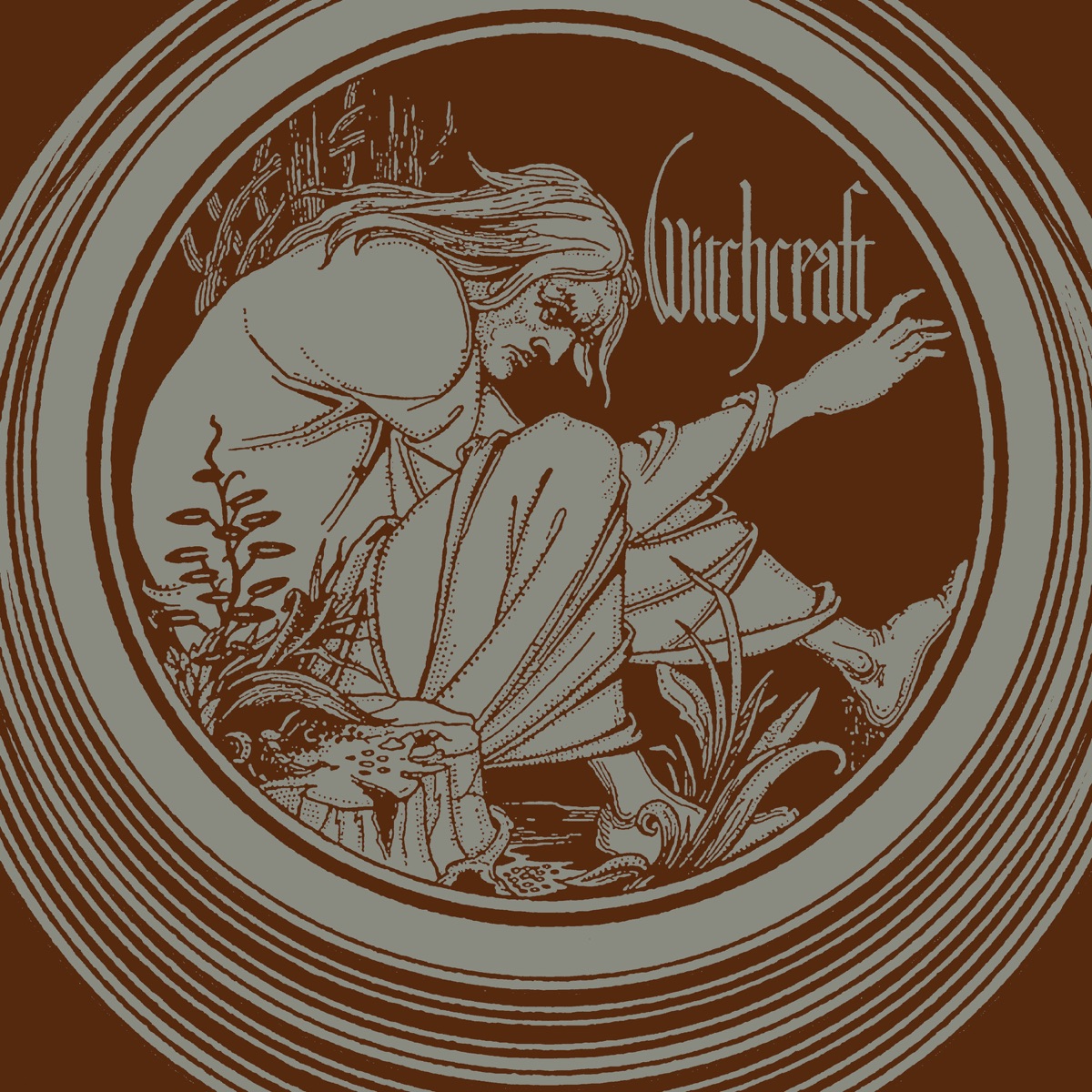
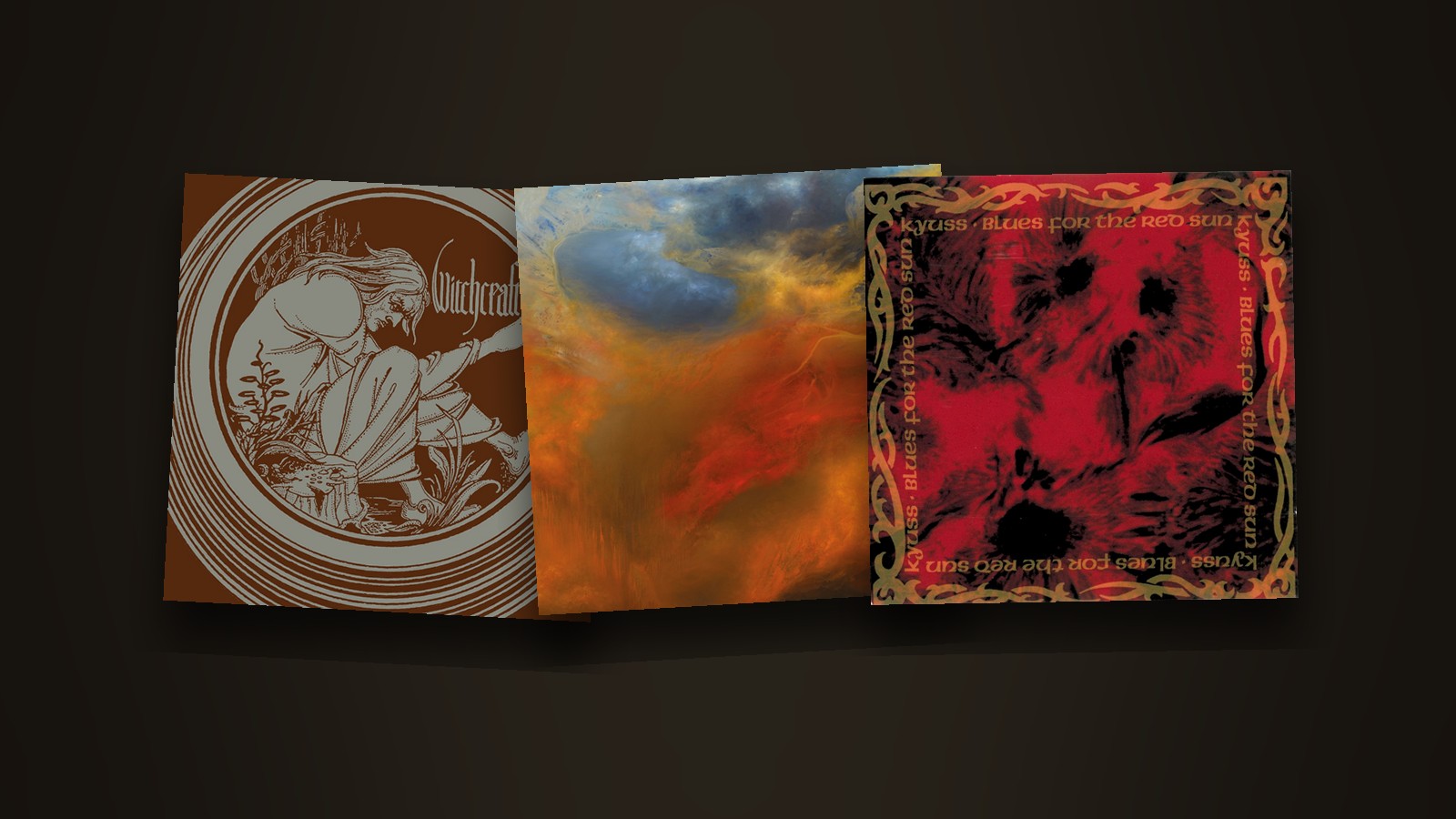
The purest pledge in the window is Swedish. Founded in Örebro in 2000 by Magnus Pelander to record a tribute to Bobby Liebling and Roky Erickson, the band that took the name Witchcraft released its self-titled debut through Rise Above in 2004 with the seventies Pentagram song "Please Don't Forget Me" among its tracks, and on the front a slightly altered version of Aubrey Beardsley's Merlin, made for J. M. Dent's edition of Malory's Le Morte d'Arthur in 1893 and 1894. Songs pledged by one band, a drawing pledged by another century, and both sold back over the counter as new stock.
The window keeps only what somebody once judged worth a ticket, the same question of what lasts that decided the Best Doom Metal Song. The borrowed sleeves passed it because the buyer already recognised the goods: an occult still or a drawing from the 1890s told him, before a bar was heard, that the music inside would be old in its manners and in no hurry.
A doom record has always arrived in the shops wearing somebody else's clothes.
The desert poster
Stoner metal stocked the window with brighter goods, the look of the gig poster and the painted van. On Blues for the Red Sun, the 1992 album by the Palm Desert quartet Kyuss, an illustration by Marc Rude shares the sleeve with a photograph of the sun credited to the Big Bear Solar Observatory, a real star lent by a scientific instrument and hung over a record named for a red one. It promised heat, not gloom.
In San Francisco the poster became a label. The artist Frank Kozik, whose posters had carried the American underground's tour dates since the eighties, founded Man's Ruin Records in 1994 and designed most of the sleeves for its more than two hundred singles and albums himself, the majority screen printed and numbered by Kozik and pressed in editions of five thousand or fewer, each run tearing the gloss off major label packaging. Every one of those sleeves priced the music exactly: limited, loud and gone by the next tour. Sludge put rougher goods in the same window, and a good many of them still sit there unredeemed, as the Underrated Sludge Metal Albums sets out record by record.
The empty window: funeral doom and the void
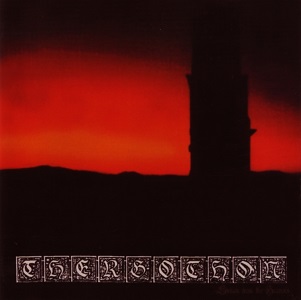
Funeral doom took almost everything out of the window. Recorded in October and November 1992 and released by the Italian label Avantgarde Music on 15 June 1994, Stream from the Heavens, the only album by the Finnish trio from Kaarina, Thergothon, was designed by its singer and keyboard player Niko Sirkiä, with a cover photograph credited to K. Sirkiä of a sunrise so low on the horizon that it reads as easily as a sunset, a barely identifiable tower standing in it at the right of the frame like the gnomon of a sundial whose shadow has not yet begun to travel, which is the pace of the music behind it, and the lyrics calligraphed in funereal white on black inside the booklet. Nothing in that picture moves.
A year later the quartet from Riihimäki, Skepticism, emptied the frame further still. The cover of Stormcrowfleet, released by Red Stream in 1995, is a close-up of something that cannot be identified from the picture alone, reddish to yellow-orange shapes on a black ground, from photographs credited to the Lihtede Group. The window displays a thing without a name. The buyer pays for it anyway.
At the far end of the family the Seattle duo of Stephen O'Malley and Greg Anderson, Sunn O))), dressed its records mostly in dark tones, and when the window took a borrowed picture it took one by a sculptor of steel. Released by Southern Lord on 18 May 2009 under O'Malley's art direction, Monoliths & Dimensions carries Richard Serra's "Out-of-round X" of 1999, a dark disc that will not close into a circle, its edge fraying into the pale ground, the dark mass crushing every lighter object the sleeve might have held like a counterweight dropped on the pan of a scale, the album's tonnage declared before a note. For Life Metal, released on 26 April 2019, the duo went to colour: four paintings by Samantha Keely Smith, "Manifold" of 2015 on the front, photographed by Ronald Dick in what the label called "baths of light colour", and Anderson told Stereogum on 5 February 2019 that the band's other records carried "a lot of blacks and whites".
What the window costs
Read in order, the forms make a ledger of what doom has been willing to owe. The black envelope of 1971 charged the buyer nothing but faith, the borrowed drawing and the traced still charged the century the band was quoting, the desert poster charged the price of a limited run and a ticket to the next show, the funeral doom frame charged the weighted patience the music would demand, and the paintings on Life Metal, forty-eight years after the embossed title, charged for colour in a genre that had spent half a century selling black. Which record to carry out of the shop first is answered in our guide to where to start on record. Doom has never hidden what it costs.
