
Whatsoever thy hand findeth to do, do it with thy might; for there is no work, nor device, nor knowledge, nor wisdom, in the grave, whither thou goest.Ecclesiastes 9:10, King James Bible
Formed in Pittsburgh in 2014 and sent out on 29 April 2016 with a debut album pressed on CD-R by a label that had named itself after the plainest move a deathcore guitarist can make, the band that piled tremolo-picked chromatic runs on top of palm-muted breakdowns heavy enough to rattle the legs out from under a folding merch table was Signs of the Swarm. The label was called Chugcore. Nobody needed the name explained.
That one word is half the vocabulary. Deathcore riffs come in four kinds, and the genre invented none of them: the tremolo riff came over from death metal, the chug from hardcore and the metalcore that grew out of it, the chromatic crawl from the death metal bands that liked their riffs ugly, and the slam riff from the slowest, most stubborn corner of brutal death metal. Deathcore's own contribution was the edit: it cut every bar that did not lead into the few seconds where the floor takes the blow.
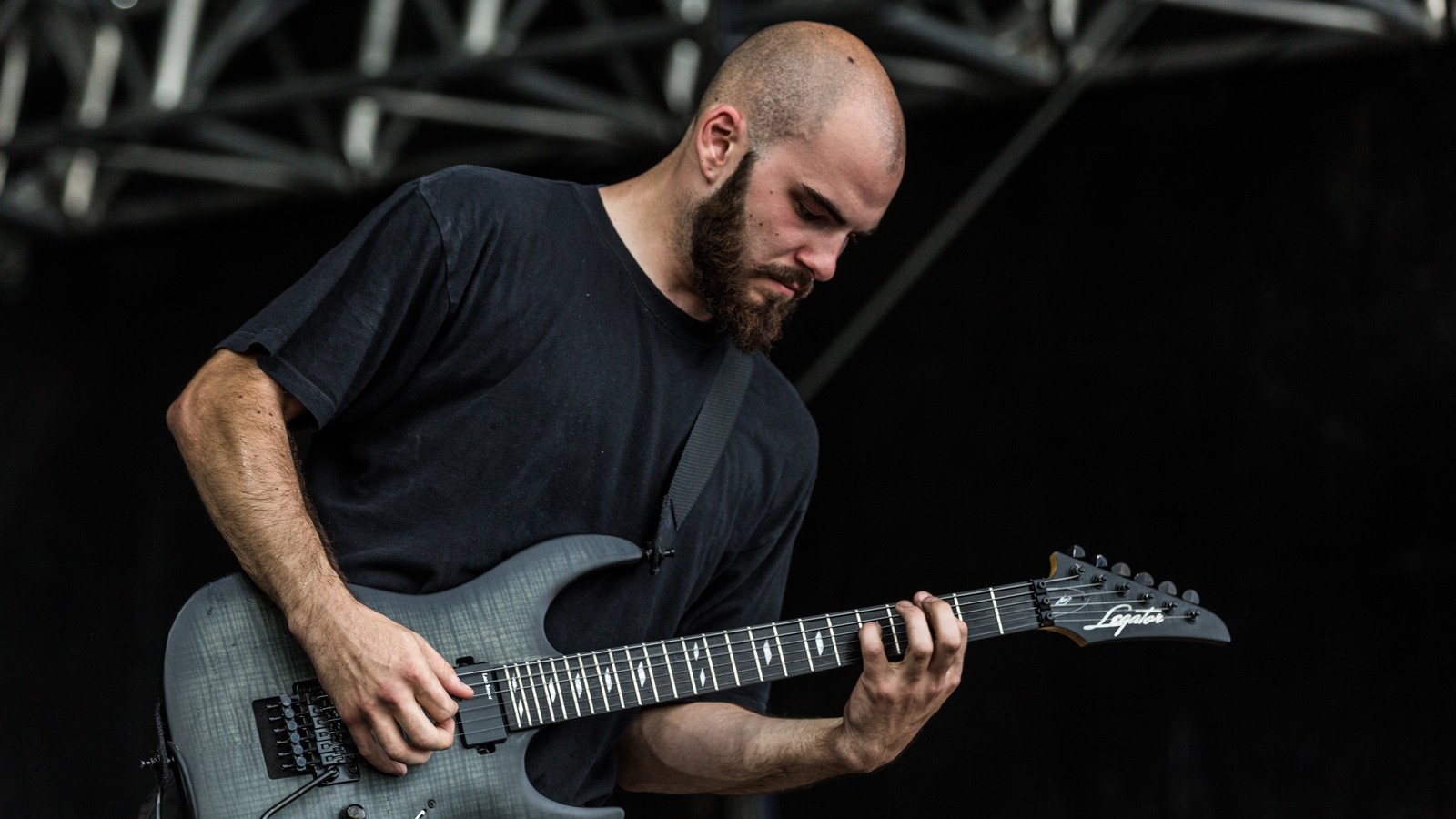
Every one of them starts in the picking hand. The left hand chooses the note. The right hand decides what kind of riff it is.
Watch two guitarists killing an hour before doors at the foosball table in the basement of a house that puts on shows. One spins his rod flat out, the way every house rule forbids, the little painted men a blur and the ball cracking off them so fast that nobody can count the hits and the whole table seems to hum. The other keeps his fist clamped on the handle and snaps it once, hard, on a count only he can hear, and the ball smacks into the far end with a single crack you can hear from the stairs. Then somebody loses, slams the rod home with both hands and drives the table a foot across the concrete, snapping a leg off at the bolt, and for one second the basement goes silent before it roars. The spin is the tremolo, strokes packed so close they fuse into one rasping tone. The snap is the chug, one note struck and choked dead. Deathcore is written for the silent second after the slam.
The breakdown that the riffs deliver, the tunings they are played in and the studios that make them audible all belong to the wider story of how the genre is built. The riff is the part you can actually watch happen, in a right hand hanging over a bridge, and it is the part that decides how hard the floor gets hit when the song finally drops.
The tremolo riff, handed down by death metal
A tremolo riff is picked down, up, down, up, for as long as the forearm holds out, so that one note or a short line of them is struck many times in the space where a slower riff would strike it once. Over a blast beat the separate strokes stop registering as strokes. What is left is a sustained, abrasive tone that can still change pitch, which makes the tremolo riff the one part of the genre that behaves like a held note and a drum roll at once. The high scream usually rides on top of it. The low growl waits for something slower.
The lineage runs straight back to death metal, which had long owned the technique, and deathcore took it from the source, often from the same stage on the same night. Signed worldwide to Century Media in January 2005 and sent out that autumn on a North American run behind Suffocation with Cryptopsy beside it, a schooling no hardcore kid could have bought on a record, the Montreal band with two singers at the front and a drummer who blasted through every set was Despised Icon, and two years later the guitars on The Ills of Modern Man still carried that circuit inside them. One Metal Archives reviewer heard Cryptopsy in the riffing. Another heard the slams of Suffocation and Dying Fetus standing right beside hardcore chugs.
In death metal the tremolo is a road. In deathcore it is a dead end, and the band takes it flat out on purpose.
What changed in transit was the length. A death metal song can ride one tremolo figure through a whole verse and on into the next riff without looking back once. A deathcore tremolo riff is shorter and it is built to be cut off, a short salvo of speed that ends with the whole band slamming into a wall on purpose. In death metal the tremolo is a road. In deathcore it is a dead end, and the band takes it flat out on purpose.
Deathcore riffs that chug: the open string from hardcore
The chug is the hardcore half of the guitar. The heel of the picking hand rests on the strings just in front of the bridge, the open low string is struck, and the note is smothered the instant it sounds, so that what reaches the back of the room is the blow with almost none of the ring. Struck in a pattern, sixteenths, groups of three, a gap where the ear expects a hit, with a note from higher on the neck thrown in, the open string turns into a beat with a pitch attached to it. Deathcore riffs that chug are the ones a crowd can throw itself into headlong without knowing a single note of the song.
Hardcore had been writing riffs for the floor since the mosh parts of the eighties, and through the nineties the bands on the Victory roster, Earth Crisis and Hatebreed among them, packed those riffs with metal's weight, palm-muted, tuned down and struck so hard that the hardcore riff and the metal chug became one and the same movement of the right wrist. Metalcore carried that open string into the next decade and hung melodies over it. Deathcore took the melodies back down.
A Metal Archives reviewer who gave The Ills of Modern Man nothing out of ten put the case against the chug as plainly as anyone has. Every metal band chugs, the review allowed, but a chug is there to add texture to a song and not to be its only source, and Despised Icon had made chugging nearly the whole formula. Read it twice and it is an accurate description of the genre with the verdict turned upside down.
In death metal a chug is texture, a few bars of grinding between the runs. In deathcore it is load-bearing. Rip the tremolo runs and the crawls out of a deathcore song and a skeleton of chugs is still standing, open string, rests and accents, with the breakdown bolted to the end of it; tear the chugs out instead and the song collapses onto the floor in pieces. That is what the hardcore half brought across. Not one riff among several, but the frame the others hang on.
The chromatic crawl and the dissonant riff
The third riff is the one that gets into the marrow of the genre and makes it sound sick. A chromatic riff steps one fret at a time with no scale underneath, so the ear cannot hum ahead and cannot guess where it will stop. Played slowly on the low strings it crawls. Played at tremolo speed it writhes. Either way it gives the listener nothing to stand on.
Why notes a fret apart sound so dark is a question of harmony, of phrygian, diminished and the dissonant chord. The riff's own contribution is motion. It drags a dark sound across the bar in steps too small to feel like progress, and every one of those steps winds the room a little tighter.
Picture the roadie at the back of the trailer at two in the morning, the load-out stacked on the asphalt and the combination for the padlock gone clean out of his head. He turns the dial one number at a time, click, click, click, each click the smallest move the lock allows and not one of them the right number, the band standing round him in the cold with their hands jammed in their pockets, until he loses patience, rams the van's jack handle through the shackle and wrenches until the hasp tears out of the door frame and both doors swing open on their own. The clicks are the crawl. The torn hasp is the drop. The crawl exists to make you want it.

Signs of the Swarm built a debut on exactly that pairing. A Metal Archives reviewer of Senseless Order heard most of its riffing down on the lowest strings of the drop-tuned guitars, tremolo-picked chromatic runs set against chunky breakdowns, with the lead guitar laying dissonant overlays across the breakdown riffs instead of taking solos. Despised Icon had reached for the same sickness by a different route, bending. On The Ills of Modern Man a reviewer singled out a breakdown in "Nameless" for the guitarist pulling on the strings to make a dissonant effect.
Slam riffs in a deathcore song
The slam riff is the one piece deathcore imported without changing a bolt. Where a chug hits on the grid, a slam riff hangs back from it: it is slower, it sits low on the neck, and its accents land late enough that the whole figure lurches forward rather than marching. Slam death metal can build a whole song out of that lurch. In a deathcore song it is one tool among four, parked beside the breakdown or swapped in for it, and the song around it still runs on hardcore's rules.
How much slam a deathcore record can carry before it stops being deathcore is a question Senseless Order answers in the open. Pressed on CD-R, it drew on brutal death metal and slam, and the Metal Archives reviewer who placed it heard it lean toward the deathcore side, closer to it than Vulvodynia or Whoretopsy, two bands further down the slam end. Its follow-up, The Disfigurement of Existence, the band's first record for Unique Leader, arrived on 3 November 2017, and one reviewer heard it lean further toward the slamming side of deathcore than the debut. The slam stayed in. So did the drop.
That is the rule the slam riff obeys inside the genre. It can flatten a verse, gut a chorus that was never there to begin with and grind a song down to walking pace at the bottom of the tuning, and it still hands the room back to a hardcore structure when it is done. A slam riff in a deathcore song is a guest with the heaviest boots in the building. It does not get the keys.
Day of Mourning: the whole kit on one record
Produced by Yannick St-Amand, once a guitarist in the band, mixed by Andreas Magnusson and mastered by Alan Douches, then released by Century Media on 22 September 2009 and sold to about 3,000 people in its first week, enough for number 162 on the Billboard 200, the record on which Despised Icon laid blasts, chugs and breakdowns side by side in one running order was Day of Mourning.
"Les Temps Changent" opens it, and more than one Metal Archives reviewer reached for it first. One was won over by it on the first listen; another filed it with "Black Lungs" and "Made of Glass" among the album's most punishing, breakdown-packed assaults. That second reviewer heard the old formula intact underneath, grindcore blast beats set against a lurching, staggering heft he called Meshuggah-ish, with grooves and breakdowns hammered in between, while the first found a melodic chug riff waiting just in front of the breakdown in the title track. Blasts for the speed, a chug for the bounce, a lurch that one reviewer set beside Meshuggah: by 2009 a band from Montreal could bolt all of it into one running order and send a club's monitor wedges skidding off the front of the stage by the end of it.
The band split in April 2010, seven months after the record came out, and was back on stage in 2014. Almost nothing a deathcore guitarist plays was born inside deathcore, so where a riff came from settles very little. What settles it is the state the floor is in at the moment the riff ends: braced by a tremolo run, already moving on a chug, wound tight by a crawl, or hammered flat by a slam. A deathcore riff is judged on that, and on nothing else.
