
Hardcore
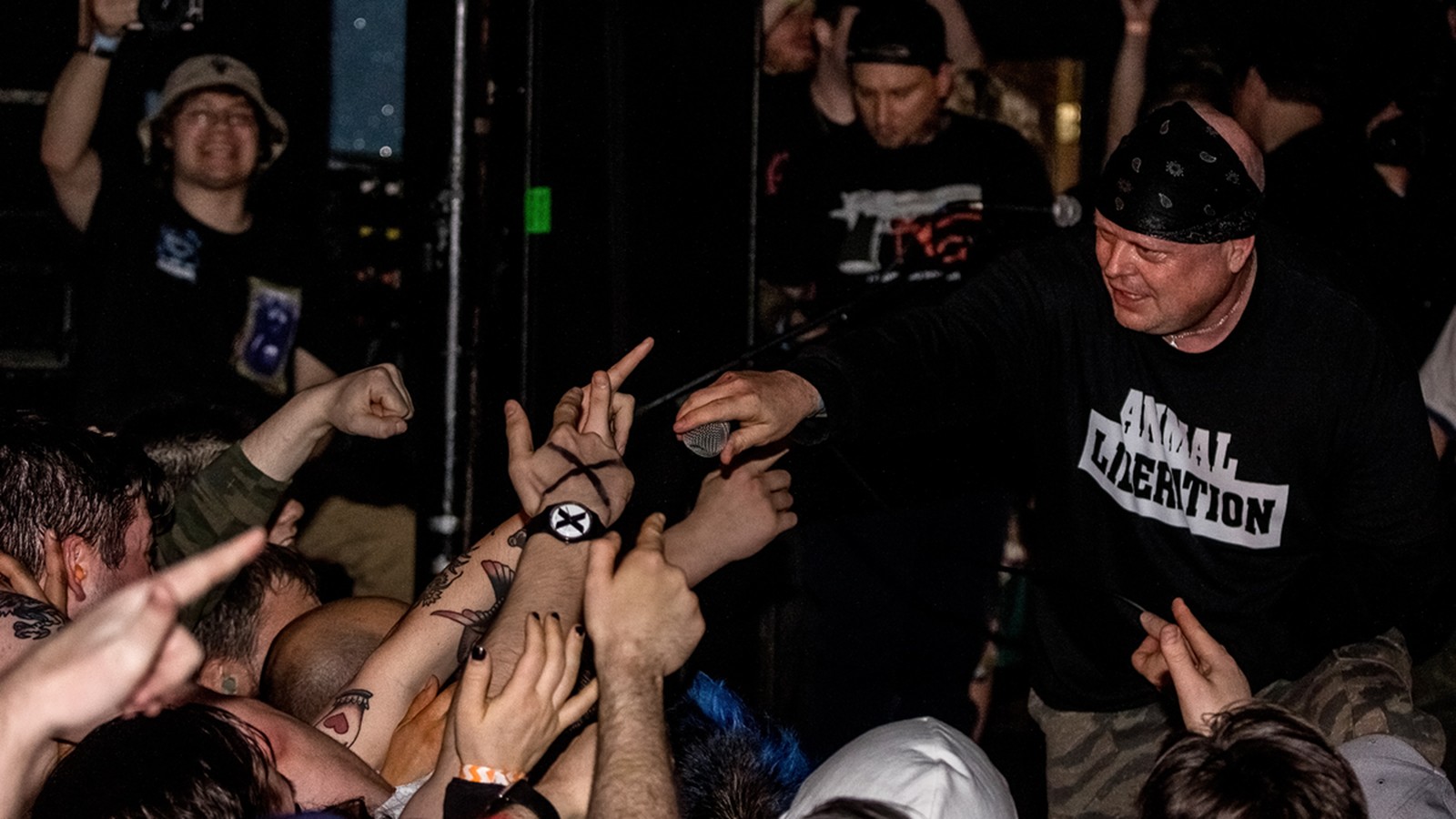
Hardcore, the loudest argument ever held in a small room, was ritualised on the Washington floors where slam dancing began and then dragged by its own children into sludge, grindcore and metalcore, and it still runs flat out. Nobody sits down.
Drums as the engine
The punk of the basement battlefield, hardcore, is played at tempos well past 150 beats a minute and driven by a rhythm section that runs like a car engine with the governor ripped out, and it sets buzzsaw power chords against drums that push rather than decorate, throws in abrupt tempo changes and song forms nobody can predict, and cranks the volume until it becomes part of the message. Rhythm beats melody. It wins every time.
What separates this punk form from the metal it keeps feeding is the job each part does. A metal riff is built to be admired; here the riff is built to be used, stripped to whatever a room needs to erupt, and the palm muted chug, the slowed breakdown and the gang chorus bellowed back by the front row are tools on a workbench, never ornaments on a mantelpiece. Songs end before the sweat dries. The floor is the point.
Hardcore's codes and weight
The scene splits along its codes and along its weight. Straight edge grew out of a Minor Threat song and spawned youth crew and hardline, the metallic wing from Integrity to Earth Crisis became the root system of metalcore, and the fastest, most violent end fed powerviolence and grindcore. Slowing the second side of My War in 1984 to a Black Sabbath crawl that split its own audience down the middle, the Hermosa Beach band led by the SST founder Greg Ginn, Black Flag, drew the road map for sludge. The purists howled.
New York forged the heaviest wing. Lit when Bad Brains moved up from Washington and packed with the bands that followed, Agnostic Front, Cro-Mags and later Sick Of It All, the city's scene built its songs on a low, chugging rhythm guitar and let the mosh part swell until a slowed breakdown could split a club floor like an axe through a pallet. Boston tried the metal route faster. SS Decontrol and DYS both turned to metal in the middle of the 1980s, and neither survived the change for long.
Three neighbours get mistaken for it. Crossover is the 1980s weld of the punk sprint to the thrash riff, punk metal is the older, dirtier meeting point around Motörhead, the d-beat and crust, and metalcore took the breakdown and hung a sung chorus beside it. Hardcore itself stays a punk form with metal leaking through the seams. After 2010 the leak became a flood: Nails out of Oxnard crushed d-beat, grindcore and powerviolence into records shorter than a sitcom, and Knocked Loose hauled the breakdown into the Billboard top 30.
Where to start
Six records, from a New York studio in 1986 to the heavy end of the 2020s.
- Cro-Mags The Age of Quarrel Profile Records, 1986
Chris Williamson producing at Eastside Studios, Harley Flanagan's bass under John Joseph's bark, and Village Voice readers voting it the greatest New York hardcore album made.
- Sick Of It All Blood, Sweat, and No Tears In-Effect/Relativity, 1989
Recorded in three days in Rhode Island, KRS-One guesting, more than 100,000 copies sold, and the blueprint of New York hardcore for the decade after.
- Xibalba Hasta la muerte Southern Lord, 2012
The Pomona band's second album, hardcore and death metal dragged down by doom, with lyrics in English and Spanish.
- Nails Abandon All Life Southern Lord, 2013
Ten songs in seventeen minutes, Kurt Ballou producing, and Todd Jones, once a guitarist in Terror, leading the charge.
- Knocked Loose A Different Shade of Blue Pure Noise, 2019
Will Putney producing, number 26 in both the United States and the United Kingdom, and fourth on Revolver's list of the year's best albums.
- Malevolence Malicious Intent Nuclear Blast, 2022
The Sheffield band's third album, beatdown hardcore with sludge and groove metal poured into the mould.
Hardcore News
All 71 stories →Hardcore Reviews
All 8 reviews → 7.0
7.0
Napalm Death
Words from the Exit Wound
Three rooms worth saving in a house the band was already leaving.
 Gareth Llewellyn
Oct 26, 2026
Gareth Llewellyn
Oct 26, 2026
 6.5
6.5
Napalm Death
Leaders Not Followers
Six borrowed songs, and half of them come back sharper.
Gareth Llewellyn
Oct 25, 2026
 8.5
8.5
Amenra
Mass VI
Six pieces of grief that weigh more than any riff on them.
 Ilse Brandt
Oct 19, 2026
Ilse Brandt
Oct 19, 2026
 8.0
8.0
Devil Master
Bloody Dreams
Twelve minutes of trailers, then a feature worth the whole ticket
Gareth Llewellyn
Sep 8, 2026
Guides & Essentials
All 4 → Genre Histories
Mosh Pits, Circle Pits and the Wall of Death
Four physicists at Cornell filmed metal crowds and found a disordered gas and an ordered vortex. Where the pit came from, what each form is triggered by, why the bre...
 Genre Histories
Earth Crisis, Integrity and the Hardcore Roots of Deathcore
Deathcore has two parents, and the hardcore one handed over the mosh part, the matinee and a label. How Integrity, Earth Crisis and Victory Records carried the break...
 Genre Histories
Ruthie's Inn: The Berkeley Club Where Thrash Learned to Mosh
A neighbourhood bar at 2618 San Pablo Avenue, a promoter who refused to sort bands by genre, and four years in which the Bay Area scene acquired an address. What is...