
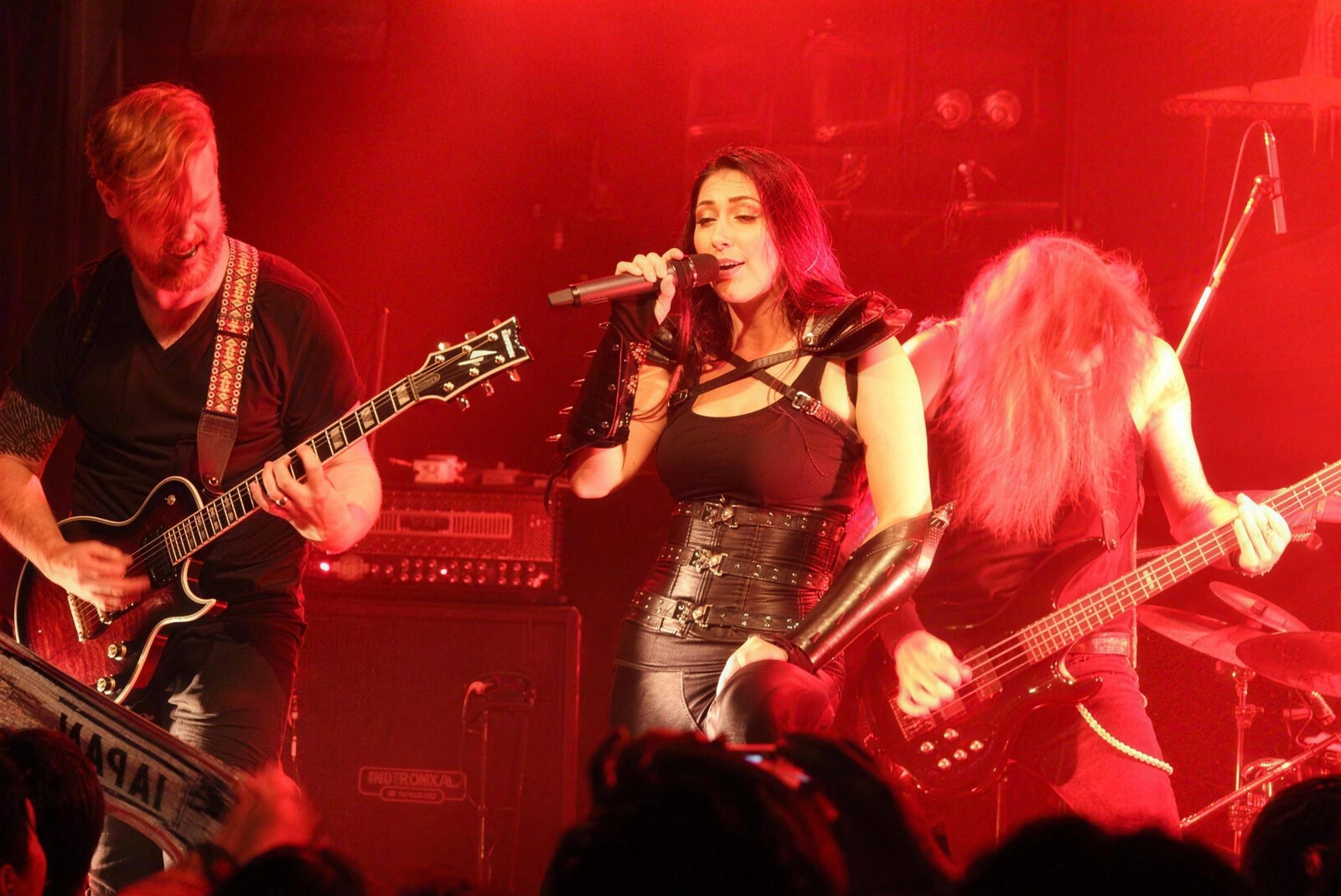
On 9 January 2006 a power metal record reached shops outside Japan with a scream buried in it. Issued in Japan twelve days earlier, Inhuman Rampage laid the harsh vocals of Lindsay Dawson, singer of the New Zealand band Demoniac, under choruses that ZP Theart still sang clean and high above the stave, kicking in a door the band had kept bolted against that kind of voice through its first two albums.
The British sextet that had been calling its own music extreme power metal for two years by then was DragonForce. Glossed by a Pollstar profile in September 2006 as epic vocal melody and duelling solos riding a rhythm section fit to frighten any thrash or death metal outfit, the phrase is usually dated to 2004, the year Dave Mackintosh first recorded on drums with the band and brought blast beats into it at a tempo power metal had never asked of anyone.
The percussion section that premiered Edgard Varèse's Ionisation on 6 March 1933, thirteen players in an annex of Carnegie Hall, carried among its drums a lion's roar: a barrel with a cord threaded through the centre of its head, rosined and drawn hand over hand through a cloth until the whole body bellows like something chained at the bottom of a pit. Its pitch slides and never lands. Set it beneath any tune ever written and the tune comes through whole, with an animal snarling under the floorboards. Hand it the tune instead, and the cord saws a groove through the drumhead and little is left that a room could sing back.
Extreme power metal is that instrument wheeled under the chorus. Everything turns on who is left holding the tune.
Extreme power metal: two hybrids, two directions
Two different kinds of record answer to the name, and they arrive at power metal from opposite sides of the house. The first is power metal pushed to the limit of its own tools: a clean high voice, a major key and a climbing chorus, with the drums driven past the double kick into blast beats and, from the end of 2005, a harsh voice brought in as a second colour. The second starts in melodic death metal, a harsh voice at the front of every line, and borrows the tempo, the bright keyboards and the neoclassical leads of the power metal trunk.
Both get filed under the same phrase in shops, forums and festival programmes. Only one of them lives on the tree that maps power metal styles, and the test that sorts them is the one the genre has applied to every branch since 1987: the sung melody has to stay clean, because it is what the audience takes home first.
The DragonForce reading is about speed. Pressed into service on Sonic Firestorm in 2004, a blast beat in that band does not work the way it works in death metal, as a wall in front of the riff; it runs under a clean melody at a rate where the separate snare strokes stop registering as beats at all, like a Leslie cabinet kicked onto its fast setting until the treble horn shrieks on its bearings and the drive belt tears loose, the notes smeared into one spinning sheet behind the singer.
Set it beneath any tune ever written and the tune comes through whole, with an animal snarling under the floorboards.
The band put the phrase on a sleeve only in 2019, when Extreme Power Metal came out on earMUSIC, fifteen years after it first started using it. By then reviewers had long been pinning the phrase on growling bands that sounded nothing like DragonForce.
The Finnish hybrid and the melodic death border

The Finnish quintet that Metal Archives still files as melodic death and power metal at once is Children of Bodom, and Hatebreeder, released by Spinefarm in 1999 and described in a 2007 Metal Archives review as the band's take on extreme power metal, a mix of shredding, thrash riffs, neoclassical passages and infectious keyboards, puts Alexi Laiho's rasp at the front of every line while Janne Wirman's keyboards chase the guitar through the fast passages.
On any honest reading the power metal tools on that record are easy to hear: the tempo, the neoclassical runs, the keyboard and guitar trading phrases in the manner Stratovarius had made a house dialect a few years earlier. The voice is the one tool missing. Laiho never sings a clean line on it, and so the melody that a power metal chorus hands to the crowd lives on the fretboard and the keyboard instead.
"Downfall", the single from Hatebreeder that came with an official video, carries the arrangement across the whole record. The melody the room takes home sits in guitar and keyboard working side by side, and the singer's job is to tear across it rather than carry it.

The swamp band from the same Finnish scene, signed to the same label group, was Kalmah, and They Will Return, released in Finland by Spinefarm's Spikefarm imprint on 30 April 2002 with Pekka Kokko singing and playing rhythm guitar and Pasi Hiltula on keyboards, carries the same double filing on Metal Archives, melodic death metal and power metal side by side.
A 2023 review of Kalmah places the band as a melodic death and power metal hybrid in the company of Children of Bodom, Norther and Wintersun. That last name extends the family into longer forms. Metal Archives files Wintersun as symphonic melodic death metal, while its Wikipedia entry lists power metal among five genres, and the project began as a side road taken by Jari Mäenpää while he still played in Ensiferum.
This is the border, and it runs along the throat. Where the voice at the front is guttural on every line and the melody has moved into the guitars, the record belongs to melodic death metal, a genre with its own shelf and its own history, which lends the power metal tree its speed and its keyboards and takes nothing back. The double filing on the archive records a debt of tempo and key. It does not record a change of allegiance.
| Band | Record | Lead voice on the chorus | Metal Archives genre |
|---|---|---|---|
| DragonForce | Inhuman Rampage (2006) | Clean lead, harsh guest underneath | Power Metal |
| Unleash the Archers | Demons of the AstroWaste (2011) | Clean female lead, harsh voice beside it | Melodic Death/Power Metal (early); Power Metal (later) |
| Children of Bodom | Hatebreeder (1999) | Harsh throughout | Melodic Death/Power Metal |
| Kalmah | They Will Return (2002) | Harsh throughout | Melodic Death/Power Metal |
| Wintersun | Wintersun (2004) | Harsh, with clean passages | Symphonic Melodic Death Metal |
Power metal bands that let the harsh voice in
Coming from the other side of the same border, the Canadian band founded in late 2007 by Brittney Slayes, who sings, and Scott Buchanan on drums is Unleash the Archers, a band whose first records put a clean, soaring female lead at the front of the chorus and a guitarist's harsh voice beside her, which is extreme power metal in the narrow sense, built from the power metal end.
"General of the Dark Army" comes from Demons of the AstroWaste, a concept album about a mercenary in space. The harsh voice on that record came from Brayden Dyczkowski on guitar, set beside Slayes rather than in her place.
The archive kept score of what happened next. Metal Archives files the band as melodic death and power metal in its early years and as power metal alone later, a change of the archive's label and not of the frame. The chorus was clean on both sides of that line. Only the label under it changed.
That is the usual life of the hybrid inside power metal. A harsh voice arrives as a guest, a second colour or a guitarist's sideline, and it stays as long as it serves the clean melody above it. No apostasy is involved. The bands that keep the tune clean can growl as much as they like and remain the progeny of the genre, by common consent of the shops, the archive and the crowd that sings the chorus.
Blast beats, black tools and the test that decides
The black metal side of the same experiment, with tremolo picking, shrieked vocals and a colder production laid over a power metal song, is a smaller and stranger branch, and its bands are mapped in blackened power metal and the bands that growl. The same test sorts it. Where the shriek takes the chorus, the record has left.
The blast beat itself settles nothing. DragonForce used it under a clean lead voice and stayed power metal on every count that matters, while the Finnish hybrid used the same tempo with a harsh lead and went to the other shelf. The tempo is shared property, the keyboards are shared property, and so are the neoclassical runs.
What is not shared is the sung hook. A power metal song is built so that a crowd can take its chorus away, and a crowd takes away most easily what was sung in pitch, at a height it can reach for. Harsh vocals, blast beats and a death metal rhythm section can all be added under that hook without moving a band off the shelf, and a band that keeps the hook clean keeps its place however extreme the rest of the record becomes.
So the phrase works as a description of degree inside power metal, and as a description of debt outside it. For a band whose singer still carries the melody, extreme power metal names how far the rest of the band has been pushed. For a band whose singer does not, it names where the tempo and the keyboards were borrowed from, and the record sits on the melodic death metal shelf with the loan recorded on its label.
