
In 1611 the Spanish dictionary maker who entered the folía as a Portuguese dance of great noise, its sound so hurried and its din so great that dancers and players alike seemed to have taken leave of their senses, was Sebastián de Covarrubias.
Almost ninety years later the courts had tamed the racket into a grave and stately tune, and the Roman violinist who printed twenty-three variations on it as the twelfth and last sonata of his Opus 5, dated 1700, was Arcangelo Corelli, whose bow saws all four gut strings raw in runs, double stops and broken chords until the tamed tune is travelling faster than any pair of feet in Portugal ever carried it.
The street lost its dance. The violin kept the tune, and handed it back its noise.
Folk power metal strikes the same bargain three centuries on. An old melody, or one written to sound old, rides at the front of a power metal song on fiddle, flute, viola or the lead guitar, and everything around it belongs to the other family: a clean lead voice, the double kick, a chorus written for a crowd to take over, and a tempo no village musician was ever asked to keep.
Folk metal proper owns those instruments as its craft, and it is the closest neighbour on the map. The two families share festivals, record labels, tour buses and a good part of their audience, and for a quarter of a century they have sorted themselves by one element before any other. Fiddles prove nothing.
Folk power metal starts with the singer
The Swedish guitarist who ran the cleanest experiment on that border was Stefan Weinerhall. Leaving Mithotyn, the Viking metal band whose three albums between 1997 and 1999 had already carried his folk-coloured melodies, he founded Falconer in 1999 to keep that writing and tear out one thing only, the harsh voice, and the demo that won a deal with Metal Blade Records was sung by Mathias Blad, an actor and singer trained in musical theatre.
A songbook kept, a throat replaced. Everything the old band had sung through a snarl now had to be carried at the top of the chorus by a voice that could hold a melody without a crack in it, and that single substitution moved the same kind of song from one family into the other.
Cut in three weeks at Los Angered Recording with Andy LaRocque and Jacob Hansen in November 2000 and issued by Metal Blade in 2001, the self-titled debut carries Mindtraveller, and on a record whose credits list no fiddle, flute or pipe the melody that sounds older than the band can only sit in the guitars, not in any instrument from a village wedding. The folk is in the tune. The family is in the voice.
Then the band ran the test the other way round. Grime vs. Grandeur, in 2005, swapped the folk melodies, themes and lyrics for conventional heavy metal arrangements with Kristoffer Göbel singing in Blad's place, the reception was muted enough that Blad was rehired to sing the next record, and Northwind put the folk back in 2006. Nobody heard the 2005 record as a change of genre. It was heard as a band without a face.
That is the lesson Haydn's Symphony No. 100 had taught London in 1794, when the second movement wheeled in the janissary kit of bass drum and cymbals and the players let the cymbals crash through the Hanover Square Rooms. Strip the kit out and every bar underneath is still Viennese, harmony, phrasing and cadence untouched. What goes out of the door with the cymbals is the nickname the piece has carried ever since, Military, and with it the reason anyone could tell that symphony from the eleven others Haydn wrote for London.
Armod, in 2011, pushed the colour further than anything before it: every song in Swedish, and the arrangements stretched, in Weinerhall's own description when the record was announced, from acoustic pieces with cello, flute and fiddle to blast beats and heavy riffing. Even there the lead stayed clean.
Guests in the credits, members on the stage
Formed in late 1997 by two guitarists who wanted to fuse power metal with folk music, and signed to AFM Records on the strength of a promotional recording, the Italian band from Sacile that put the branch on record was Elvenking, and its debut, Heathenreel, issued on 23 July 2001 after mixing at Fredman Studios with Fredrik Nordström, opens on Pagan Purity once a forty-six second prelude has cleared the way.
Read the credits and the folk sits outside the band. The flutes belong to Umberto Corazza and the fiddles to Paolo Polesel, both listed as guests, while the death vocals in the backing belong to Jarpen, one of the two founding guitarists, so the record that fixed the branch already carried a growl inside it and kept that growl chained in the backing, snarling under the clean lead of Damnagoras.
The folk is in the tune. The family is in the voice.
That ordering of voices is what put the record in the power metal family, and it is why the longer account of the whole tree hangs the branch on Heathenreel rather than on anything from Scandinavia. The stage said the same thing. Elvenking toured the European festivals beside Blind Guardian, Gamma Ray, Edguy and Virgin Steele, and after August 2002 a violinist and keyboard player, Elyghen, joined the line-up, so the fiddle stopped being a hired hand and took a member's chair.
Folk metal came in from thrash
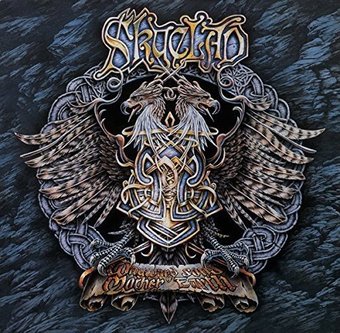
The British singer who had left a thrash band behind to start another around a fiddle was Martin Walkyier, and The Wayward Sons of Mother Earth, which Skyclad put out on Noise Records on 17 October 1991, is a thrash record with a fiddle in the credits, played by Mike Evans as a guest, and with one song that later bands treated as the first sketch of a genre that did not yet have a name.
The song is The Widdershins Jig, and the title says what it does: a jig run widdershins, against the course of the sun, the unlucky direction of every old superstition, straight into the downpicking of a thrash rhythm section, trampling the palm mutes and coming out the far side with the fiddle still sawing on top.
That is the other road into the same territory. Folk metal arrived from thrash and later from black and Viking metal, and it kept the rough voice it came with; most folk power metal arrived from the Hamburg side with a clean singer already at the front and borrowed the tunes. The label that pressed the Keeper records for Helloween pressed Skyclad too, which makes Noise Records the parent house of both roads, and the genre begotten on the thrash side never once asked the singer to climb.
Fiddlers in the line-up: the Spanish case
The Spanish band that has kept a violinist in its line-up since 1992 and treats him as a fixture as permanent as the drum kit is Mägo de Oz, and on La Leyenda de La Mancha, the 1998 concept record that retells Don Quixote, violin and flute stand in the credits beside the guitars and set Cervantes' windmills turning in Molinos de viento.
Finisterra, the double album of 2000, added a flautist and an accordion to the line-up and is the band's most folk record while still standing on heavy metal. The archive's genre string follows the records rather than the personnel: heavy metal and hard rock for the early work, Celtic folk, power metal and hard rock for what came after, the archive's benediction arriving only once the flutes and the climbing choruses had both moved in.
Not every fiddle buys a seat at this table. Saurom, also Spanish, is attested on Metal Archives as heavy and folk metal with no power in the string, and Grave Digger, who put bagpipes on the Scottish concept record Tunes of War in 1996, never became a folk band: a set of pipes for one record is a guest appearance, not a change of family.
Dwarves, samurai and the far border

Founded in Pisa in 2009 and filed on Metal Archives as progressive power metal for its early records and folk power metal for its later ones, the Italian quintet that turned Tolkien's dwarves into a whole aesthetic is Wind Rose, and Stonehymn, released by Inner Wound Recordings in May 2017, is where the change of filing can be heard taking hold.
To Erebor, the second video from that record, carried the band to a far wider audience on Facebook and YouTube and onto the bills of Bloodstock and Masters of Rock. The branch's inheritance is plain in the arrangement: a lead voice that never growls, a chorus stacked for a field to sing back, and the folk emphasis laid in around it with keyboards and choirs.
The Finnish band that dresses the same machinery in samurai armour sits squarely on the line. Whispered is filed on the archive as melodic death, folk and power metal at once, and a harsh lead voice drags it across to the far side of the test that Falconer was built to pass, however brightly its melodies climb.
Further out, the genre strings name the other family plainly. Ensiferum is epic folk metal, Korpiklaani is folk metal and Turisas is folk and symphonic metal, three bands that share tempo, subject and festival stages with the faithful of the power metal side and are filed elsewhere every time, because the voice at the front of the song is not the voice that branch is built around.
| Band | Country | Genre on Metal Archives | Record discussed |
|---|---|---|---|
| Elvenking | Italy | Melodic Power/Folk Metal | Heathenreel (2001) |
| Falconer | Sweden | Folk/Power Metal | Falconer (2001) |
| Mägo de Oz | Spain | Heavy Metal/Hard Rock (early); Celtic Folk/Power Metal/Hard Rock (later) | La Leyenda de La Mancha (1998) |
| Wind Rose | Italy | Progressive/Power Metal (early); Folk/Power Metal (later) | Stonehymn (2017) |
| Whispered | Finland | Melodic Death/Folk/Power Metal | none |
| Saurom | Spain | Heavy/Folk Metal | none |
| Skyclad | United Kingdom | Folk Metal | The Wayward Sons of Mother Earth (1991) |
| Ensiferum | Finland | Epic Folk Metal | none |
| Korpiklaani | Finland | Folk Metal | none |
| Turisas | Finland | Folk/Symphonic Metal | none |
The same sorting runs along every other edge of the family. Where thrash riffing rather than folk melody crowds in under a clean singer, the branch is power thrash, and there too the voice settles the filing before the riff is even counted.
Every band on the power side of that table could lose its fiddles, flutes and accordions tomorrow and still sing in the same family. Falconer as good as proved it in 2005, with a record that kept a clean lead, dropped the folk and was heard as anonymous rather than as a change of genre. What the folk layer carries is identity: the melody a listener recognises before the singer comes in, the reason one Swedish band of 2001 does not sound like the next. The voice decides the family. The melody decides whose house it is.
