
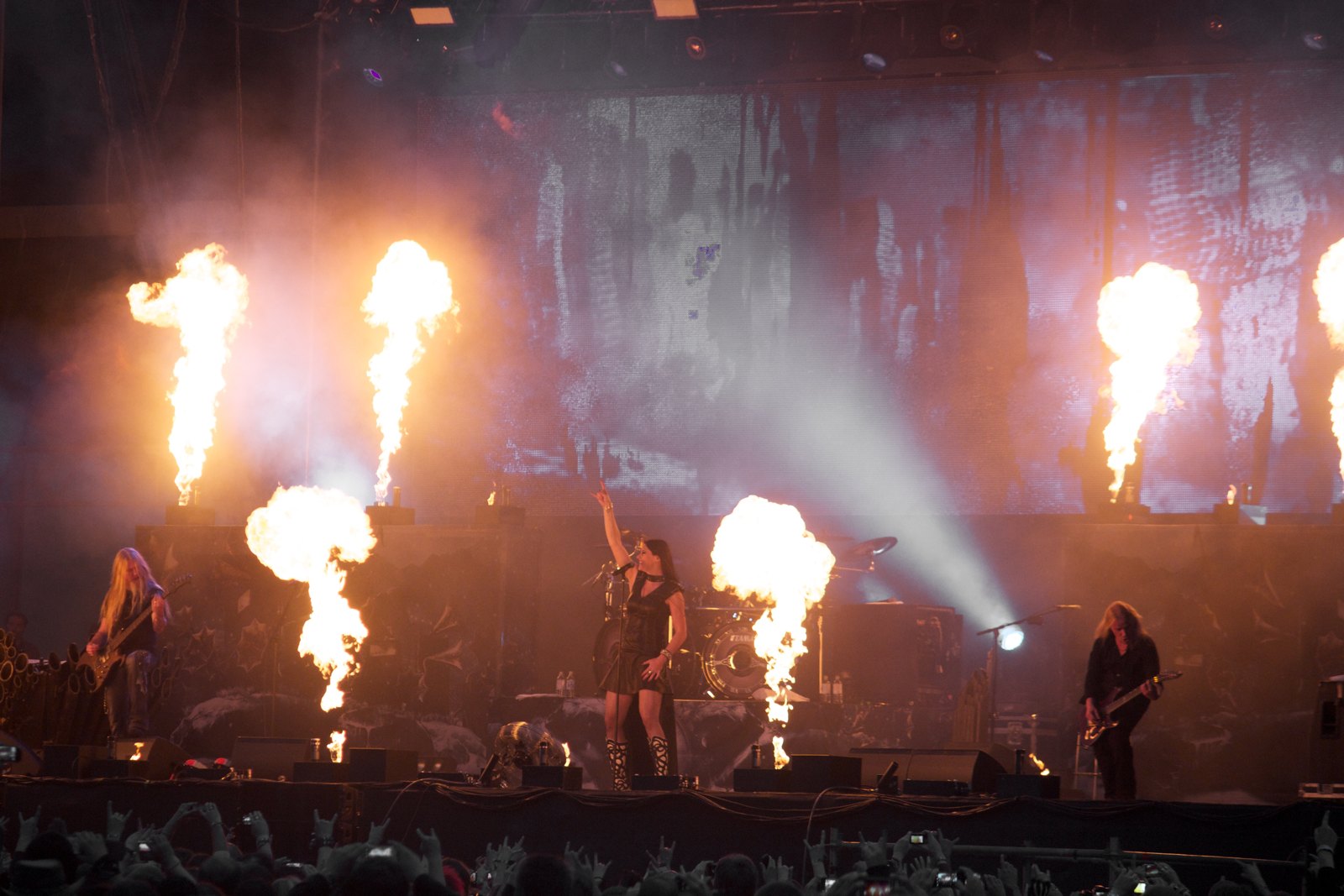
On 7 December 1998 Spinefarm Records released Oceanborn in Finland, ten tracks in forty nine minutes, and more than a quarter of a century later the Metal Archives entry for the band that made it still splits its genre string with a semicolon, symphonic power metal for the early records and symphonic metal for the later ones. So is Nightwish power metal? On Oceanborn and on Wishmaster two years later, without reservation. On Century Child in 2002, by half. From Once in 2004 onward, no, and none of the usual suspects explains the verdict, because the soprano, the keyboards, the fantasy and the stage clothes were all present on the records that do qualify.
The Finnish band whose keyboard player wrote or co-wrote almost every original song across those four albums, with the same guitarist, the same drummer and the same singer standing beside him from Oceanborn to Once, is Nightwish, and that continuity is exactly what makes the question hard. Same hands. Different music.
Ernst Chladni showed in the 1780s how such a thing happens. Scatter sand across a thin metal plate, clamp it at one point, drag a violin bow down one edge until the metal shrieks, and the sand is flung off every region that moves and heaped along the lines that stay still, a figure as sharp as a drawing; damp the plate with a fingertip somewhere else and bow it from another edge, and the same sand on the same metal smashes the first figure to loose grit and throws up a new one. Nothing in the plate decides the pattern. Where it is held and where it is driven decides it.
A band is a plate of that kind. On the records of 1998 and 2000 the four players at its core are driven from the drum stool and the rhythm guitar, the double kick under the bar and the riff on top of it, and the sand settles in the shape the Hamburg records had drawn a decade earlier; from 2002 the drive moves into the orchestral score, the same four are held at a different point, and, by Once, what comes up is a different genre. The verdict on any one of these albums follows from where the drive enters, and from nothing else.
Is Nightwish power metal on Oceanborn and Wishmaster

Recorded between August and October 1998 and issued that December, Oceanborn is the record on which Tuomas Holopainen, taking Stratovarius as his model, stripped the folk lilt off the arrangements of the debut and drove the band into faster tempos, guitar and keyboard leads running side by side and a double kick under the fast songs. That was the template the Finnish school had just made standard. Nightwish took it whole.
Sent out in November 1998 as a split single ahead of the album, with music by Holopainen and Emppu Vuorinen, "Sacrament of Wilderness" is the plainest exhibit in the file: a song that held the top of the Finnish singles chart for four weeks, credited on its single to the band's five players alone and filmed as a live performance in Kitee. It is power metal by the measure of the record around it.
The voice is where the question usually goes wrong. The test the genre sets its singer was never a tenor's chest: it asks for a clean voice placed above the guitars and able to hold a melody there at speed, and Tarja Turunen, a soprano with a classical training behind her, held that position on the record. Trading a tenor for a soprano recolours the top line and leaves its job untouched. Tapio Wilska, hired for a harsh voice on "Devil & the Deep Dark Ocean" and "The Pharaoh Sails to Orion", only sharpens the point, the growl dropped in for contrast on two tracks of ten while the lead never leaves the clean register.
Trading a tenor for a soprano recolours the top line and leaves its job untouched.
The record that went to number one in Finland and to 21 in Germany, carried its title song on names lifted from Tolkien and from the Dragonlance novels, and hired five male voices where its predecessor had hired four strings was Wishmaster, released in May 2000, a few days ahead of schedule because the music had already leaked onto the internet. Holopainen later called it the most distant and least personal album in the catalogue. Distance suits this genre. Its lyrics have always lived somewhere else.
The hired voices on Wishmaster are credited as additional musicians, the band is credited as Nightwish alone, and a review of the day filed the record as melodic power metal with a classically trained female vocalist. The record bends toward slower songs, "Two for Tragedy" and "Dead Boy's Poem" among them, and the eight minutes of "FantasMic" close it. None of that crosses a border. Power metal records have carried ballads since 1987 and long closers since 1988.
Century Child, held at two points

The first album the band recorded with a live orchestra and choir, credited to the Joensuu City Orchestra under Riku Niemi, with the St. Thomas Chorus of Helsinki above the strings and Marko Hietala newly installed on bass and male vocals, and the first on which the drive enters from two directions at once, was Century Child. It went to number one in Finland and to five in Germany. It has two centres of gravity, and they pull against each other.
The opening track holds the split inside six minutes and twelve seconds. "Bless the Child" carries spoken words from Sam Hardwick, with an orchestra and a choir on the credits beside the band, and the track is the kind usually described as film music with a band beneath it, the orchestra taking the downbeat off the drum stool. Next in the running order "End of All Hope" comes in upbeat at three minutes fifty-four, a short song after a long one, as if nothing had happened. Half the record is power metal with strings. The other half is something else with a band.
The cover version on the record is a fair witness too. "The Phantom of the Opera", Andrew Lloyd Webber's duet, gives Hietala and Turunen a stage number to share, and the ten minutes of "Beauty of the Beast" that close the album run in three parts, the first of them with music by Hietala. A record that ends in a three-part suite with a hired orchestra under it has stopped asking the drum stool for permission. The verdict on Century Child is the only one in the catalogue that has to be split down the middle, and it should be.
When the orchestra took the downbeat
Recorded between November 2003 and March 2004 with a London orchestra on nine of its eleven songs, at a cost close to a quarter of a million euros that made it the most expensive recording made in Finland up to then, Once sold more than two million copies, entered the Finnish, German and Norwegian charts at number one and turned the verdict over. Its centrepiece runs to ten minutes and the band is one section inside it. "Wish I Had an Angel" puts its chorus riff over a synthesized drumbeat. The drum stool is still occupied. It no longer drives anything.
The composer who settled the question of which part is the piece, by 1853, by laying a melody of his own across the first prelude of Bach's Well-Tempered Clavier, written more than a century earlier, was Charles Gounod, and singers have carried his line over Bach's all but unchanged broken chords ever since. Send the singer home and the accompanist plays on, the prelude whole and needing nothing. Kick the stool out from under the accompanist and Gounod's line falls over in its second bar, a melody left hanging in an empty room with no chord to tell it where it is. The part that stands alone is the piece. The other part is decoration, however lovely.
Run that test on the catalogue and it cuts cleanly. Take the keyboards off "Sacrament of Wilderness" and a power metal song is left on its drums and guitar. Nightwish ran the same test the other way on its own records: Imaginaerum came out in 2011 and was followed in 2012 by The Score, thirteen reinterpretations of its songs, twelve of them instrumental, and the second disc of Human. :||: Nature. in 2020 is a single orchestral work in eight chapters. No power metal band can issue its own record with the metal lifted out. There would be nothing left to press.
| Album | Year | Hired beyond the band | Shelf |
|---|---|---|---|
| Angels Fall First | 1997 | A flute | Power metal in sketch, a demo pressed as an album |
| Oceanborn | 1998 | A flute, two violins, a viola and a cello, one harsh guest voice | Power metal |
| Wishmaster | 2000 | A flute, five male voices, two speaking parts | Power metal |
| Century Child | 2002 | Joensuu City Orchestra, St. Thomas Chorus of Helsinki | Split down the middle |
| Once | 2004 | A London orchestra on nine of eleven songs | Symphonic metal |
| Dark Passion Play to Yesterwynde | 2007 to 2024 | Orchestra and choir on every record | Symphonic metal |
Neither the singer nor the tempo
Two changes at the microphone settle the last doubt about the voice. The singer who took the lead on Dark Passion Play in 2007 and Imaginaerum in 2011, with a delivery that reviews of the day heard as pop rather than operatic, was Anette Olzon, and the one who has carried every studio record since Endless Forms Most Beautiful in 2015, able to take a soprano line and a full-throated rock line inside the same song, is Floor Jansen. The records stayed exactly where Once had put them. If the soprano had been the reason for the old verdict, a pop voice in her place would have moved the band, and it moved nothing.
Speed fails the same way. Oceanborn carries a slow cover of Howard Blake's "Walking in the Air", and the 1999 reissue added the ballad "Sleeping Sun", while the later albums still turn heavy where the material wants it, "Master Passion Greed" on Dark Passion Play taking thrash into the mix. A slow song does not take a power metal record off the shelf, and a heavy one does not put a symphonic metal record back on it. What moved between 2000 and 2004 was the place the drive comes from, and the tempo was a passenger.
The exponents of the genre who did keep an orchestra and stayed inside it made the opposite choice at the same fork, and that bloodline, from Italy northward, is the craft of symphonic power metal, where the strings double what the band is already playing and leave the band in charge of the bar.
Two shelves for one band
The honest answer to the question comes with a date. Nightwish was a power metal band from 1998 to 2000, was half of one in 2002, and has not been one since 2004, and the Metal Archives entry, early and later on either side of a semicolon, says the same thing in fewer words. A listener who comes to the group through "Nemo" and works backwards hears Oceanborn as a rough draft of the later band, which it is not; it is a finished record in a different genre, made by the same people before the orchestra arrived.
The band belonged to the Hamburg line for two records and to the film score from Once on, and a shop that racks the whole catalogue in one place is filing by surname. How the orchestral branch grew beside a dozen others off the same trunk is that part of the story which no single band can carry on its own. The answer for this one is in the credits, and it changes in 2002.
