
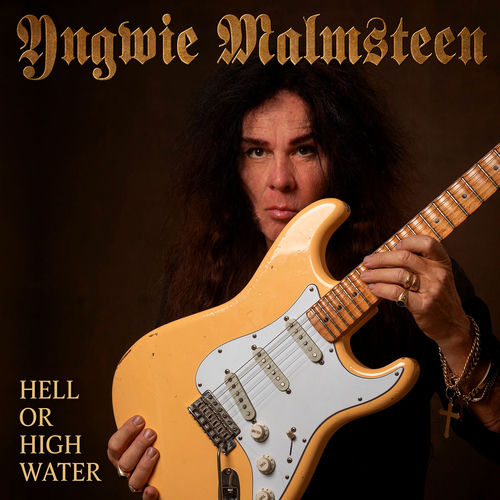
Eighty or ninety. That is roughly how many pieces Yngwie Malmsteen wrote at home across eight months for Hell or High Water, and nine is the number that made it off the bench. A luthier works the same way: a stack of spruce tops in the corner of the shop, each one tapped and listened to, most of them set aside, and only the handful that ring true carried to the bench for carving. The Swede has never been accused of leaving anything out. This time he did, and the record is better for it.
Recorded in his own studio, released through Music Theories Recordings on 13 November 2026, five years after Parabellum and a year and a half after the live set Tokyo Live, and timed at about forty-six minutes so that the whole programme fits on one vinyl LP without a note sacrificed to the lathe, this is the first studio record the guitarist has made since his father died in 2025, and it closes on a piece called "Father". He sings on four of the nine. The other five are instrumentals. That ratio says plenty about where the weight sits.
Nobody comes to this record for a surprise, and none is offered. Every bar of it is cut from the pattern the virtuoso with the scalloped fretboard has been working since the 1980s: neoclassical runs at velocities that would char the varnish off a lesser instrument, harmonic minor spirals, the pomp of a gilded concert hall where the harpsichord has been swapped for a wall of Marshalls. What has changed is the discipline. This is the most focused and best-sequenced Malmsteen record in some years, and an improvement on Parabellum, nine pieces planed and fitted so tightly that the joints hardly show.
"Now or Never", the first single, opens the case like a fanfare and lays out the tools, a song built to remind you who you are listening to before the first chorus is over. "Am Caprice / Hell or High Water" is the title piece, and its first half announces the form: a caprice, which in Malmsteen's vocabulary means a showpiece for the right hand in the line that runs back through Paganini to the violin makers of Cremona. For my money it is where he most plainly plays for himself. "(He Is) Living a Lie" is the other way in, one of the strongest songs here, and the voice on the four sung tracks does more than anyone had a right to expect from him; to my ear no one will mistake him for the singers he once hired, and the tunes survive it.
The varnish gleams exactly as it always has, and this time the wood underneath is sound.
The middle of the record is where the workshop gives way to the concert hall. "Antikythera" is compact, three minutes and fifty seconds of it, and earns its place. "Beyond Zeta Reticuli", an instrumental, at six minutes and twenty seconds the second-longest piece here and one of the record's three official videos, is where the playing climbs into the gallery and stays there. "Prestissimo in Bm / Adagio" names its own trick in its title. "(On the) Battlefield", which carries another of those official videos, and "Eye for an Eye" are sound songs that do their work and make way.
Then "Father". Seven minutes and forty seconds, the longest thing here and the last, written for the man he lost in 2025, and one of the finest things on the record. Placing it at the very end is the sequencing at its most deliberate: the last word of Hell or High Water belongs to the son, not to the showman.
Here is what holds it back, and it is not a small thing. The dialect is the old dialect. Familiarity is the price of every Malmsteen record, and the solo-driven passages here still pile run on run until the music becomes a demonstration of the hands rather than a piece of writing, a fine instrument being played to prove that it is fine. The discipline of the sequencing hides much of it. It does not hide all of it, and across the full forty-six minutes even the faithful may catch their attention drifting toward the joinery.
So: a better record than he has made in a while, built like a well-made instrument and played like one, without a single idea he had not already patented. Those who have the 1980s records on the shelf and wanted one more in the same hand will be well served, and those who walked out of the hall years ago will find nothing new enough here to bring them back in.