
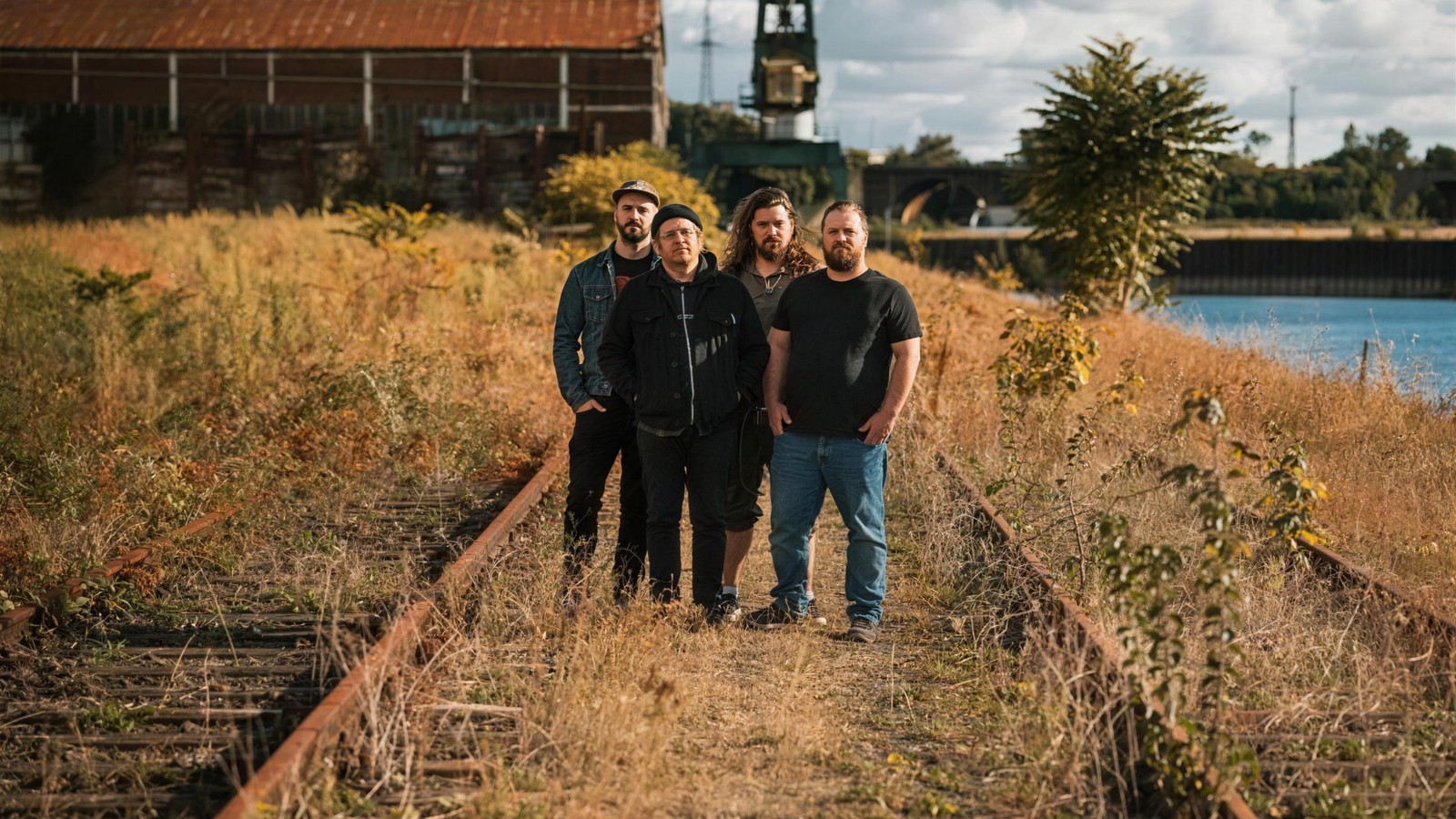
"Painfully beautiful death metal" is how Nico Mirolla summed up his band's sound to Everything Is Noise in June 2021, and it is half right. The beauty is attested on every record. The death metal part is the wrong word.
Formed in Tempe, Arizona, in 2012, a band that set out to write progressive deathcore with sci-fi elements and atmospheric breakdowns, by its guitarist's own account, and on Metal Blade by the time the label reissued its 2020 EP, the four-piece that stamped a brand new word onto its own records in 2017 is Kardashev, and the deathgaze genre starts with that word: a name one band, in its guitarist's telling, built for itself after the forums told it that it fit neither death metal nor deathcore. What the name describes is deathcore with the guitars turned into weather. The blast beats still flatten the room, the gutturals still come up from under the floorboards, and the slow parts still stomp the plywood stage into splinters. Everything around them is washed out.
Picture an all-ages hall where somebody has thumbtacked a white bedsheet across the back wall and pointed a borrowed classroom projector at it, slow clouds and grainy starfields rolling over the band through the whole set, until the first breakdown rips the sheet off its tacks and drags it into the pit, and the projector keeps right on throwing its clouds across the kick drum, the singer's back and two hundred moving heads. The picture never stops. It just lands on everybody.
That is the trick, and it is small. The map of every branch, from the orchestras to the half-time crawl, is drawn in the longer account, and deathgaze sits at its thin end: one band that named it, a handful of records that point toward it, and a border nobody has finished drawing.
What the deathgaze genre takes from shoegaze
Shoegaze, the British guitar style of the late eighties and early nineties, built its songs out of reverb, delay and long open chords stacked until the individual notes dissolve, with the voice mixed in as one more layer of the haze rather than a lead on top of it. Deathgaze takes exactly those parts and nothing else. The guitars ring instead of chugging between the hits. The clean voice floats. The heavy sections arrive inside the wash rather than after it.
Reviewers of Liminal Rite, the 2022 Metal Blade album, kept landing on the same split. Distorted Sound's Will Marshall heard shoegaze guitar motifs folded into Mark Garrett's layered vocals, a storm of blast beats opening "Silvered Shadows", and Garrett moving from soft croons to death metal roars. Wonderbox Metal heard a swing from delicate, bright shoegaze to brick-heavy brutality. Two ears, one diagnosis. The barrage and the haze are on the same tracks at the same time.
That is also where the line against the orchestras runs. In symphonic deathcore a sampled string section holds the chord in the air over the guitars, a second band standing behind the first. In deathgaze there is no second band. The guitars themselves smear into the cloud, and the drop has to come out of the same instruments that were floating a bar earlier.
In deathgaze there is no second band. The guitars themselves smear into the cloud.
And there is a difference between deathgaze and plain atmospheric deathcore, which is the wider and older shelf. Atmospheric deathcore puts pads, ambient interludes and dark texture around a song that is otherwise built the usual way. Deathgaze moves the atmosphere into the guitar part and the vocal itself. One decorates the room. The other changes what the walls are made of.
Kardashev and the word

Released on 27 October 2017 by a band that was still pitching itself on the online forums, the record that first went out under the new word was The Almanac. Mirolla told Heaviest of Art in June 2022 how it happened. People online kept saying the band was neither one thing nor the other, so he blended death metal with shoegaze, which he described as dreamy and washy, and settled it in one sentence that ended with the word itself.
"Beyond Sun and Moon" is the song the band put out with an official video from that record. The same interview names the forebears Mirolla heard in the band's early direction, Fallujah, Aegaeon and The Contortionist, and names Deafheaven as inspiration. Three deathcore-era bands and one blackgaze band. That is the recipe on one line.
The Baring of Shadows followed as an EP, put out in May 2020 and reissued by Metal Blade on 7 May 2021, and Mirolla has said that it and The Almanac are where the gaze side of the band began. Then came the second full-length, after 2015's Peripety.
Put out on 10 June 2022, eleven tracks long, Liminal Rite is the clearest single document of the style, and "Compost Grave-song" is the place to hear its deathcore spine. Metal Temple heard a punishingly slow sound with heavy accents. In a song like that the breakdown does not drop on the room, it pours: a ready-mix truck backed up to the venue's loading ramp, the chute swung out and a full load of wet concrete sliding down it over the rebar, burying the cable snake and the monitor wedges in one grey tide while the reverb hangs over the top like dust that never settles.
Then the word started to loosen its grip on its own makers. Alunea, released on 25 April 2025, is in Mirolla's words closer to progressive death metal, with the gaze surfacing only now and then, and Garrett called it a very proggy album. The band that coined the genre has spent its latest record walking toward the exit. It still owns the name.
Before the name: Fallujah and the borrowed voice
The direction existed before the word did, and the clearest early evidence comes from the Bay Area band Mirolla named first. Founded in early 2007 while its members were still in high school, and filed under deathcore in its early years, Fallujah had already signed to Unique Leader for its full-length debut, and the record after it went further.

Issued on 2 April 2013 by Unique Leader as a digital-only release, three tracks long, with "The Dead Sea", "Silent" and "Venom Upon the Blade", the EP that carried ambient sequences, clean guitars and a woman's voice into a band still swinging deathcore's hammer was Nomadic. The voice belonged to Byanca Munoz, who had sung lead in the Modesto shoegaze band Whirr until 2011. A shoegaze singer on a deathcore-era record. Four years before anybody named the result.
"Silent", the middle track, is the ambient piece, which reviewers hear as an interlude of synth and samples between two metal songs. It shows the method. A voice like Munoz's set into music this heavy is a pint glass of water set on top of the bass cabinet, every breakdown hammering rings across its surface and rattling it against the grille, and not one drop going over the rim.
Fallujah did not stay. By Dreamless on Nuclear Blast in 2016, with Tori Letzler among the guest voices on "The Void Alone", the band was filed under technical and progressive death metal, and the deathcore tag had gone. That exit is the boundary test in action. Lose the drop, and the haze sits on top of death metal instead.
The neighbours: blackgaze, heavy-gaze and atmospheric weight
The suffix itself was borrowed. Blackgaze, black metal laid over shoegaze guitars, was carried far beyond the black metal crowd by Deafheaven's Sunbather in 2013, so a genre built by sticking "gaze" onto the end of an extreme metal word was a ready template by the time Kardashev reached for one. The schism between the two is mechanical. Blackgaze keeps black metal's tremolo and shriek under the wash. Deathgaze keeps the low growl and the breakdown.
The closest neighbour sits in the same metro area. Holy Fawn, the Phoenix band whose debut Death Spells came out on 14 September 2018 and was reissued by Triple Crown in 2019, has shared a bassist with Kardashev in Alexander Rieth, and Everything Is Noise put The Almanac beside Death Spells and Lantlôs' Melting Sun as a trinity of heavy-gaze records. Holy Fawn is shoegaze and post-metal with black metal edges, not deathcore. The tensile line between the two bands is one man's bass and a lot of shared reverb.
On the other side stands the atmospheric deathcore that never gazes at all. Humanity's Last Breath, out of Helsingborg, released Välde on Unique Leader on 12 February 2021 with, in the label's words, a further emphasis on the atmospheric side of its sound, and reviewers from Angry Metal Guy to Heavy Blog Is Heavy heard the record push deeper into dark, dissonant territory. There the atmosphere is pressure, not light: the air in a sold-out basement in July with the one window painted shut, every chord pressing the crowd's shirts flat against their backs. No clean wash, no floating voice. Same word, atmospheric, opposite job.
The paper trail is thin: one band calls its own sound deathgaze, and the press that covers it mostly repeats the word. The sound is not thin.
Why a one-band genre still counts
A genre with one founder that is already drifting toward progressive death metal looks fragile on paper. The deathgaze genre is real for a plain reason all the same: the combination does something neither parent does alone. Shoegaze has the wash and no floor, and deathcore has the floor and seldom lets a chord ring out long enough to blur. Put them together and the slow, heavy section is heard against something soft enough to make its weight obvious, which is the same contrast every breakdown has always relied on, pushed to its widest setting.
So the test for any band that arrives under the name is simple. Listen for the clean, smeared guitar carrying the song rather than decorating it, and then listen for the growl and the drop underneath. Both present, it is deathgaze. Only the first, it is shoegaze or post-metal with harsh vocals. Only the second, it is atmospheric deathcore, with the atmosphere kept outside the guitars. Kardashev passed that test on The Almanac and Liminal Rite, Fallujah passed half of it on Nomadic, and the next band to pass it whole will be the one that turns a single band's word into a branch with more than one member.

