
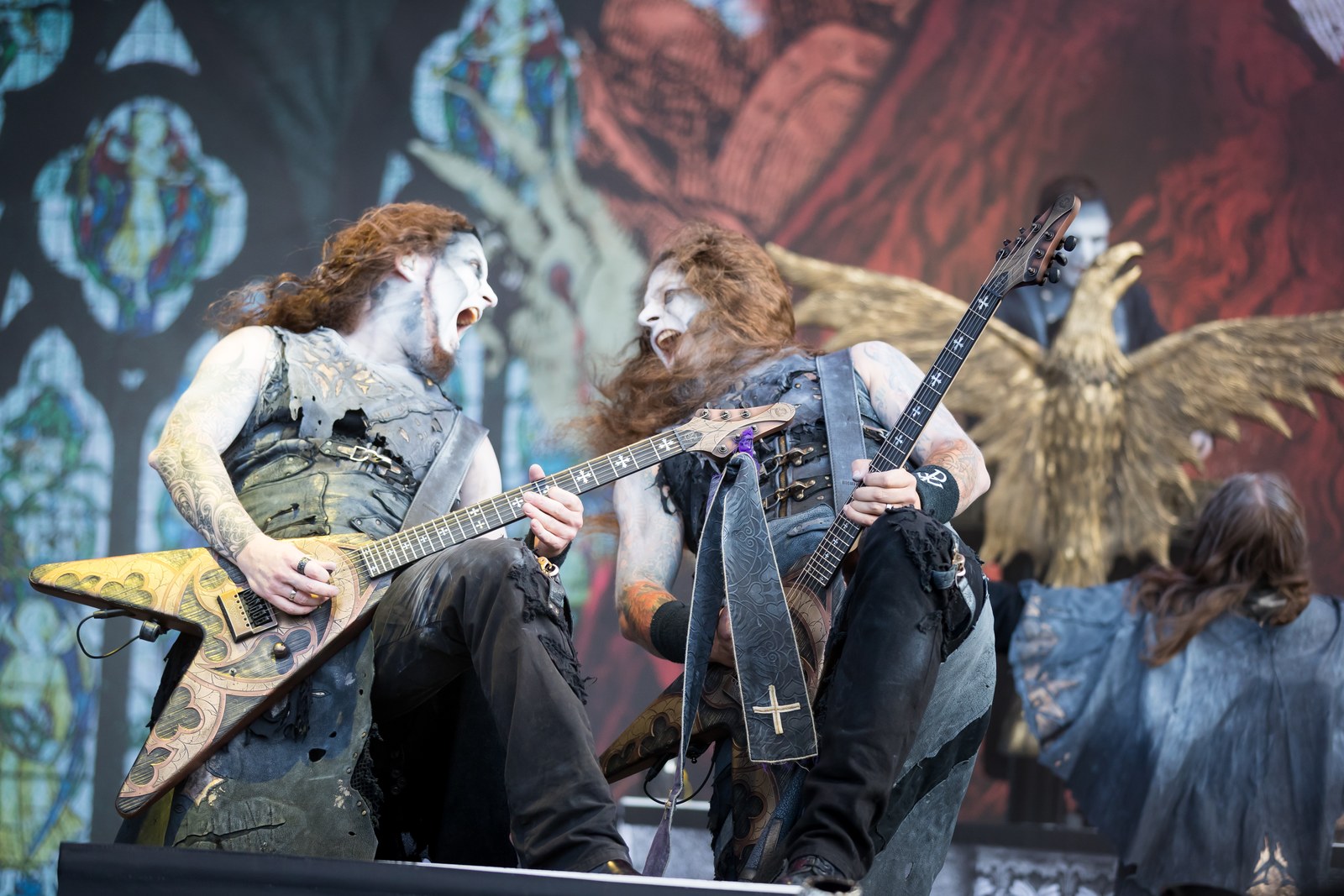
Madrid, 9 December 2017, the WiZink Centre, a tape running. The German seven-piece that walked onto that stage with three lead singers inside its own line-up, two of them taken back decades after they had left, was Helloween. The record taken off that night, two discs of it inside a three disc set out on 4 October 2019 as United Alive in Madrid, has to name a singer beside its titles, because nothing shorter would have been true: Kai Hansen takes a medley of the early songs alone, and the duets run between Michael Kiske and Andi Deris. The best power metal live albums are the only records in this genre that keep that kind of accounting. A studio album here is built in layers. A stage has one of each.
In a bunraku house one chanter speaks every part in the play, man, woman and demon. The figure he is speaking for is carried by three bodies at once: one man with the head and the right hand, one hooded man on the left hand, one hooded man on the feet, each of them serving years on a limb before anybody trusts him with a head. A fraction of disagreement between two of those hands wrenches the arm out of the figure in front of the whole house. Nothing on a multitrack has ever had to agree with anything that way: a guitar tracked on a Tuesday against a drum part cut in March, a sixth vocal line sung by a man who has not yet heard the fifth. One room, one second, one body per part is another test entirely.
The furniture of the genre makes the test worth running. A lead voice doubled and tripled, rhythm guitars tracked six deep until the riff reaches a tensile strength no two pairs of hands can match, a choir smelted out of dozens of passes of one throat, orchestration nobody on the payroll can play: the records that fixed that specification are laid out in the survey that covers it. Which of those layers a song needed is the one thing none of them can report. The studio is where the answer was manufactured.
What the credits of power metal live albums admit

The small print is where to start. The quartet whose singer had put his bass down at the end of the Imaginations tour so that he could sing what he had recorded was Blind Guardian, and the double album it issued in May 2003 as Live carries seven names: four members and three men filed as guests. Oliver Holzwarth plays bass and Michael Schueren keyboards, and both are credited with backing vocals, as are the two guitarists, which is the line that matters. The choirs on the studio records are Hansi Kuersch multiplied. On a stage a choir is however many mouths are standing there. Here it is five: four men credited with backing vocals, and Kuersch in front of them.
The arrangement is older than the compact disc. The five piece whose two guitarists had spent 1987 and 1988 building the Keeper records deeper than five men can play was Helloween again, and the Edinburgh Playhouse tape of November 1988, out across Europe in April 1989 as Live in the U.K. and in Japan as Keepers Live, hires exactly one man: Joern Ellerbrock, keyboards. Two guitars, one bass, one voice, one drummer, and every doubled part torn out of the songs before the first chord lands. Eduardo Rivadavia’s AllMusic entry gives it one and a half stars out of five. It stayed the last of its kind for thirty years, the only Helloween live record with Kiske and Hansen both on it.
The same line runs through the rest of the shelf. Gamma Ray issued Skeletons in the Closet on Sanctuary’s Metal-Is label on 25 August 2003 out of two nights in Barcelona and Strasbourg, four members and Axel Mackenrott hired for keyboards. Rhapsody Of Fire, then under a shorter name, taped the Metropolis in Montreal on 14 June 2005 for Live in Canada 2005 - The Dark Secret, five members and Dominique Leurquin hired for rhythm guitar. The exception is Stratovarius, whose Live! Visions of Europe, out on T&T on 7 July 1998, carries five men from Milan and Athens and not one session credit, the keyboard chair being on the payroll.
| Live album | Band | Year | Hired for the stage |
|---|---|---|---|
| Live in the U.K. / Keepers Live | Helloween | 1989 | Keyboards (Joern Ellerbrock) |
| Live! Visions of Europe | Stratovarius | 1998 | Nobody |
| Skeletons in the Closet | Gamma Ray | 2003 | Keyboards (Axel Mackenrott) |
| Live | Blind Guardian | 2003 | Bass, keyboards, a stand-in drummer |
| Live in Canada 2005 | Rhapsody Of Fire | 2006 | Rhythm guitar (Dominique Leurquin) |
| One Cold Winter’s Night | Kamelot | 2006 | Seven voices, three choir voices, a guitarist |
| Twilight Dementia | DragonForce | 2010 | Nobody, and a harmoniser pedal |
| The Flying Opera | Avantasia | 2011 | A rhythm section, two guitarists, six singers |
| United Alive in Madrid | Helloween | 2019 | Nobody, with three singers in the band |
What a second guitarist and a pedal are covering
A hired man is a receipt for a layer. Leurquin’s rhythm guitar on the Montreal tape is the bed under Luca Turilli’s solos, the same chair he filled on the studio album, and it wants a second body the moment a solo starts. The orchestration and the choirs of the album being toured got no body at all: five men and one extra guitarist carrying music made with an orchestra and an academy choir in the room. The songs went out with no one hired for those parts, which says what the payroll thought they needed.
The songs went out with no one hired for those parts, which says what the payroll thought they needed.

The sextet whose studio records run as many as six guitar parts at a time is DragonForce, and its double album of 13 September 2010 opens on a seven minute "Heroes of Our Time" taken off the last leg of a tour. Speaking to Total Guitar that month, Herman Li put the arithmetic plainly: with as many as six parts on the album and two players on a stage, certain things have to be adapted. Doubled solos are his own example, each man altering a technique to sit inside the other’s. A couple of parts he feeds from the keyboard into a pedal that reads the chord and adds a third above and below it, which is circuitry hired to be a layer.
The songs that cannot be put on a stage as written
Some arrangements will not reduce, and then the answer is a hiring list. The five piece that taped the Rockefeller Music Hall in Oslo on 11 February 2006 for One Cold Winter’s Night was Kamelot, and it brought eleven credited guests: seven voices, Simone Simons as Marguerite among them and Snowy Shaw credited as Mephisto beside Shagrath as the voice of Mephisto on one song, three more on choirs, and Sascha Paeth playing guitar on another. Sixteen people to stage the work of a five piece, in place of cutting the material. Avantasia is the limit of it, a studio project with no band to send anywhere, whose The Flying Opera of 2011, filmed at two festivals in 2008, lists three men as the band and everyone else as a guest.
The subtraction shows up as absence too. "Born in a Mourning Hall" closes the first disc of the Blind Guardian album and survives the move intact. What is missing is the material whose choruses want more voices than the band owns, and one Metal Archives reviewer names it: "Battlefield" and "Wait for an Answer" for the size of those choruses, "Age of False Innocence" for leaning on keyboard melodies and on both ends of Kuersch’s range, all three absent from the 856 Blind Guardian setlists fans have logged on setlist.fm. Gamma Ray went at the same problem from the other end, building its 2002 shows out of a set list its fans voted for on the internet, songs the band had rarely or never played live.
What arrives on tape, and what a band will say about it
Then there is the layer that travels. Four bars of keyboard cut to tape in a rehearsal room, loaded into the trucks and played out of a rack in every hall, identical in Helsinki and in Lisbon, arriving on the beat whether or not the man in front of it has anything left in his throat by the fortieth night, and walking over the top of him and taking the phrase off him when he has not. Sabaton was plain about its own keyboards. Announcing a touring line-up on 2 April 2012, the band wrote that it was still looking for a keyboard player, and that until one was found Daniel Myhr would be with them in digital form, having specially recorded all the keyboards for the tour. A part that cannot be asked anything is the one thing a stage never tests.
A concert record can be tidied in a studio afterwards, which is why a plain statement of what was left alone is worth quoting. Li told Total Guitar that all nineteen shows of the final leg were recorded, that every man in the band marked every song out of ten off a set list sheet, and that two numbers, "Revolution Deathsquad" and "Heart of a Dragon", were left off, the first for not sounding as alive as the rest. Overdubbing it, he said, had been available and was not wanted. A live album can look like a reliquary of one night; the Blind Guardian double album lists nineteen cities as its source.
Powerwolf built something else again. The Monumental Mass: A Cinematic Metal Event, streamed at the end of 2021 and issued through Napalm the following July, is an eighty minute production in four chapters with pyrotechnics, sets and a narrative running through it, which Jack Press at Distorted Sound reviewed on 10 July 2022 as audio carrying the band’s live force behind a more sensational visual half. It is not the tape of a night: the wolves played it to no crowd at all, and their keyboardist calls it film and theatre rather than a concert.
Which of these live albums is worth the money
Four of them. The Madrid record for its accounting, where "Invitation / Eagle Fly Free" goes to Kiske and a buyer can tell whose throat he is getting. The Blind Guardian double album, because five mouths doing the work of dozens is the plainest demonstration of what a choir layer was for. Twilight Dementia, because the band most often accused of existing only on a multitrack published the figures. Live! Visions of Europe, because five men needed nobody. A catalogue has room for releases made for other reasons, among them the power metal Christmas albums.
The test costs nothing and needs no equipment. Put the studio track on, then the concert version, and count what has gone. If the song has lost nothing, what went was weight. If the tune has gone, something in there was carrying it and nobody had noticed. And if nothing at all is missing, with six guitar parts still arriving at once out of two players, then a pedal or a hired hand is supplying the rest, and the credits are where to ask which.
