
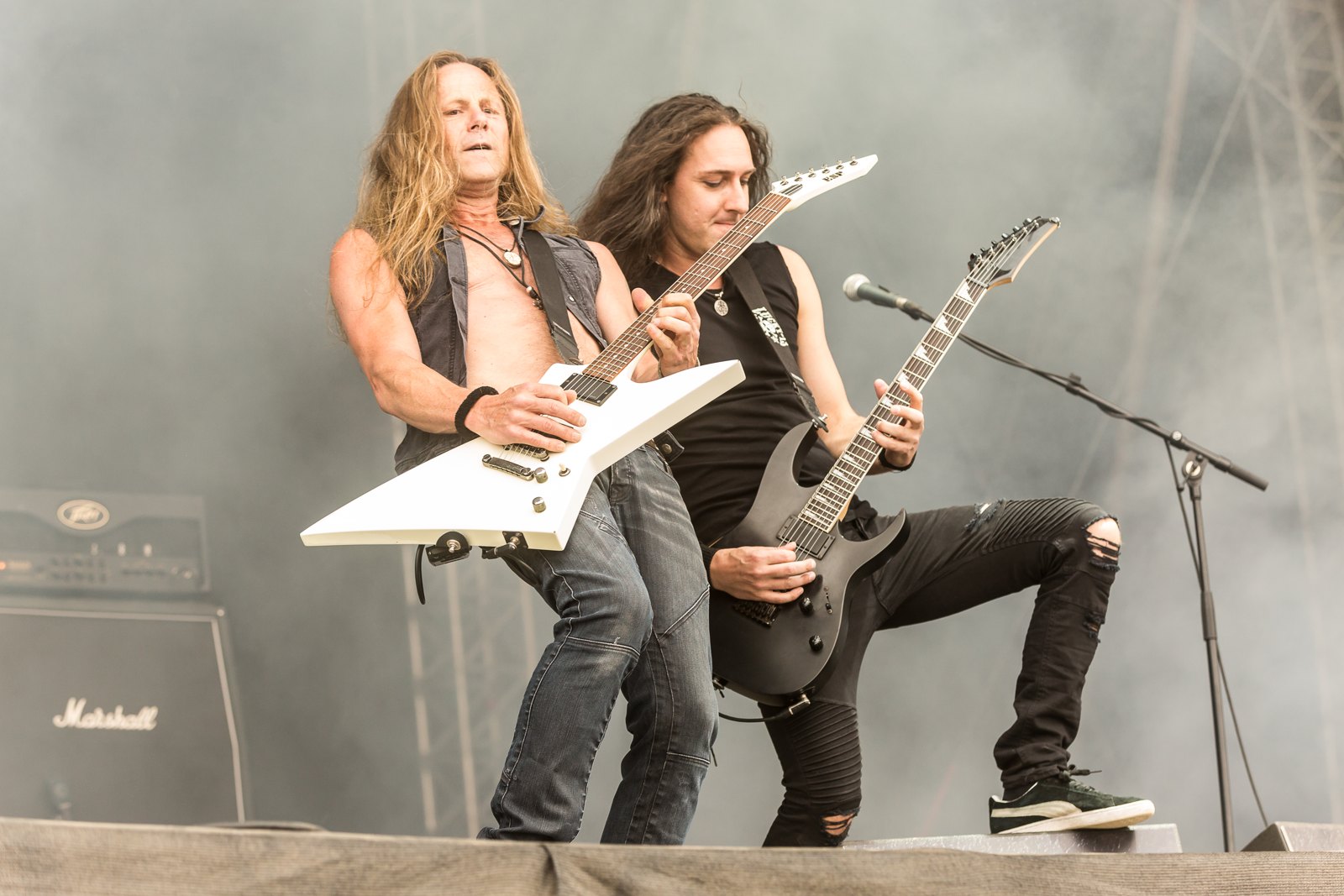
By 1998 a drummer on leave from Gamma Ray and a singer who had spent years in other men's bands were writing songs together with a goal they stated plainly, and every account of the band has repeated it since: happy metal.
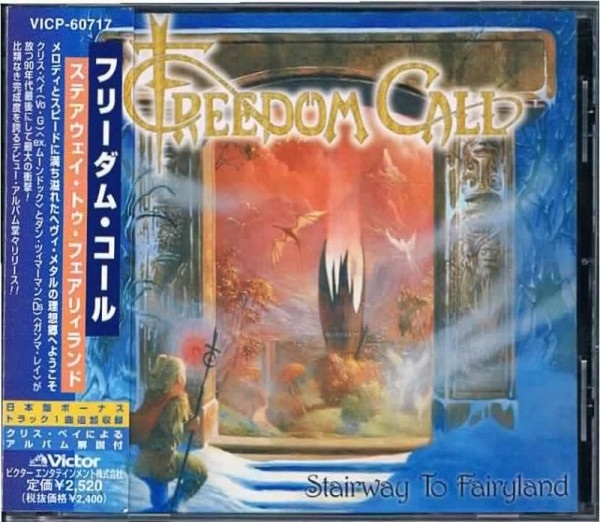
Produced by Charlie Bauerfeind, issued in the spring of 1999 and sung, played and stacked into choirs largely by its writer, who is credited with lead vocals, guitars, keyboards and the choirs, the record was Stairway to Fairyland, and the quartet that took a loaded word and wrote it into its own plans was Freedom Call. It is the cleanest exhibit for a question that sounds foolish until somebody tries to answer it, which is what melodic power metal can possibly mean in a genre that has been melodic by definition since Helloween put out the first Keeper of the Seven Keys in 1987.
The answer is not a sound. It is an order of work.
Every power metal record carries a tune. The adjective marks the strand that settles, before a single riff exists, that the tune owns the song, and then bends everything else in the arrangement until it serves that tune. Picture a carpenter's handsaw clamped between a player's knees on a kitchen chair, the teeth turned away, the steel flexed into a long S and struck with a soft mallet, so that a tool made to rip through oak gives out a wavering, singing line, every higher note paid for with a tighter curve, until one curve too many kinks the blade and it will never again run true through a plank. That is what melodic power metal does to the riff, which is the genre's cutting tool. It bends it until its first job is to sing, and it accepts the kink.
What melodic power metal writes first
The branches that grew out of the Hamburg records afterwards, the orchestras, the odd meters and the growls, make up this part of the history; the strand that stayed nearest the trunk added nothing of that kind, and it still ended up needing a name of its own. The reason is that the trunk was never one thing, and the clearest proof came out of a single band's inheritance inside two years.

Formed in 1997 by a singer who had fronted Gamma Ray's first three albums and had then been passed over as Rob Halford's replacement in Judas Priest, with a bassist from the German hard rock circuit beside him, back in the shops with a second album in 1999, the same year as the Freedom Call debut, the band that dragged the Gamma Ray tenor back to a Birmingham riff and bolted it there was Primal Fear. The record was Jaws of Death, and its credits say something: of the five players, not one is a keyboard player.
Same school, same years, opposite orders of work. On the Primal Fear records, as three Metal Archives reviewers of Jaws of Death hear them, the riff comes first and the voice is hauled up on top of it, a Priest arrangement with a Halford-like tenor at the microphone. On Stairway to Fairyland the riffs are there and one Metal Archives reviewer rates a couple of them highly, but he calls the band much more focused on vocals than on guitar, and describes choruses in which every member sings his own part until the lead voice becomes one among a gleaming group.
Every power metal record carries a tune. The adjective marks the strand that settles, before a single riff exists, that the tune owns the song.
One writer of the strand describes his own desk the same way. The Finn who sings, plays keyboards and writes for Sonata Arctica, credited on the 1999 debut with vocals, keyboards, songwriting and lyrics, is Tony Kakko, and he has described a song as starting from a feeling and a melody, with the melody as the key to everything, to the point of writing a club track with a strong tune in it, stripping out the dance production and putting rock drums and guitars underneath, as he told Blabbermouth in 2019. A riff is what gets built under a tune like that. It is seldom where the song began.
Where the keyboard took the tune
Opened by Father Time, a shade over five minutes of it, released on 22 April 1996 and recorded with a keyboard player who had spent years in the band of Yngwie Malmsteen, the Finnish quintet that ripped the melody out of the guitarist's sole keeping and handed a share of it to the keyboard was Stratovarius, and Episode is the record on which that line-up first stood together, Jens Johansson on keyboards and Jörg Michael on drums, the pair who would hold those two chairs for well over a decade. Reviewers on Metal Archives have since filed it as a classic, one of them hearing its first three tracks as riff-based melodic speed metal.
The reviewers of Episode catalogue the keyboard solos and the guitar and keyboard sprinting side by side through the instrumental Stratosphere. The point for the adjective is plainer. When the singer stops to breathe, the tune does not stop with him, because an instrument built to play a melody and its chord at the same time can take the line and keep it going until the voice comes back. The tune is never off the floor.
Three years later the singer and the keyboard player were the same man. On Ecliptica, issued by Spinefarm in 1999, Kakko holds both credits, and UnOpened, eighth of ten tracks and a shade under four minutes, comes from a band whose melody lives in the hands that also hold the microphone. Freedom Call shows the same arrangement on its debut, Chris Bay credited with keyboards beside his voice and his guitar and a second player brought in only for additional parts.
Set the three credit lists beside the Jaws of Death sleeve and the pattern stops being a matter of taste. In the melodic strand, on two of the three credit lists, the man who writes the tune has his hands on the instrument that carries it between verses. In the riff-first school the keyboard is nobody's trade.
Happy metal, German metal, melodic speed metal
The tag sits beside the polite name. Pinned on Helloween, happy metal followed the major-key choruses to every band that sang them, and Freedom Call is the sect inside the strand that picked the word up off the floor and nailed it over its own door.
The market that took these records to heart and renamed them along the way was Japan. Japanese writers first called the music German metal, meaning in practice anything that sounded like the two Keeper albums; once Stratovarius in Finland, Angra in Brazil and HammerFall in Sweden were making it, a place name no longer fitted the practitioners, and the trade tore it off the rack in favour of melodic speed metal and melodic power metal, shortened to merosupi and meropawa, with no strict line between the two. Outside Japan the same records are filed simply as power metal.
One Japanese reading pushes the distinction further and says that Helloween and Gamma Ray are the origin of melodic speed metal without quite being it, the name belonging properly to the bands that brought more classical material in after them. Whatever the merit of that, it shows the label tracking a strand and not a nation.
Names given in contempt have a way of outliving the contempt. In May 1734 an anonymous letter in the Mercure de France took the jeweller's word for a pearl that will not grow round, the lump sorted out of the tray and sold off cheap, and threw it like a fistful of gravel at the score of Rameau's first opera, Hippolyte et Aricie, premiered the previous October, for harmony that broke its melody apart; by the twentieth century the same reject's word had been consecrated as the neutral name of the Baroque age, with no insult left in it and nobody alive who remembered that it had been one.
The charge in 1734 was too little tune. The charge against happy metal is too much. Melodic is the kind of word a sneer can turn into once the people who meant it have stopped listening, and Freedom Call skipped the wait.
What the adjective costs a band
An order of work has a price, and the strand pays it in one currency. When the tune owns the song and everything else exists to deliver it, a weak tune leaves nothing standing behind it, no riff heavy enough to hold the track up on its own and no darkness to hide in.
The readers of Stairway to Fairyland show where the bill arrives. One Metal Archives reviewer ranks it among the great power metal albums of the late nineties, and the same review singles out We Are One as the song to avoid, a cheap copy of Helloween's I Want Out. That is the charge tune-first writing invites. A tune too close to its model collapses the whole track, because little else in the track was meant to stand.
A riff-first song with an ordinary chorus fails more quietly. Its rhythm guitar is still there doing the work it was written to do, and the listener who came for the riff goes home with it. The melodic strand gives up that safety in exchange for the moment when the tune is right, and the records of the strand that have lasted, Episode and Ecliptica among them, are the ones where the trade came off.
So the adjective is not redundant. Inside a genre where every band carries a tune, melodic power metal names the bands that write the tune before anything else, hand it to a keyboard when the voice stops, and let the song stand or fall on it: Stratovarius from 1996, Sonata Arctica and Freedom Call from 1999, and the Helloween records all three come down from. Happy metal points at the same records from further away, with a curled lip.
Take the fairy tale further than Freedom Call ever did and a narrower label takes over at the sugared extreme, which is what is flower metal, a question answered by how far a band is prepared to go rather than by what it writes first.
