
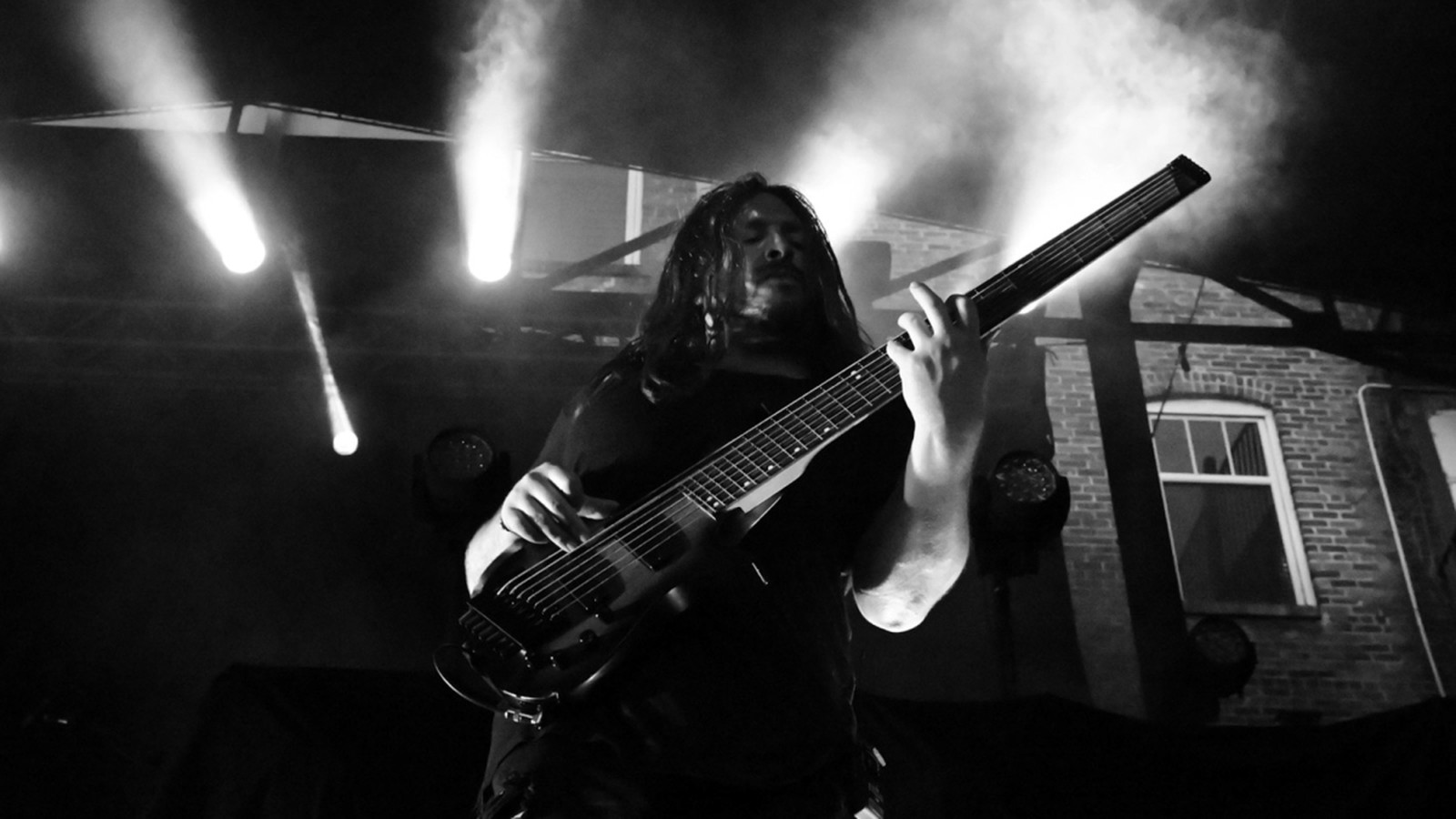
On 25 October 2019 Nuclear Blast released The Sea of Tragic Beasts, and the song that opens it went into a chorus the reviewer at Exclaim! heard as metalcore.
Formed in New Jersey in 2008, produced by its own guitarist, Will Putney, and five albums into a catalogue built on the breakdown by that autumn, the band that ripped open the middle of its own opening song and smashed a gap in the wall of downtuned guitars wide enough for a gritty metalcore chorus to climb through, a chorus Joe Smith-Engelhardt set beside Architects in his review on release day, was Fit for an Autopsy. That review gave the record 8 out of 10 and took the choruses as proof that deathcore could still change.
Deathcore clean vocals have started louder fights than that one, and most of them were fought as if the question were taste. It is not. The quarrel is about pitch, not polish, and the grit on that chorus changes nothing about the mechanics, because a melody carried through gravel still lands on notes, and a note asks the rest of the band for something a growl never asks for.
Deathcore clean vocals and the note they need
Start with what the low and the high actually do. A guttural and a scream are noise shaped by rhythm: they hit, they tear, they ride the kick drum, and neither settles on a pitch long enough for the ear to hear a tune in it. The growl and the scream divide the throat between weight and speed, a split laid out in the account that frames it, and neither half of that split makes a single demand on the guitars. That freedom is the design. The guitarists can carry the whole onslaught on the open low string for sixteen bars, stab a chromatic note against it, drop out and slam back in, and the voice on top never clashes with any of it, because there is nothing in the voice to clash with.
A sung line ends that freedom on its first held syllable. The moment a voice sits on a note, the ear wants to know what the note is standing on, and an open string pounded in sixteenths gives a poor answer: hold a pitch over it for a bar and the melody either floats over nothing or grinds against the riff in a way nobody chose. So the guitars move. They leave the open string for chords, the chords start changing under the tune, the song takes on a key it never had to declare, and the passage that sounds like a band easing off is very often the guitars playing a chord progression for the first time in the song. The voice is the part that gets blamed. The riff is the part that changed.
Picture the band's fifteen-passenger van with a manual gearbox and a clutch worn down to the carpet. A breakdown is that van floored in first across a muddy festival field, the engine howling on one pitch and the tyres hurling turf over the trailer behind it. A clean chorus makes the driver shift, second, third, fourth, every change grinding teeth off the synchros and throwing the whole load forward against its straps, until the drop comes and he slams it back into first so hard the lever tears out of its rubber boot. Same van. Different road. The gears are the harmony, and the singer is the one asking for them.
The voice is the part that gets blamed. The riff is the part that changed.
Who sang, and when
The records keep the dates. Clean singing came into deathcore one band at a time and almost never at the start: in each of the six cases it arrived on a third, fourth, fifth or sixth album, after the band had already shown it could fill a record without a single sung note.
| Year | Band, record | Label, release date | Where the singing sits |
|---|---|---|---|
| 2008 | All Shall Perish, Awaken the Dreamers | Nuclear Blast, 5 September 2008 | The title track and "Memories of a Glass Sanctuary" |
| 2015 | Veil of Maya, Matriarch | Sumerian, 12 May 2015 | A new singer, Lukas Magyar; the growl gives way to screaming |
| 2016 | Whitechapel, Mark of the Blade | Metal Blade, 24 June 2016 | "Bring Me Home" and "Decennium", Phil Bozeman's first clean vocals |
| 2017 | Suicide Silence, Suicide Silence | Nuclear Blast, 24 February 2017 | Announced in December 2016 as mostly clean |
| 2018 | Bleed from Within, Era | Century Media, 6 April 2018 | A rhythm guitarist, Steven Jones, on a couple of songs |
| 2019 | Fit for an Autopsy, The Sea of Tragic Beasts | Nuclear Blast, 25 October 2019 | Metalcore-style choruses, starting with the title track |
The Chicago band that paid for its singing with its lowest register was Veil of Maya. Announced on 23 March 2015 together with its single "Mikasa", Matriarch was the band's first album with clean vocals and its first with Lukas Magyar at the microphone, and the singing did not move in beside the old guttural: it took the guttural's bars, with the harsh parts now screamed rather than growled. The arithmetic is plain. A song has only so many bars and the middle of a mix has only so much room, and a voice that needs both for a tune takes them from somebody. On Matriarch it took them from the bottom of the range, and the reception among the band's own listeners was mixed.

Glasgow solved the harmony problem with a single body. Formed in 2005, four albums deep by the spring of 2018 and fronted by Scott Kennedy's harsh voice, the band that gave its clean parts to the man already holding the rhythm guitar was Bleed from Within, and Era, released by Century Media on 6 April 2018, was the first record with Steven Jones in that double job. Reviewers found the singing on only a couple of its songs. The arrangement settles the harmony problem mechanically: the hand that chooses the chord and the throat that chooses the note belong to one person, so the melody can never float off the riff, because the same body is fretting the floor it stands on.
What a chorus spends before the drop
A deathcore song stores tension and spends it in one place. The blast, the riff and the build all pull the same way, like the bungee cords lashed over a tarp on an open trailer, each one stretched another hook further on every bar of the build, until the breakdown lets go and the hooks whip across the load hard enough to crack the corner of a speaker cabinet. A sung chorus unhooks one of those cords halfway down the highway. A melody comes home to its key, and a song that has already come home once gives the listener a landing before the breakdown has landed.
That is the schism, and it runs along a mechanical seam. One side hears the drop arriving on a body that has already exhaled, the weight hammered flat by the relief that came before it. The other side reads the same mechanism the other way round: a bar is heavier after a quiet one, a low string hits harder after a chord has been ringing above it, and a song that rises for eight bars has further to fall. Both descriptions are true of the same song. Which one a listener feels depends on whether the chorus or the drop is the thing that listener came for, and no review has ever argued anybody out of that.
The size of the dose matters as much as the dose. On three of those six records the singing is confined to a song or two and the albums around it keep their low end; on Matriarch it became a major part of the record, and on the Suicide Silence album, which the band said before release would be mostly clean, it became the main voice. A chorus that comes back three times in one song, each time on chords and each time taking bars that a breakdown used to own, is a different proposition, because by the third return the song has been rebuilt around the tune rather than around the drop.
Where the singing stands by 2026
The bridgehead held for the bands that built it slowly. Fit for an Autopsy followed The Sea of Tragic Beasts with Oh What the Future Holds on 14 January 2022 and The Nothing That Is on 25 October 2024, both on Nuclear Blast, and Bleed from Within put out Zenith on the same label on 4 April 2025, with Jones still singing from behind his guitar. In both bands the singing stayed after the first record that carried it. Neither went back to a catalogue without it.
The other quarrel over the singer runs the opposite way. It is the doubter's quarrel, settled with cameras and single takes rather than chords, and whether the growl and the scream survive that test is the question of are deathcore vocals real. A clean voice never has to sit it.
Deathcore clean vocals were never a matter of a nice voice or an ugly one. A pitched line asks the guitars for chords, the chords give the song a key, and the key gives the listener somewhere to rest before the drop. Some bands decided that rest was worth paying for and kept paying. Others decided the drop needed all of the tension and took the singing back out. The argument between them is about where a song should put its weight, and it is decided one chorus at a time.
