
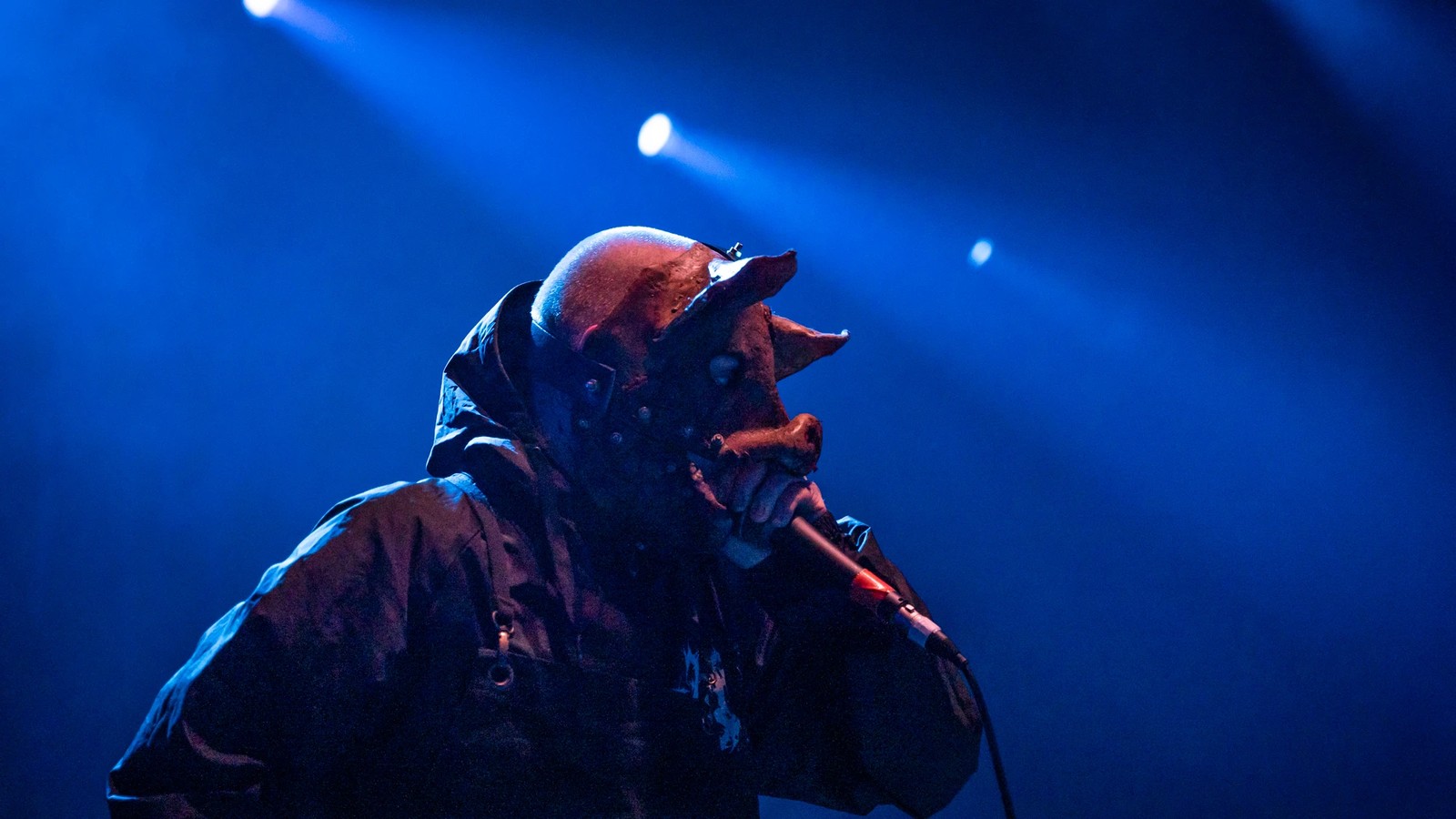
"Pig squeal" vocals, drum machine drops and flat-brimmed hats, Max Heilman wrote in Riff Magazine on 15 November 2019, were "scene hallmarks at this point". He filed the sound beside a hat. Wrong drawer. A hat comes off at the door, and the pig squeal is the noise that tells you, before a single riff has registered, which genre just ripped the room open.
Formed in Montreal in 2002, signed to Century Media for The Ills of Modern Man in 2007, split in April 2010 and back by 2014, the band whose squeals one critic had declared gone a decade earlier, and whose Purgatory on Nuclear Blast put the noise back on a deathcore sleeve in 2019, was Despised Icon. The squeal had left. Then it came back. That round trip says more about what the sound does than any definition.
Picture the security guard at the barricade of an all-ages show, the one who spends the set confiscating water bottles off the front row. Between bands he crushes a half-full two-liter bottle of soda in one fist, and the plastic shrieks, the cap blows off and the last of the cola spits out of the neck in one fizzing, choking burst, high and wet and over in less than a second, a noise nobody in the room could mistake for anything else. That is the pig squeal. The shriek of the plastic is the pitch, the spit of soda is the wet edge riding on it, and the timing is the whole trick: it goes off once, hard, and the band comes down behind it.
It is one of four sounds at the bottom and the strange edge of the range, and all four are part of what deathcore singers do when the voice has to carry a breakdown instead of a tune: the pig squeal, the guttural, the gurgle and the tunnel throat. Only the first one is high. The guttural and the gurgle live in the cellar, and the tunnel throat is a shape that either a low or a scream can take.
What are pig squeals?
Heard as sound, a pig squeal is a short, high burst of noise with a gurgle running through it, closer to the animal in its name than to a scream, made by some singers on the inhale and by others on the exhale and recognisable either way. It has a pitch, but nobody hums it. The wetness is the point. A fry scream tears dry; a squeal rattles, as though the voice were being forced through something liquid on its way out, and that rattle is why fans file it with the low sounds even though it sits up high.
Singers do not hold it. A squeal lasts a beat or two, rarely longer, and it lands where a drummer would put a cymbal accent: on the off-beat of a breakdown, at the tail of a line, in the hole before the drop. That makes it the most percussive thing a deathcore voice does. It cuts into the rhythm instead of carrying words, which means a band can take it out of the song and the song still stands.
The Montreal records prove it. Reviewing Day of Mourning for Teeth of the Divine on 28 September 2009, Erik T heard a formula and a delivery barely changed from The Ills of Modern Man two years earlier, with one thing missing: the pig squeals had gone. The breakdowns still landed. The two singers, Steve Marois and Alex Erian, were still splitting the low and the high between them. What left with the squeal was a layer of punctuation, and the band could afford to lose it because nothing structural hung from it.
Ten years later the punctuation was wanted again. "Snake in the Grass", which Nuclear Blast released with an official video ahead of Purgatory, was headlined by Alternative Press as a "pig squeal worshipping" new track, and Heilman heard Marois still able to jump from guttural lows to high shrieks in an instant across the album, with Erian's midrange barks as gruff as ever. Same band, same two throats, one hit put back in the bar. That is how you know it is punctuation: the song stood without it, and the song reads sharper with it.
Gutturals in metal: what the word means
Guttural comes from the Latin guttur, the throat, and in plain English it covers any sound made deep in it. Metal narrowed the word. Look up the gutturals meaning in any deathcore comment section and you get the lowest harsh register a singer owns: a roar pitched under the ordinary growl, dark, wide and close to toneless, every vowel worn down to one shape and the consonants ground off the ends of the words. A growl taken further down the stairs.
The growl itself is death metal's, and how the death metal growl works is a story that belongs to that genre and its first throats. Deathcore took the growl as found and kept digging under it. The voice researchers say the digging happens somewhere most listeners never picture. Speaking to Science Friday on 25 April 2025, Amanda Stark, a speech pathologist and voice researcher at the University of Utah, described a lot more activation of the supraglottic structures, the tissue and muscle sitting above the true vocal folds, in the metal singers her team scanned.
Heard in a room, a guttural is the band van idling at the pumps of an all-night gas station after its muffler got ripped off on a curb two towns back: a low, ragged, toneless roar that rattles the side mirrors, bounces off the steel canopy and shakes the price sign on its pole, with no note anyone could whistle and nothing to hold on to except the weight of it. Put that under a breakdown and the breakdown gets heavier without getting any slower. It is hauled up, not sung.
Most singers who own one of these sounds own the other. The Sydney singer whom Georgia Haskins of Wall of Sound, writing on 15 February 2025 about "Forced Diet Reassignment", heard delivering "moist and throaty pig squeals" beside bellowing gutturals is Dane Evans of To the Grave, and Unique Leader put the song out with an official visualizer. Moist is the exact word. The squeal and the guttural share that wet edge where the scream's high is dry, the same raw material cut off at a different height.
Gurgles, the wet end of the low
A gurgle is a guttural with water in it. The low register is still there, but a rattle runs right through the middle of it, a bubbling, choking texture that breaks the roar into pieces, as though the sound were being hauled up through liquid. A plain guttural is a wall. A gurgle is a wall with something moving behind it.
Picture the five-gallon water jug on the side-stage cooler at a summer basement show, the moment a toppled cymbal stand punches a hole in its side: water hammering out through the split, air gulping back in through the same hole, the whole jug glugging and choking in deep, uneven pulses until it runs dry. That is the gurgle. The low is the water's weight, the choke is the air fighting it, and the uneven pulse is what stops a long low note from sounding held.
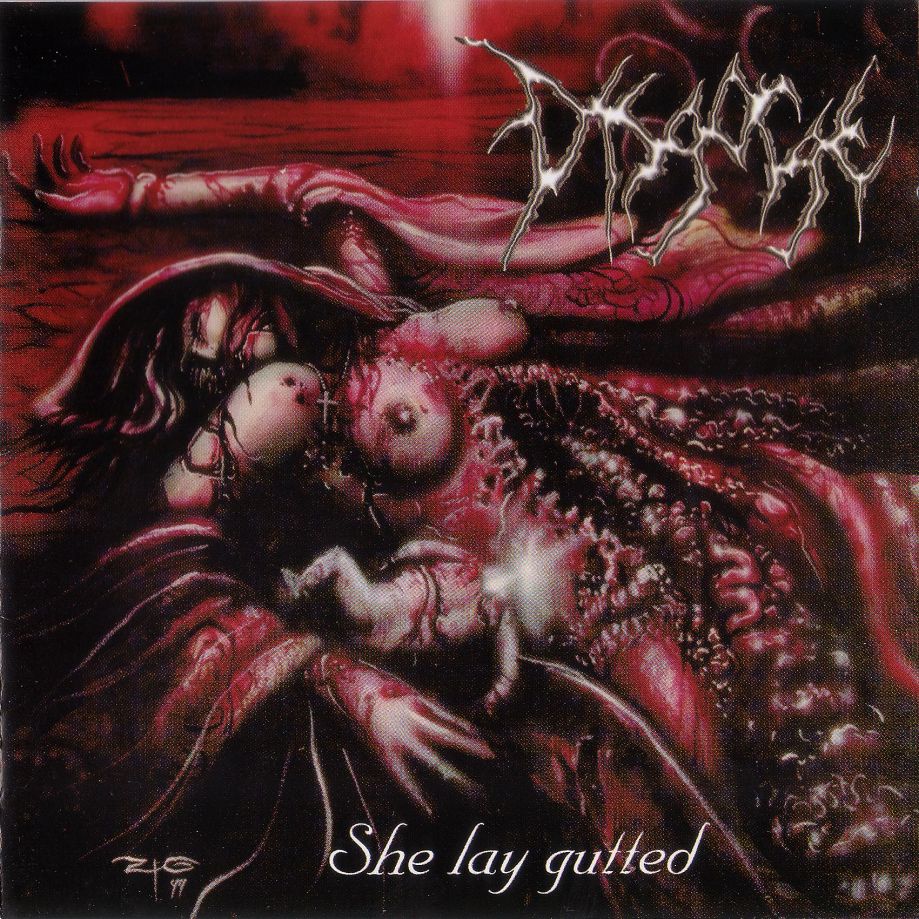
The gurgle is older than deathcore, and its natural habitat is the brutal death metal underground. Released by Unique Leader on 9 November 1999 with Matti Way among the band's vocalists, the record that stands for that underground is She Lay Gutted, by the San Diego band Disgorge. Brutal death metal was the home of the low, wet end of the voice before deathcore had a name. Deathcore borrowed it the way it borrowed the blast beat, whole, and found a different place to put it.
That place is the slowdown. On 8 May 2026, the day Metal Blade released Denigration by Ingested, Katarina McGinn of Dead Rhetoric singled out the oppressive slowdowns of "Oaths Betrayed", the Manchester band's late-album cut, and the low gurgled vocals riding through them. There is the placement in one line. Played at full speed a gurgle blurs into the guitars and reads as plain growl; laid across a slowdown, with air between the hits, every bubble in it gets heard, and the slow part sounds as if it were chewing the marrow out of the riff.
A gurgle is a guttural with water in it.
Tunnel throat, and why it sounds bigger
Tunnel throat is the least known of the four names and the easiest to hear once somebody points at it. It is less a separate sound than a way of shaping one: a low, or a scream, given a rounder, booming resonance, as though the space around the voice had suddenly grown. The pitch hardly moves. The size does.
The singer who gave the term its plainest public description is Mark Garrett of Kardashev, a vocal coach as well as the band's frontman, who told Science Friday on 25 April 2025 that the shape of the mouth and tongue behind a scream, a common habit in the metal vocal world, is called tunnel throat, and that it changes the sound of the voice. The scream underneath stays the same scream. What changes is the room it comes out of.
It works like a traffic cone ripped off a roadworks barrier on the walk to the venue and bellowed through in the parking lot after the show. The voice going into the narrow end is the same voice; what comes out of the wide end is bigger, rounder and booming off the sides of the parked vans, and the cone adds no note of its own. A guitarist would call that a filter. The source stays put and the cabinet changes.
Kardashev's own catalogue is the obvious place to listen for it, and "Snow-Sleep", the second track of the 2020 EP The Baring of Shadows, which Metal Blade put out with an official video in March 2021, puts Garrett's voice inside the band's own setting, the deathgaze sound Kardashev are known for pioneering, where a widened low has the most room to ring. In a genre whose singers keep stacking choirs and orchestras behind them, a resonance that makes one throat sound like a room is a practical tool. It buys size without buying volume.
From slam to deathcore: where the sounds came from and what they do
Dredged out of the brutal death metal and slam underground of the 1990s, where records like She Lay Gutted were being made, carried into hardcore-shaped songs by bands with a foot in each world, and pushed out profile page by profile page in the middle of the following decade, these sounds met their teenage audience on the late 2005 EP that dropped the squeal into a breakdown, Doom, by Job for a Cowboy. The parts were older than the genre. Deathcore supplied the place to put them.
That transfer is how the deathcore history runs from one end to the other: death metal hands over the raw material, hardcore hands over the song shape, and the vocal kit is assembled at the joint. The low sounds came over almost unchanged. What changed was the job each one was given once a breakdown sat at the end of the song.
Laid out by job, the kit is simple. The guttural carries weight, and it takes the breakdown, the bar where the whole band drops onto one note and the voice drops with it. The squeal is percussion, a single hit on the off-beat or in the gap before the drop, where the room is waiting for a signal. The gurgle is texture, the low with movement inside it, and it earns its keep on the slowdowns, where there is space to hear it bubble. Tunnel throat is size. None of them carries a tune. None of them is there to deliver a word, either, which is why the lyric sheet exists.
The guttural and the gurgle were at home in the death metal underground before deathcore had a name. What the younger genre did was put all four in one throat and point them at the same moment in the song, so that a single singer could maul a breakdown from underneath and punctuate it from the side within the same bar. Death metal used these sounds to fill a song. Deathcore uses them to aim it.
The rest of the range sits at the opposite end, where fry and false chord take over and the voice tears instead of rumbles, and the highs work under different rules. Down here the rule is short. A low sound in deathcore is judged by where it lands, not by how low it goes, and a squeal or a gurgle dropped into the wrong bar lands on nothing and does no work.

