
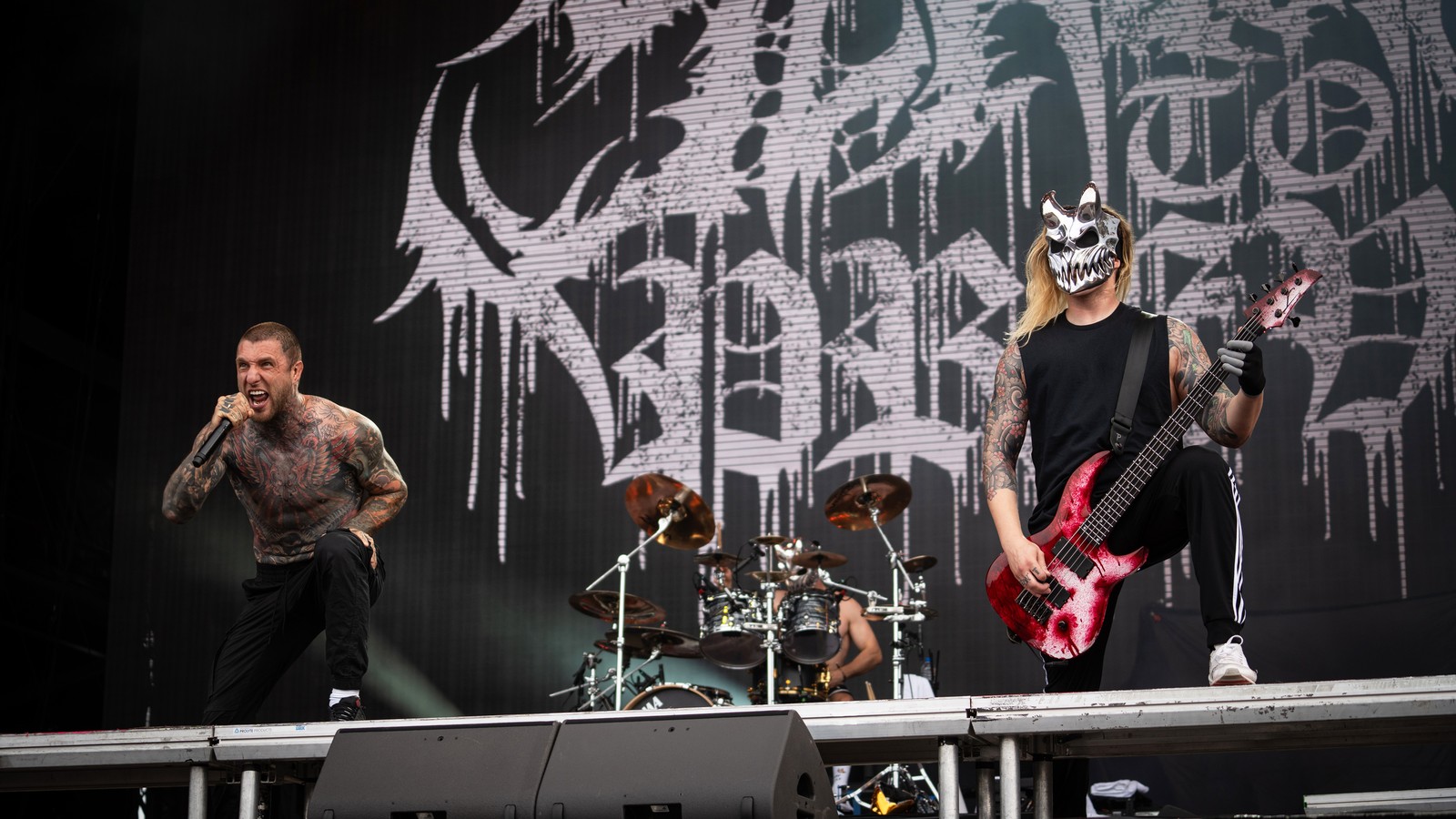
"Violent and suicidal propaganda." That, Jack Simmons told Revolver in 2021, was the reason given when his band had an event cancelled in Russia, and the phrase gets the music backwards. What a room takes from the best Russian deathcore bands is not a message. It is the low end of the guitars and the count of the drums.
Formed in Yekaterinburg in 2014, signed to Sumerian two years later and carried out of the Urals on a groove that drags the breakdown sideways into a nu metal bounce before it slams the whole thing through the floorboards, the band whose guitarist said those words, and the one Russian name the rest of the deathcore world already knows by heart, is Slaughter to Prevail.
It is not the only one. It is only the loudest.
Behind it stands a scene of bands spread across a country of eleven time zones, from St Petersburg on the Baltic to Surgut in western Siberia, most of them unsigned, many of them on hold, and a handful that shaped the export without ever leaving the country. Where Russia sits beside Montreal, Durban and the rest is laid out on the map of the scenes.
Slaughter to Prevail and the Moscow tapes
Start with the room. Picture the cloakroom rail of a club in midwinter, two hundred parkas hung on it at the door, and the groove hitting the floor so hard that the rail starts to swing in time, sheepskin and wet down rocking on their hooks, until on the drop the brackets rip clean out of the plaster and a quarter ton of winter coats crashes onto the tiles on the beat. That is the Yekaterinburg method. The bounce loads the weight. The breakdown takes the wall with it.
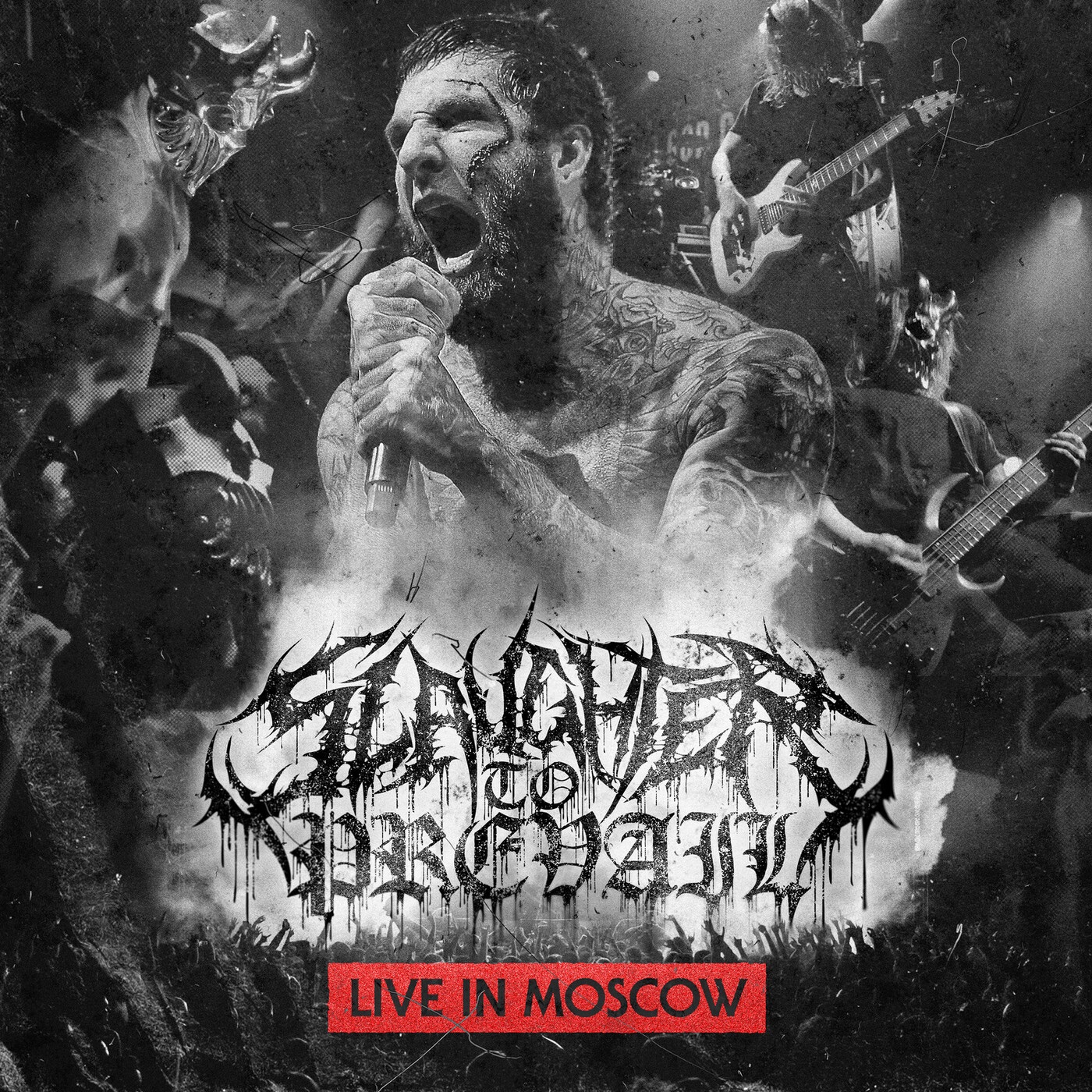
The proof is on tape. Released by Sumerian on 30 June 2023 and taken from a sold-out show at the club 1930 in Moscow on 15 December 2021, the record that caught the band in front of a Russian crowd is Live in Moscow, twelve tracks with "Demolisher", "Baba Yaga", "Bonebreaker", "Bratva" and "Agony" among them. The crowd is part of the evidence.
The personnel tell the other half of the story, and they are why the smaller bands of the scene matter. The drum stool went in 2018 to Evgeny Novikov from Katalepsy, the Moscow slam band that had been on the American label Unique Leader since Autopsychosis in 2013. The bass went to Mikhail Petrov, who had founded a St Petersburg deathcore band of his own in 2007. And the band had come in part out of We Are Obscurity, an earlier Yekaterinburg band with Aleksandr Shikolai, Alex Terrible on stage, at the microphone, and Dmitry Mamedov, who plays rhythm guitar in Slaughter to Prevail today, played in it too. Slaughter to Prevail is a Russian deathcore band built largely out of other Russian bands. That is the first reason it leads.
The second reason is where the band now stands. In 2022 it set up in Orlando, Florida. In January 2025 Shikolai told the Yekaterinburg news site URA.RU that he would not say he had moved to the United States outright, that he was working there on a visa that ran to August 2025, and that the band had last played his home city in 2020 or 2021. "Russian Grizzly in America", released as a single on 23 April 2025 and placed on Grizzly that July, carries the situation in its title.
St Petersburg: My Autumn, the band that lent a drummer to Paris
Formed in St Petersburg in 2007 by Mikhail Petrov, out with The Lost Meridian in 2009 and Oblivion Era in 2011, the band that built a bridgehead for Russian deathcore in the European clubs years before anyone in Yekaterinburg had a contract was My Autumn. It met the French band Betraying the Martyrs at a show in Belgium around 2009, and the two bands toured Europe together two years later and went on into Russia and Ukraine.
Slaughter to Prevail is a Russian deathcore band built largely out of other Russian bands.
That friendship moved a player across the continent. On 4 June 2012 Lambgoat ran the French band's announcement that Mark Mironov, My Autumn's drummer, had replaced Antoine Salin, and the statement said Mironov had left his country to live and play with them. On 27 July 2016 the same band announced that Mironov had left because of ongoing visa issues tied to his Russian citizenship, and that the difficulties had weighed on it both in consistency and financially. Boris Le Gal took the stool.
"Faceless", which the band put up on its own channel as an official video in June 2013, came out of the years when the St Petersburg band was booking its own European runs, three of them between 2009 and 2011. A band that sends its drummer to Paris and its founder into the bass chair of the most famous Russian deathcore band of all has done more for the scene than most bands with a bigger catalogue.
Moscow: Sumatra, Ease of Disgust and The Hearth of Discordia
Moscow produced the fast end. Formed in the capital in 2005, out with The Sixth Circle EP in 2008 and the full-length Heliocratic Infinity in 2009, silent from 2012 and back in 2020 with a run of singles carrying Russian titles such as "Skazki", fairy tales, before switching to English for "Cursed Night" in 2023 and "Awakening" in 2024, the band that filed Russian deathcore under the technical heading earliest is Sumatra. The date is the reason: the band began within three years of Despised Icon in Montreal and Suicide Silence in Riverside.
Watch a band like that before a set and see the guitarist chuck a string winder into a cordless drill to restring in the green room, the new low string spun onto the post in two seconds flat, the motor screaming, and the whole job ending when the string whips off at the ball end and cracks against the wall. Technical deathcore runs on the same motor. Everything spins at full speed until the breakdown snaps it.
Formed in Moscow in 2008, on record with The Shell EP in 2009 and two full-lengths, Chaos in 2010 and Black Flame in 2014, the band that kept the breakdown on a short leash is Ease of Disgust. One reviewer on Metal Archives counted no more than one breakdown per song on Chaos and heard the drummer tear through "Disincarnate" at a speed that startled him. The band's last single, "Two Years of Silence", came out in 2017, and it has been on hold since. It earns its place by restraint, one breakdown a song, each one a single salvo where other bands fire a barrage.
The younger generation is still unsigned. Formed in Moscow in 2016, with the Threshold of Horrors EP in 2021, The Hearth of Discordia shows that the capital did not stop producing deathcore bands when the country's most famous one set up in Florida. The line of descent did not break with the export. It kept going in rehearsal rooms.
Yaroslavl, Surgut and the slam neighbour
Yaroslavl, a few hours north-east of Moscow by road, gave the scene its hardcore conscience. Formed there in 2008, signed today to Gigawatt Music, writing about straight edge, inner struggle and freedom, and out with a full-length in Russian, Istina v tebe, the truth is in you, in 2009 before Apotheosis in 2015 and Realms of the Void in 2023, the band that kept deathcore's hardcore roots in its lyric sheet is Under the Scythe. Straight edge is the creed deathcore inherited from the hardcore side and mostly let lapse. Yaroslavl remembered.
"Xenoforms", released as a single on 22 December 2021 with a video on the band's own channel, comes from the stretch when Under the Scythe was filing itself as technical death metal and deathcore at once, and it turned up again as the sixth track of Realms of the Void two years later. If Slaughter to Prevail is all you know of Russian deathcore, start with this clip. It is the furthest thing from a bounce.
Further out the scene thins, and the thin end is where it is easiest to measure how far the music had travelled. Formed in 2006 in Surgut, an oil city in the Khanty-Mansi region of western Siberia, active until 2015 and on record with the Waiting to Exhale EP in 2009 and the full-length Dominion in 2011, the band that hauled the breakdown more than two thousand kilometres east of Moscow was One More Victim. A deathcore band in Surgut in 2006 says the music outran every tour that might have carried it there.
| Band | City | Formed | Record to hear | Why it counts |
|---|---|---|---|---|
| Slaughter to Prevail | Yekaterinburg | 2014 | Live in Moscow (2023) | The export, built from local bands |
| My Autumn | St Petersburg | 2007 | Oblivion Era (2011) | Early European tours; sent a drummer to Paris |
| Sumatra | Moscow | 2005 | Heliocratic Infinity (2009) | The earliest technical deathcore |
| Ease of Disgust | Moscow | 2008 | Chaos (2010) | The breakdown kept on a short leash |
| Under the Scythe | Yaroslavl | 2008 | Realms of the Void (2023) | Straight edge in the lyric sheet |
| One More Victim | Surgut | 2006 | Dominion (2011) | Deathcore in western Siberia |
| The Hearth of Discordia | Moscow | 2016 | Threshold of Horrors (2021) | The unsigned generation |
| Katalepsy | Moscow | 2003 | Autopsychosis (2013) | The slam neighbour that gave a drummer |
Katalepsy stands beside the deathcore bands as a neighbour rather than a member. Formed in Moscow in 2003, it plays slam and brutal death metal, not deathcore, and it counts for one transfer. In 2018 a drummer trained on slam tempos came over from a Moscow brutal death band to the biggest Russian deathcore band, and the credits of its third album, Grizzly, put him on the kit.
What the Russian bands share
Read the bands side by side and three things stand out. They write in two languages, Russian for the home crowd and English for the rest, and sometimes switch between records. They pass players between them, so that one export carries players from at least three local bands under one name. The paperwork is on the record too: a drummer lost to visa trouble in 2016, a singer on a work visa in January 2025, a show cancelled at home and reported in 2021. None of that is in the music. It shows in who stood on the stage, where the band lived and which cities it could play.
The genre came to Russia second hand, and its bands answered by building a family tree tighter than most. How the music got from the American clubs of the early 2000s to Yekaterinburg is the KaosMetal story of deathcore, and Slaughter to Prevail is one of the reasons that story now runs past the American coasts.
The question of what an exporting band leaves behind is asked again in Australian deathcore, where the band that broke out came out of Blacktown and the roster around it never left.

