
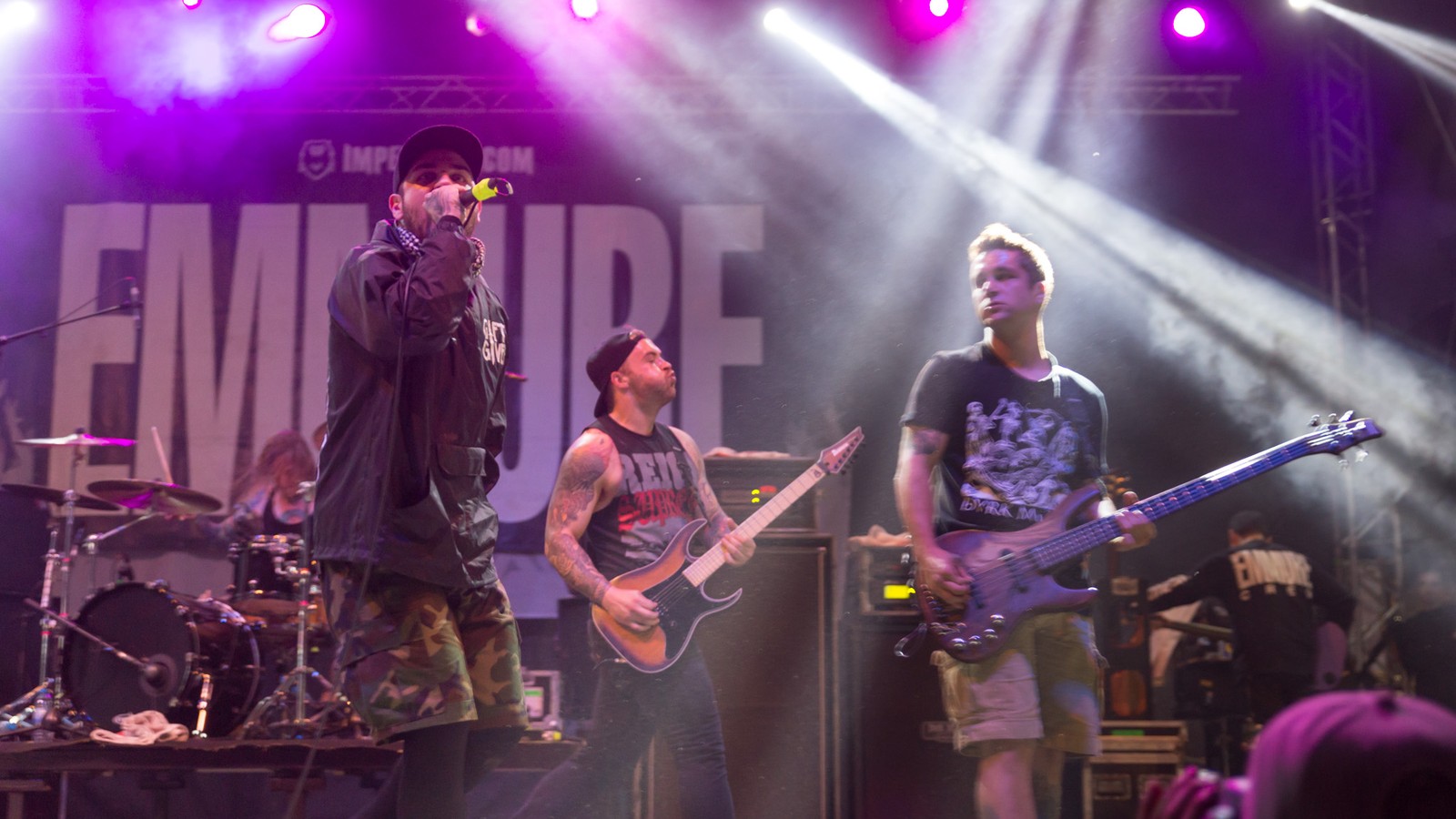
"I have said many things out of anger, even some I wish I could take back." That sentence reached the German researcher Marcus Erbe in an e-mail interview for Ox Fanzine, and it is still one of the plainest admissions the first wave of deathcore misogyny produced from inside a band. The singer who typed it, fronting a group whose Victory Records debut had a single that turned a breakup into a threat and a video that taped the girlfriend's mouth shut, was Frankie Palmeri of Emmure. Erbe's paper, presented in Cologne in October 2009, quotes the e-mail, and a German translation of the whole interview ran in Ox issue 97, August 2011.
Released on Victory in March 2007, led by a single called "10 Signs You Should Leave", Goodbye to the Gallows put at its centre what Erbe called the narrative of the decent guy who feels rejected or betrayed by a woman and sets out to restore his injured pride by violence, the reading he gave at the Heavy Metal and Gender congress in Cologne on 9 October 2009. Nobody needed the lyric sheet to follow it.
Picture the plywood door of the only bathroom stall in an all-ages club, where every opening band of a long summer leaves its mark with the point of a pocketknife, each one gouging its word deeper and slower than the band before so that it can still be read from the sink, until the panel splits along the grain under the last and ugliest cut. Nobody reads that door for its ideas. What matters is how deep the blade went. The shock lyric of the late 2000s worked the same way over a riff: one word cut slowly enough, at the bottom of the breakdown, to be read through the roar, by a band fighting forty others for the same half minute of a stranger's attention.
The door stayed up for years.
Where the shock lyric came from
The bloodline of the worst pages runs through the slam end of the family rather than through the death metal canon. The goregrind records had made disease and the autopsy table into a running joke, and the slam bands that followed took the joke and pointed it at women, in titles more than in verses, because a slam vocal is rarely made of words that can be followed.
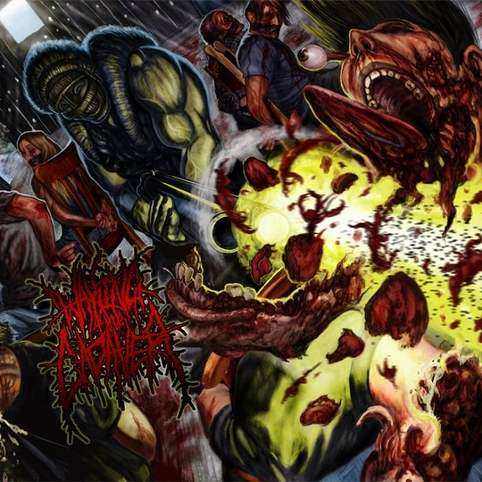
Recording at Cape Studios in Cape May between February and April 2007, putting the result out through Necroharmonic on 21 November that year, the New Jersey band whose debut named rape outright in two of its song titles was Waking the Cadaver, and by the liner notes' credit most of its words came from the drummer Denis Morgan and Steve Vermilyea, not the singer. Critics panned it, and it is filed as slam death metal and as deathcore both.
The MySpace profile page was the second root. A band's MySpace page in 2006 showed a photograph, a player and a list of song titles before a single note had loaded, and for most visitors the title was the only line of the lyric sheet they ever read. A shock title was free advertising, a road flare struck and dropped on the shoulder of a dark interstate, spitting red sparks across two lanes until every driver for a mile stamps on the brakes, and every band on the same bill had a reason to strike a brighter one than the band before it. The sparks landed on whoever happened to be standing nearest.
Formed in Blacktown, in Western Sydney, in 2006 with most of its members around fifteen years old, and putting the EP Infinite Death out in 2008 on its own MySpace page, the band whose first record had every lyric written by Brendan van Ryn on vocals was Thy Art Is Murder. He left the same year.
The third root was hardcore's grudge. Hardcore had always trained its ordnance on somebody it could name, the promoter who short-changed the band, the friend who sold the scene out. When the MySpace generation tuned that grudge down to a drop, the somebody became a girlfriend. The pile-on at the lip of a basement stage, twenty kids climbing each other's backs to scream the band's grievance into one microphone, swung round in those years from the crooked promoter to a single absent girl, and the lip of the stage sagged under them on every word. The gentler end of that story, breakup songs and the MySpace heartbreak lyric, kept the heartbreak and left out the revenge.
Deathcore misogyny, built into the breakdown
Deathcore misogyny was never mainly a matter of vocabulary. Erbe's point in Cologne was that the words of "10 Signs You Should Leave" are, taken alone, not overly vicious, a darker kind of love song about losing control after a breakup, and that the menace is assembled by the delivery and the video around them.
In Erbe's hearing the song does three things to make itself understood through harsh vocals that are often hard to follow. It opens slowly, with the first lines recited rather than growled, a staccato rhythm guitar on one stereo channel and the lead riff panned to the other. A good part of it then runs at punk speed. And when the central breakdown arrives, announced by an onslaught of drum fills and a single bent guitar note, the words come back metrically clear and repeated over and over, with the fifth of the power chord swapped for a tritone to sharpen the edge. If a breakdown carries words, Erbe concluded, that is the moment a listener catches them. The breakdown was the delivery system, the one stretch of the song slow enough for a word to land.
The breakdown was the delivery system: the one stretch of the song slow enough for a word to land.
The video spelled out what the words left implied. In it the singer plays a boyfriend who films his girlfriend's betrayal, kills the rival, takes her to a warehouse, tapes her mouth shut and screams the song's refrain at her, while the band smashes up a room of mirrors around photographs inscribed with the insults. The video Carnifex made the same year for "Lie to My Face" followed the same plan, in Erbe's reading. The lyric talks about lies and scars. The video, as he describes it, shows a young woman gagged and tied to a chair and beaten during the breakdown at the song's climax.
Then there was the claim of truth. Killwhitneydead, a band built on film samples and revenge, had its songwriter Matt Rudzinski tell interviewers, as Erbe quotes them, both that he wrote about seeking revenge on people who had done him wrong and that he wrote horror stories, like Stephen King or Clive Barker, set to music instead of film. Erbe's answer was mechanical. A fantasy band can fight its sorceress with magic in a painted kingdom. These videos put the plot in a real room with duct tape and a crowbar, and the genre's idea of authenticity, Erbe argued, makes it hard to separate the singer from the part he plays. That is where the breakdown and the breakup lyric fused into something nastier than either.
The scene's own reckoning
The reckoning, when it came, came in the bands' own words and mostly without ceremony. Palmeri's e-mail is the early example: he declined to dive too deep into his views on women, called music a healthy way to express what you feel in the moment, and allowed that some of what he had said in anger he would take back if he could.
Thy Art Is Murder changed its writer and then its subject. Andy Marsh, who joined on guitar in late 2010 and writes the band's lyrics, told Distorted Sound in February 2019 that for Holy War the band had made deliberate attempts at more real subjects, with less fantasy and less un-targeted aggression, and songs about real-world things in their place.
The death metal shelf that deathcore had borrowed from answered differently. Asked about the subject on The Metal Podcast in October 2017, Paul Mazurkiewicz, the drummer of Cannibal Corpse, called much of the criticism an overreaction blown out of proportion, granted that some songs carried more brutality towards women than others, said he might write something now that he would not have written fifteen years earlier and that he had changed since having a child, and said the band's music would stay horror-themed.
The sharpest words came from the slam end, where the worst of it had started. The slam project whose 2023 record 4 - "Enduring Freedom" was built on the Iraq War and the abuse of prisoners at Abu Ghraib was Torture, founded in 2022 by the Chicago musician who records as K.K., and he told Kim Kelly at Salvo in May 2024 that he could not see why so many slam lyrics were so misogynistic, when a song about murdering women frightened him far less than genocide and war crimes.
| When | Who | What they did or said |
|---|---|---|
| by August 2011 | Frankie Palmeri, Emmure | Told Marcus Erbe by e-mail (Ox translation 2011) that some things said in anger he would take back |
| October 2017 | Paul Mazurkiewicz, Cannibal Corpse | Called the criticism an overreaction; might not write some lyrics now |
| February 2019 | Andy Marsh, Thy Art Is Murder | Said Holy War aimed at less fantasy, less un-targeted aggression, more real-world subjects |
| July 2022 | Carnifex | Re-recorded "Lie to My Face" with a new video of performance footage |
| May 2024 | K.K., Torture | Slam about Abu Ghraib; asked why so much slam is misogynistic |
| 10 July 2026 | Bring Me the Horizon | Re-recorded the 2006 debut; interview report says lyrics unchanged |
Re-recorded, re-shot, left on the record
The quietest answer is a re-recording. Made in July 2022 to mark fifteen years of Dead in My Arms, with Adam Warren of Oceano as the guest voice, the new "Lie to My Face" came with a video that mxdwn described as performances by the band over the years under a grainy old-camcorder filter, with clips of the new merch collection alongside.
Recorded at Oli Sykes's house in Brazil, released through RCA on 10 July 2026 and played in full that night at the BEC Arena in Manchester, Count Your Blessings | Repented was a re-recording of all ten tracks of a 2006 debut, with one new bonus song, and the band that faced its own oldest lyric sheet in public was Bring Me the Horizon. On Nik Nocturnal's podcast in May 2026, Sykes said he could censor and take the horror out because it was not cool, then called it a how-long-is-a-piece-of-string question of where you stop; Nu Metal Agenda's report of the interview says the band was not changing the lyrics.
That is the fair shape of the reckoning so far. Nothing was wiped. The records of 2006 and 2007 are still on release lists, and the bands that made them have mostly chosen to say what they think of them, in interviews and on camera, under their own names.
Followed across twenty years, what the lyric sheets say moved on to childhood and grief, politics, manga and starships, written by the same generation ten years older, and none of it needed a woman tied to a chair to find an audience.
The deeper change was mechanical. The shock lyric depended on two shortages, a voice nobody could follow outside the breakdown and a page that showed nothing but the title, and both shortages ended. Lyric videos now put every word of a deathcore song on screen, in order, in large type, and the 2026 version of a 2006 song arrived as exactly that. A band whose every line is printed under the breakdown writes lines it is prepared to defend in an interview the following week. The old anathema was never quite banned. It was simply made legible, and legibility did most of the work.
