
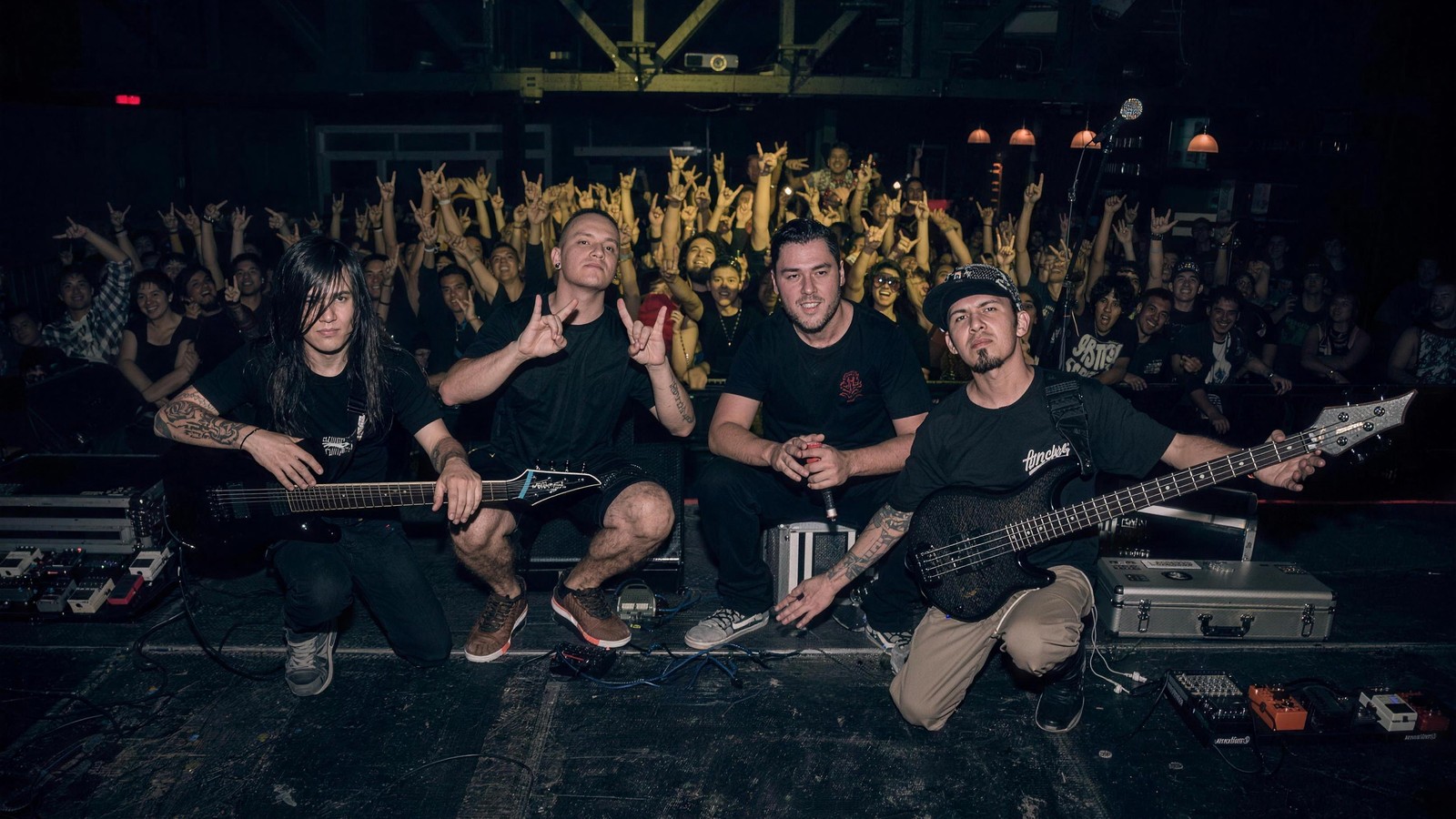
Toward you all, in America's name, / I raise high the perpendicular hand, I make the signal,Walt Whitman, Salut au Monde!
Formed in Belo Horizonte in April 1986, trading members back and forth with Sarcófago and Sextrash, and filed by its own city under a word that a freeway town in southern California would not pick up for close to twenty years, the band that hammered three demos onto cassette as Brazilian deathcore, long before the music now sold under that name existed, was Insulter. The word meant something else there. In Brazil at the end of the eighties, deathcore was the name for the raw thrash that was turning into black metal, all speed and spite, with no slow part anywhere in it for a hardcore kid to stamp on.
So the story of latin deathcore opens with a false start: a name that arrived early and stuck to the wrong music, and a sound that arrived late, carried down by American bands on routes that took years to reach the far side of the Rio Grande, and then seized by local bands who had to build their own rooms before they could wreck them. Mexico reached the big stages first. Brazil carries the most weight now. Argentina, Chile and Colombia show a handful of bands each. The wider map, from Durban to Yekaterinburg, is laid out in the survey that covers it.
Picture a singer at the lip of a club stage in a country where he cannot order a coffee in the local language, stabbing a finger at his floor wedge and jerking his fist at the ceiling, and the monitor engineer at the side of the stage, who has no English either, shoving the kick drum fader to the top of its slot without a word passing between them, so that on the next breakdown the wedge hops off the lip of the stage into the pit and rips its own cable out of the back. Nothing needed translating. The breakdown went south as a signal the body reads before the ear does. The words came later, in Spanish, in Portuguese, or in an English learned off record sleeves.
Belo Horizonte, 1986: a word with no breakdown in it
The Belo Horizonte bands were a family before they were a scene. Sarcófago formed in the city in 1985 and released I.N.R.I. in July 1987; Insulter supplied several of the men who ended up in Sextrash in 1987, so three bands drew on one small muster of players. The traffic ran through the drum stool too: D.D. Crazy hammered I.N.R.I., and by the time Sarcófago cut the Rotting EP in 1989 a session drummer, Manoel known as Joker, was behind the kit. When Nuclear War Now! Productions gathered Insulter's three demos onto one record, Andrew Edmunds wrote in Last Rites on 30 July 2015 that deathcore had apparently been the Brazilian term for thrash that ended up as proto-black metal, and a record shop's listing for the same music warned buyers not to confuse it with the modern use of the word.
Set the two musics side by side and the gap is mechanical. The Brazilian deathcore of 1986, in the reading of the critics who dug it back up, was thrash on its way to black metal, a music of speed that tore through its songs like a chainsaw left running on a tin roof. The deathcore that reached Latin America after 2005 is built around the moment a song stops running: the half-time bar, the open low string, the drop. One is a sprint. The other is built on the stop.
Nobody in the later scene claimed the old bands as ancestors, and the old bands claimed nothing from the new one. The lineage is a coincidence of vocabulary. It is still the oldest use of the word the sources on this map record.
Aguascalientes and the Kraken: Mexico on the big stage
Founded in Aguascalientes, in central Mexico, in 2007 by the brothers Tore González on guitar and Deivis González on drums, sent out on a self-titled debut through the Mexican label 666mx and Concreto Records and taken on the road through Mexico and Europe behind it, the band that dragged the American breakdown into the country's festival listings was Here Comes the Kraken. Its records stayed on 666mx for well over a decade, which made a small Mexican label the spearhead of the genre at home.
The band's biggest stage came early. On Friday 8 April 2011 it was on the bill of Vive Latino at the Foro Sol in Mexico City, a deathcore set on a bill named for Latin rock. Its second album, Hate, Greed and Death, came out that spring through Sony Music and 666mx, and leaned toward nu metal.
The record also shows how a Mexican band reached the American bands it had learned from. "Nu Beginning", whose official video, directed by Manolín Ávila, went up on 11 July 2011, was released as a feature with Eddie Hermida, then the singer of All Shall Perish and later of Suicide Silence, and an American deathcore voice on a record from Aguascalientes was a salvo fired back up the road the genre had come down.
The rest of Mexico shows up in smaller print. Decrypter, from Mérida on the Yucatán peninsula, calls its own sound cosmic blackened death metal and stands on the border the genre shares with it. Satanice plays symphonic, blackened deathcore and put out the full-length Erectoctomy in 2023. My Place Was Taken, a deathcore band from Matamoros on the Texas border, signed to Rottweiler Records around the turn of 2016 and 2017 and released the EP Imparables there in March 2018. Three corners of the country, hundreds of kilometres apart, with no single label tying them together. That is what a scene looks like before the infrastructure arrives.
Latin deathcore on the touring map
The American bands came south late, and they came in packages that leaned on death metal to sell the tickets. Announced in Buenos Aires in August 2011 as part of a Latin America Tour 2011, with Teatro Flores on Avenida Rivadavia booked for Tuesday 6 December and the night given the name Death Flowers, the bill that was to walk Suicide Silence onto an Argentine stage had Cannibal Corpse at the top and The Black Dahlia Murder beside it. The outlet that announced it had to explain what deathcore was. It called it an extreme metal genre and moved on.
The next headliners took far longer. On 2 December 2023 Carnifex played its first show in Brazil, at the Fabrique Club in São Paulo, and five days later, on 7 December, its first in Chile, at Sala Metrónomo in Santiago, carrying Necromanteum, its album of that October. The São Paulo room was not packed. Wikimetal wrote that the crowd turned the club into a hell on earth anyway, and that a pit made up predominantly of women opened from the first song of the local support set. A band formed in San Diego County in 2005 had needed eighteen years to reach two of the largest cities in South America.
Then the biggest band of the second wave came through in one sweep. In March 2025, five months after the Behelit EP of 15 October 2024, Slaughter to Prevail made its first run through Latin America, selling out the Circo Volador in Mexico City on 14 March, playing the Royal Center in Bogotá on 16 March, passing through Peru and Chile, then the Groove in Buenos Aires on 25 March, Tork N' Roll in Curitiba on 27 March and the Vip Station in São Paulo on 29 March. Six countries in sixteen days. The band from the Urals covered the continent in a fortnight.
| Date | Band | Room | City |
|---|---|---|---|
| 8 April 2011 | Here Comes the Kraken (festival bill) | Foro Sol, Vive Latino | Mexico City |
| 2 December 2023 | Carnifex, first show in Brazil | Fabrique Club | São Paulo |
| 7 December 2023 | Carnifex, first show in Chile | Sala Metrónomo | Santiago |
| 14 March 2025 | Slaughter to Prevail | Circo Volador | Mexico City |
| 16 March 2025 | Slaughter to Prevail | Royal Center | Bogotá |
| 25 March 2025 | Slaughter to Prevail | Groove | Buenos Aires |
| 29 March 2025 | Slaughter to Prevail | Vip Station | São Paulo |
Read the dates as a ledger and the shape of the region's scene is plain. Mexico sits next door to the American circuit and had a local band on a major festival in 2011. The southern cone waited until the 2020s for deathcore headliners of its own. Nights like those need a local band to open them, and that is where the scenes below come from: the support slot, filled by whoever in town could tune down and hold a breakdown in front of a touring band's crowd.
The breakdown went south as a signal. The local bands wrote the words.
Curitiba, Jundiaí, São Paulo: the Brazilian bands
Brazil's modern scene starts in the same year as the MySpace boom up north. Buried Yesterday formed in Curitiba, in Paraná, in 2007 and put out its first EP, The Only Salvation for Us, in January 2008, Slow Bleeding grew in the Federal District around Brasília, and Athimia formed in São Paulo in 2014, a brutal deathcore band that names Thy Art Is Murder, Whitechapel and Oceano among its models. None of the three became a headliner abroad. Their importance is that they exist at all, in three corners of a country that size, years before any American headliner had played it.
Born in Jundiaí, an hour inland from São Paulo, in December 2012, playing the songs of a decade on the road in Portuguese, among them "Intolerância" and "Eleitos Pela Mentira", and sent onstage on 2 December 2023 to open Carnifex's first show in the country, the band that warmed up the São Paulo pit that night was Fim da Aurora. At that show it tried out a new song, "Ritual", which turned up in 2024 on the album Empty, with an official video in June and a lyric about consumerism written in English. The choice of language is the scene's live argument: Portuguese for the home crowd, English for the rest of the world.
The Portuguese titles carry the local weight. "Eleitos Pela Mentira" means elected by the lie, "Intolerância" is intolerance, "Guerra Pela Liberdade" is war for freedom, and "Trincheira", the trench, came out as a video with Théo Moratti of the band Moana as a guest. The riff is the one every deathcore band in the hemisphere plays. The titles aim it closer to home, at lies, elections and the fight over freedom, and a breakdown pointed at a ballot box lands on something a São Paulo crowd can name.
Wikimetal's account of that December night is the best measure of what a support band in the region is for. The room was not full when Fim da Aurora went on and the pit opened anyway, the support band's breakdown coming down like the steel roll-down shutter of a corner shop when its strap snaps at the top, the whole curtain of slats dropping the height of the doorway and slamming onto the pavement in one blow, bouncing once, and every body in front of the stage moving with it. The headliner inherited a floor that was already moving. That is the job.
Signed to Napalm Records for The Pain Made Me Who I Am, the band's fourth album, the Brazilian act that bolted nu metal and metalcore onto a deathcore low end is AXTY. Its video for "who I am" went up in July 2026, and Katarina McGinn heard in the song downtuned nu metal riffs, spinning turntables, a chorus with a Deftones air and a punchy breakdown, writing in Dead Rhetoric on 19 August 2026. The band has no interest in staying inside one filing. The breakdown is still in it.
Talking to the same magazine on 9 August 2026, Jonathas Peschiera, who plays guitar and mixes the band, put the change plainly: "Now I can say that we have a scene here." More bands play metal in Brazil than before, he said, though few of them do it professionally, and the plan was to tour Brazil first, everywhere the band could. A scene that a guitarist can name out loud is a scene that has reached the point of being counted.
Buenos Aires, Rancagua, Bogotá: where the map runs thin
Argentina holds the longest list in the south and the youngest bands. Dar Sangre, formed in Buenos Aires in 2004, plays metalcore with a deathcore edge rather than the thing itself. Nvlo, formed in 2018 in the western suburbs of the city, shared the Groove bill with Slaughter to Prevail, and Megalodón, formed in Buenos Aires in 2024, put out a slamming deathcore EP called La Extinción de la Humanidad. The names are in Spanish and the titles mostly are too. The breakdown came through in the original.
Formed in Buenos Aires in 2023 and on the bill at Uniclub on 4 February 2025 as the opening act for the Brazilian thrash band Nervosa, the band that ran its set to a click track with backing tracks behind it, and opened the night with high growls that a reviewer from Sunray Magazine called powerful, is Disomnia. Picture the kind of rig that takes: a laptop on a folding chair at the side of the stage, its fan screaming, the click it sends to the drummer nailing every hit to the grid while each breakdown shakes the chair one notch closer to the edge until a roadie plants a boot on the crossbar. A band barely two years old, playing to a click in front of a touring headliner, is a scene running on discipline rather than numbers.
Chile's clearest name came out of Rancagua, south of Santiago. Before Breathing, a metalcore and deathcore band, released an EP in 2021 and was on the support bill when Carnifex played Sala Metrónomo for the first time. In Colombia, Withering Void from Bogotá mixes melodic death metal with deathcore and writes about the sociopolitical anger of Colombia. Peru was a stop on the March 2025 run and has Blessing Lies in Lima, filed under metalcore and deathcore. The bands exist. The labels, the festivals and the second album mostly do not, yet.
What the region adds up to is a blunt pattern rather than a sound. The pioneers formed close to the American circuit, the touring bands arrived a decade or more after the genre had peaked at home, and the local bands that grew up in the support slots took the breakdown as it came and changed only the language over the top of it. Asia ran on a different route, built by booking agents rather than by one festival band, and that route is mapped in the piece on indonesia, china and southeast asia. What is still missing is the route running the other way: a Latin American label putting its own bands on European and American stages, where for now a São Paulo band needs a label on another continent to get there.
