
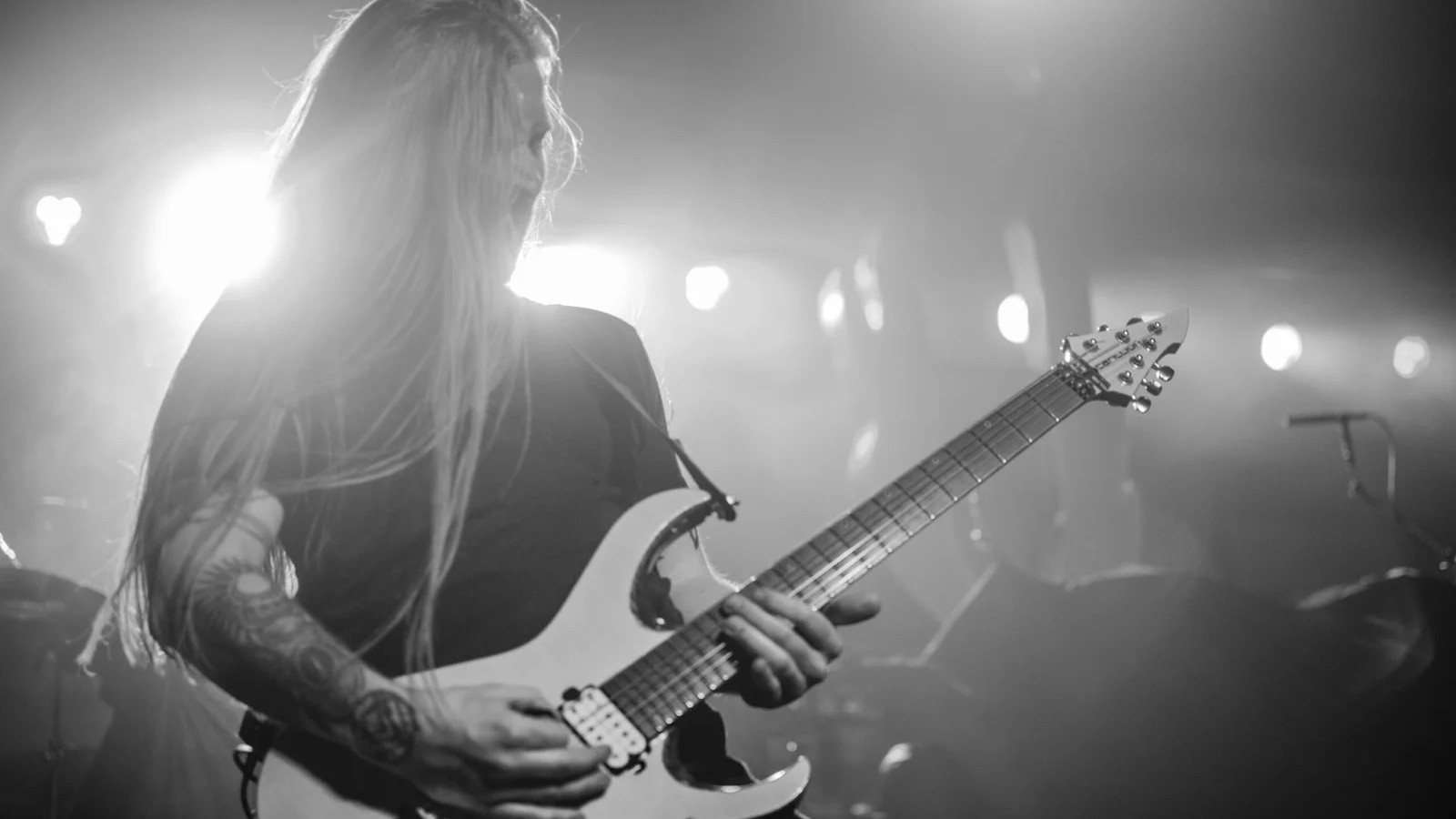
Two guitars, one melody, two pitches at the same time. That is the whole arithmetic of melodic deathcore, and none of it was invented in a deathcore band.
Worked out in Gothenburg in the middle of the 1990s, on records such as Slaughter of the Soul by At the Gates and The Jester Race by In Flames, where two lead guitars play one line in harmony and the riff itself carries the tune, and then dragged across the Atlantic into rooms built for the half-time drop of a hardcore song, the Swedish method that ripped the melody out of the singer's mouth and nailed it to the fretboard found its American practitioners in the first half of the 2000s, in South Carolina, in Los Angeles and above all in the Bay Area. Recorded with Zack Ohren at Castle Ultimate Studios in Oakland, released by Nuclear Blast in September 2008 and sold just under five thousand times in its first week, enough for number 126 on the Billboard 200 and the top of the Heatseekers chart, the record that dragged the lead guitar to the front of a deathcore album and left it there was Awaken the Dreamers, and the Oakland quintet with a shredder in the lead chair behind it was All Shall Perish.
Picture the beer sign in the window of the bar next door to the venue, two glass tubes bent into the same looping word, one a hand's width above the other and burning in two colours, and picture every breakdown from the stage next door slamming into that window until the pane splits corner to corner and a shard drops onto the sidewalk, while the two tubes go on burning, one word over the other, inside the broken frame. The breakdown wrecks the glass. The harmony stays lit.
The Gothenburg graft
Across the whole deathcore family tree, from symphonic to downtempo, each branch earns its name by swapping one job in the song, and the job this branch swaps belongs to the lead guitar. In the MySpace template the guitars mostly hold rhythm: tremolo for speed, open-string chugs for the drop, a squeal on top. Here one guitar, and usually both, takes the tune back.
A harmony lead is two guitars playing one line at two pitches, the harmonised leads that Gothenburg metal is built on, so the tune comes out doubled and wider than a single guitar could make it. On the Swedish records that line sat over death metal drums. Grafted into deathcore, it runs over a blast, a low growl and a double bass roll, and then it stops dead, because the drop is coming and the drop wants every string in the band.
Melodic deathcore bands that keep the tune
A band counts as melodic deathcore for a mechanical reason, not a mood. The melody has to live in the guitars, the blast and the growl have to stay, and the breakdown has to land where it always lands. Hold a band to those three conditions and it will either show them on a record or it will not. The lead guitar either carries the song or it only decorates the chug.
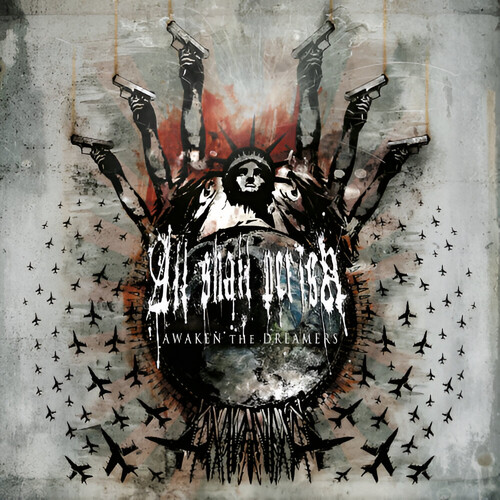
All Shall Perish earns the name through the lead chair. Formed in Oakland in 2002 out of former members of Antagony and other Bay Area bands, the band put Chris Storey on lead guitar from 2003, with Ben Orum holding the rhythm underneath, and by Awaken the Dreamers the leads had come out in front, with more solos and more shred than the records before, while Matt Kuykendall kept the blasts going under them and Eddie Hermida growled over the top. Twelve tracks run about thirty-six minutes. Three of them are instrumentals, and the longest is a shred-fest.
"Black Gold Reign", the second track, is the one to hear first, and the band's own Topic channel carries it. The guitar news on the record sits further in, on the title track, where Your Last Rites heard dueling guitar melodies and extended soloing, the stretch where a MySpace-era band would have parked a chug, and when the drop finally comes, the melody has already been planted so deep that the breakdown lands like a boot on something already alive. When Storey left in 2009, the band went on to Jason Richardson and then Francesco Artusato on lead guitar, which tells you where the band kept its weight: in that chair, and nowhere else.
Through the Eyes of the Dead got there in the same years, from the other side of the country. Formed in Florence, South Carolina, in 2003 by Justin Longshore after his previous band broke up, and signed to Prosthetic Records in time for a first full-length, Bloodlust, in 2005, the South Carolina band that wired melodic death metal lead guitar into a deathcore record while MySpace was still a novelty was Through the Eyes of the Dead, a band filed under deathcore, melodic death metal and technical death metal at once.
"Two Inches from a Main Artery", the second track on Bloodlust and posted by Prosthetic Records, is the way into the record. On Bloodlust the leads break up the crush, as Blabbermouth's reviewer heard it, and they go through it the way a box cutter goes through the packing tape on a carton of shirts at the merch table, one clean pull that splits the whole seam, and then the breakdown tips the box over and everything spills across the floor. Malice followed in 2007 and Skepsis in 2010, both on Prosthetic, and when Disomus arrived in 2017, the band had kept improving its melodic yet scathing solos and leadwork in the judgement of Dead Rhetoric's reviewer, with Longshore and Steven Funderburk on guitars. Twelve years on, the lead line was still the reason.
As Blood Runs Black is the Los Angeles version of the same alloy. Formed in 2003 out of a band called Broken Stems, the Los Angeles band put out Allegiance on Mediaskare on 6 June 2006, a record filed under deathcore and melodic death metal both and carrying melodic solos and tremolo-picked leads, and their second, Instinct, reached number 111 on the Billboard 200 and number one on the Heatseekers chart in the spring of 2011. Zack Ohren produced Allegiance two years before he produced Awaken the Dreamers.

Formed in Scotland in 2005 and introduced by its first album, Humanity, in July 2009, the Scottish band that stayed on the Swedish side of the line on its very next record was Bleed from Within, and Empire, released by Rising Records in May 2010, belongs to the early years that Metal Archives files under melodic death metal and metalcore. Its second album sits inside the line. What the band did afterwards puts it on the far side of a different line as well.
| Band | Formed | Record to start with | What it brought |
|---|---|---|---|
| Through the Eyes of the Dead | 2003, Florence, South Carolina | Bloodlust (Prosthetic, 2005) | Swedish lead lines inside deathcore before the MySpace boom |
| All Shall Perish | 2002, Oakland | Awaken the Dreamers (Nuclear Blast, 2008) | The lead guitar carries the song over the blast |
| As Blood Runs Black | 2003, Los Angeles | Allegiance (Mediaskare, 2006) | Melodic death metal guitar in a Southern California deathcore band |
| Bleed from Within | 2005, Scotland | Empire (Rising, 2010) | Melodic death metal in a deathcore band, before the clean vocals came |
Where melodic stops and symphonic starts
The boundary with the symphonic branch is the one this branch is most often accused of not having, because the two share bands, records and fans. Shadow of Intent, formed in Connecticut in 2013, and Synestia, formed in 2020, carry both names on their Metal Archives pages, and neither label is wrong. The line still exists. It runs through the breakdown.
Listen to where the tune goes when the drop arrives. Two guitarists are two pairs of hands, and on the breakdown every one of those hands is needed on the low string, so in melodic deathcore the melody gets let go the way a roadie lets go of the cymbal bag to catch a toppling speaker cabinet with both arms, the bag smacking onto the concrete, the cab caught an inch from the floor. The lead stops. The chug takes every finger in the band. When the breakdown is over, the guitars pick the tune back up off the ground.
In melodic deathcore the tune and the breakdown take turns, because the same two pairs of hands have to play both.
An orchestra has no such problem. Strings, choir and brass need no hands on stage, so in the symphonic branch the tune can ride straight across the breakdown and land on top of it, chord held, while the guitars hammer the open string underneath. That is the structural difference, and it is why Lorna Shore, filed by Metal Archives as symphonic deathcore, sits plainly on the far side of the line, with the melody and the tension handed to the orchestral side while the guitars drive the blast and the drop. Shadow of Intent and Synestia straddle it, which is exactly what their double filing says. Keyboards turn up in melodic deathcore often enough. In the branch they stay colour: a pad under a riff, a piano for an intro, never the voice that leads.
Where metalcore starts: the sung chorus
The other line is not about the guitars at all. Melodic metalcore took its guitar writing from the same Swedish records, and Killswitch Engage and As I Lay Dying are the names that stand for it, so a twin lead alone proves nothing about which side of the fence a band stands on. What moves a band across is the singing. When a chorus is written to be sung back, by a clean voice, and the song is shaped around getting to it, the band has crossed into metalcore, whatever it plays underneath.
A clean voice can visit melodic deathcore without moving in. Awaken the Dreamers already carries clean vocals, on "Memories of a Glass Sanctuary" and elsewhere, and nothing about the album's shape changed: the blasts stay, the growl leads, and the clean lines arrive as one more colour inside a song that still exists to deliver the drop. A sung chorus is different. It is the house lights slammed on in the middle of the set, every kid in the pit caught in the glare with his fists still up, the circle broken in one second into an audience with its arms around its own shoulders, singing.
Bleed from Within crossed that line in its choruses. Steven Jones joined on guitar in 2017 and brought clean vocals with him, and from Era in 2018 and Fracture, released by Century Media on 29 May 2020, Metal Archives files the band under metalcore and reviewers hear groove and melodic death metal around it. "Into Nothing", from Fracture, comes with an official video on Century Media's channel, and the house lights come up elsewhere on the record, in the choruses that reviewers singled out on "Ascend" and "The End of All We Know", where Jones sings over the growl. The leads did not leave. The chorus arrived, and it changed the address. Zenith, released by Nuclear Blast in April 2025, drew the same three labels from reviewers, metalcore, groove and melodic death metal, which is exactly what you would expect from a band whose guitars never stopped speaking the same language.
Out of Perth, Make Them Suffer took the same road a few years earlier and by a different door, the singer rather than a second guitarist. From 2015 its harsh vocalist, Sean Harmanis, sang clean as well, and the walk toward progressive metalcore that began on Old Souls that year, on Roadrunner, turned the barrage of the early records into simpler, more melodic songs. Same exit. Different stairs.
Speed is not tune, and the one test left
Speed and tune are not the same thing, and the guitar-led branch next door proves it. The technical deathcore bands spend the same fretboard on sweeps, taps and odd metres at blast tempo, and almost none of it is built to be hummed. A melodic band wants the line remembered. A technical band wants it to outrun the count.
Strip it all back and the branch asks one thing of a record: can a guitar carry the melody across a whole song, over blasts and growls, and still hand the floor to the breakdown when the breakdown comes? Through the Eyes of the Dead answered yes in 2005, All Shall Perish answered it loudest in 2008, As Blood Runs Black answered it in Los Angeles, and Bleed from Within answered it in its early records before the band started singing. The question is short, and so is the roll of bands that can answer it.

