
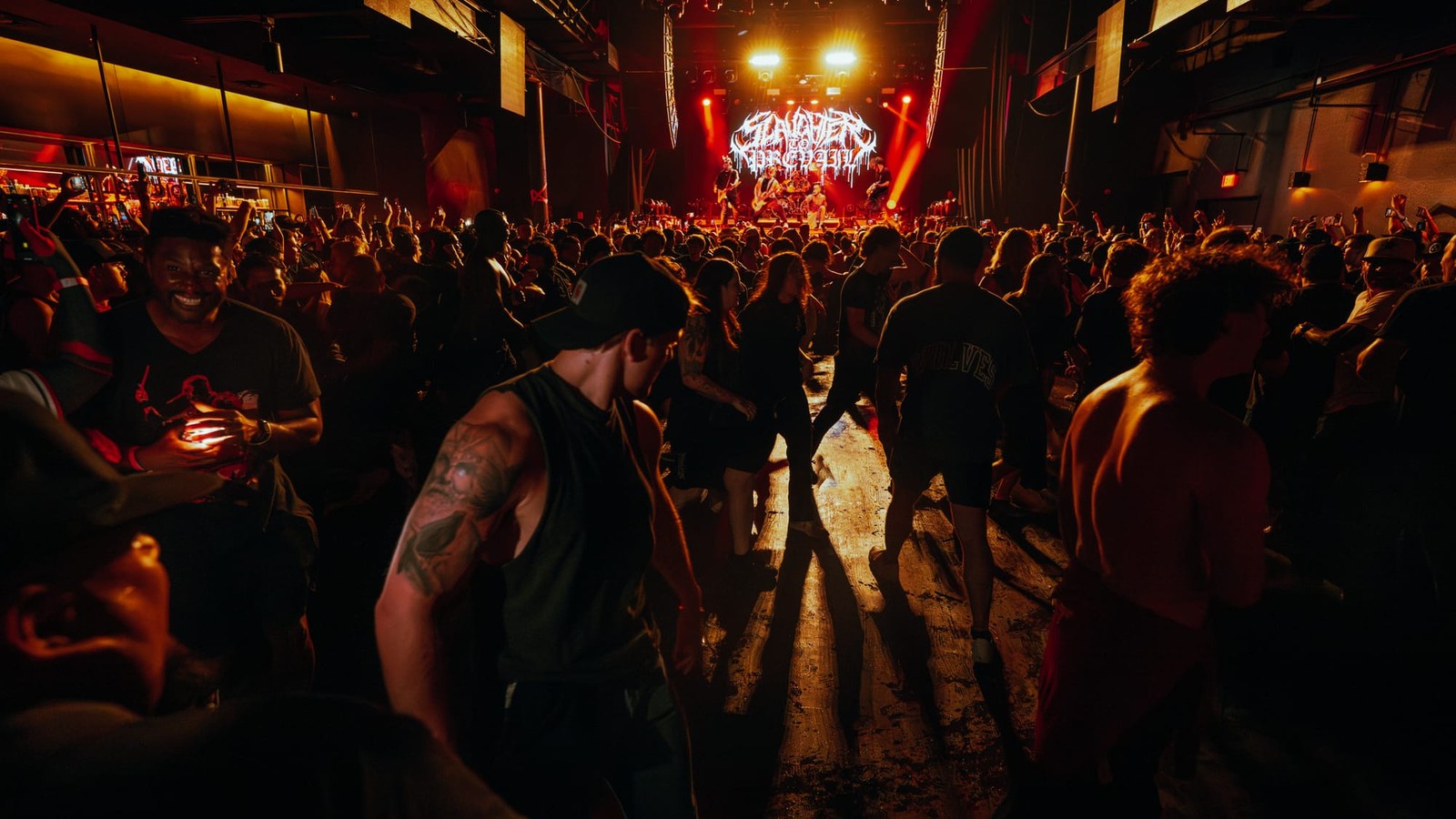
Writing for Melodic on 23 March 2026, Adam Colwell called it "the biggest wall of death that the Pinnacle has seen so far", and of everything that happened on that floor, the size is the least interesting part.
Booked into the Pinnacle in Nashville on 21 March 2026 on a bill with Attila and Whitechapel, with circle pits opening and collapsing and crowd surfers flying over the barricade through the headliner's set, the headliner from Yekaterinburg that ripped the concert floor down the middle for that wall of death was Slaughter to Prevail. The run across is the part every rock crowd knows, and the wait before it is the part that belongs to deathcore.
A deathcore mosh pit is organised around a gap. Most heavy floors move when the music moves: a circle pit spins up on the fast part, a crowd surfer goes over on the chorus, a hardcore floor starts swinging the moment the mosh part arrives. The deathcore room does something stranger. It stops, clears a space, stands still inside the space it has cleared and waits for one beat that every person in it can feel coming, because the band has spent the previous bars announcing it.
Picture the dunk tank a volunteer fire company sets up behind the VFW for its summer fundraiser, a man in a soaked T-shirt perched on the plank over four feet of water and a kid at the throwing line winding up with a softball while the crowd around the tank goes quiet. The ball is the call. The half second it hangs in the air is the silence the band leaves before the drop, and when it smacks the target the plank gives way, the man slams into the water and the tank heaves its whole load over the rim onto the front row, who had shoved forward knowing exactly what was about to happen to their shoes. The soaking is the pit. Nobody in the front row is surprised.
How the breakdown builds a deathcore mosh pit
Built from death metal's blast beats and tremolo riffs on one side and hardcore's breakdown on the other, a deathcore song spends its fast sections packing the floor tighter rather than spreading it out, because at blast speed there is no step a body can keep up with, only a pulse too quick to follow, so the front of the room leans into the barricade, heads go down and the open ground in front of the stage shrinks to nothing. Then the band drops into half time.
The drum mechanics of that drop, the snare pulled back and the pulse cut in two, are set out in the section that covers it. On the floor the result is plain arithmetic. The beat now arrives half as often, and a body has twice as long to fill the space between two hits.
That is why the space opens. A swinging arm needs time between beats, a jump needs time in the air, a run across a floor needs a long bar to land at the end of, and the half-time drop hands the room all three at once. Deathcore then often does it again, and toward the slam and downtempo end of the genre the band leaves silence hanging between the chords, which hands the floor a heavier, wider, more deliberate movement than a plain half-time drop does.
A deathcore mosh pit is organised around a gap.
The call, the gap and the drop
Every breakdown in this music arrives with a warning, and the warnings come in a fixed order. First the call, a shouted word from the singer, a number counted into the mic, or one clipped syllable the genre has made its own. Then the gap, a dead stop where every instrument on the stage cuts out at once. Then the drop. A floor that has been to three shows knows the sequence by heart.

Filmed and recorded at the International in Knoxville, Tennessee, in June 2014, a hometown night whose DVD was paid for through an Indiegogo campaign, and released by Metal Blade on 30 October 2015 as a CD and DVD with a documentary alongside the full set, The Brotherhood of the Blade is a record of a deathcore room taking its orders from a stage. The Knoxville band that put its own home crowd on tape, three guitarists strung across the front of the stage, was Whitechapel.
Three guitars matter more to the gap than to the riff. Metal Blade put "The Saw Is the Law", from the band's self-titled album of 2012, online as a live clip on 27 October 2015, three days ahead of the release, and the clip, cut from the Knoxville footage, shows why a third guitarist is a gift to a floor waiting for its cue. When one guitar stops, the room hears a thinner riff. When three stop on the same instant, chords choked off under three palms at once, the room hears nothing at all, and nothing is the loudest instruction a deathcore band can give. The silence hits the floor harder than the chord did. The drop follows it.
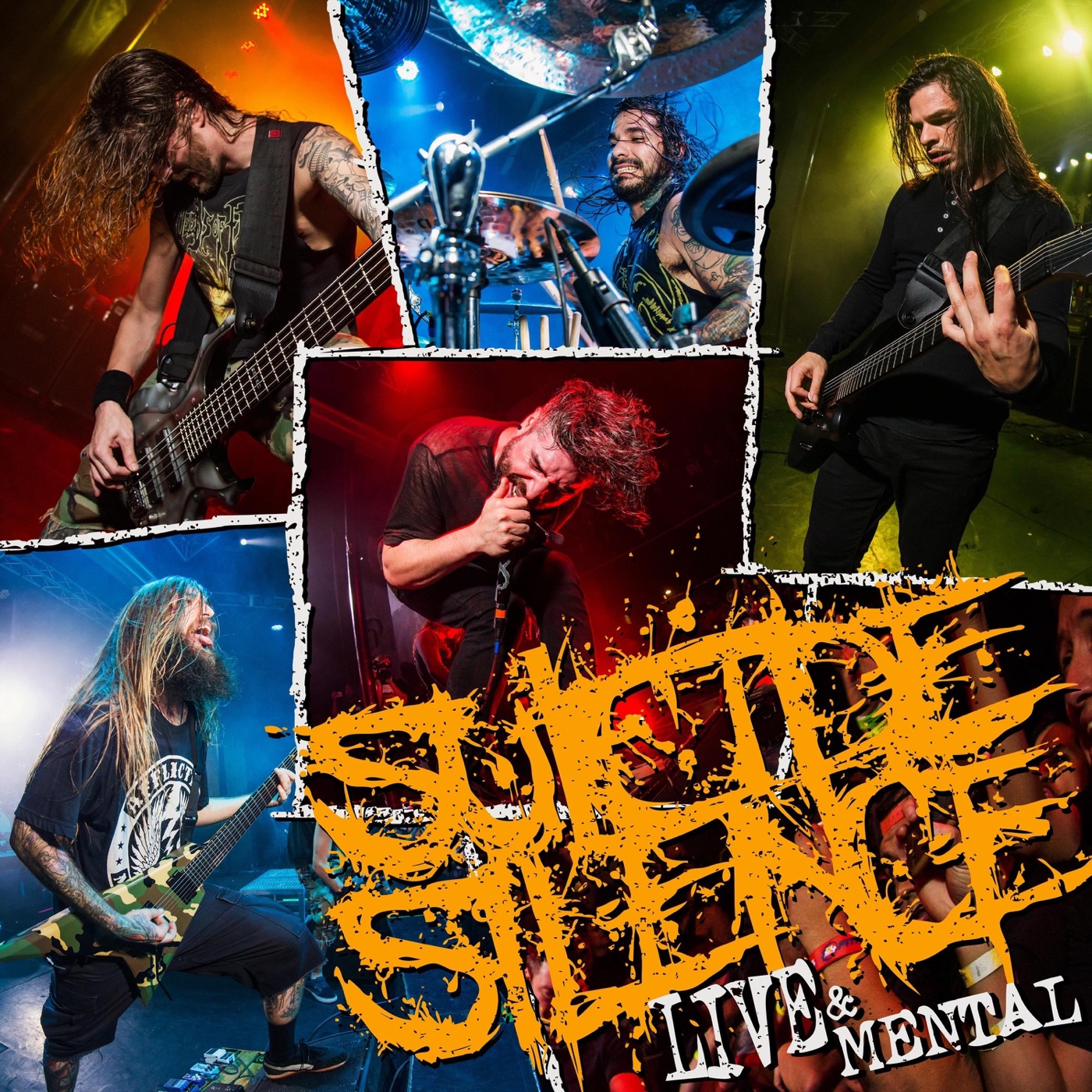
Captured on 4 December 2015 at the Observatory in Santa Ana, California, and released by Nuclear Blast on 12 July 2019, Live & Mental is a deathcore set recorded with the room left in, and a live tape is the one place where the gap before a drop is not empty: in the studio the dead stop is plain silence, while on a stage it fills with a floor drawing its breath, shuffling back from the centre and then hammering the hole shut the instant the chord returns. The quintet that kept that night in the vault for three and a half years and then led it out with somebody else's song was Suicide Silence.
The song was "Blind", the opening track of the 1994 debut by Korn, and the band put it out as an official live video on 28 June 2019. It is the right choice for a pit. The Korn original starts small, on cymbals and a thin bass line the band added as an intro before the song proper arrives, a lesson in making a crowd wait that nu metal floors had learned years before the first deathcore record was pressed. Deathcore took that patience and moved it from the start of one song to the middle of every song.
Crowd killing and the deathcore breakdown
Throwing fists and feet at the people standing around the edge of the pit rather than at the people inside it belongs to the hardcore floor, and so do the arguments over it and the two-step that travels beside it. What deathcore changed is the speed it happens at.
A hardcore mosh part often sits at a mid tempo, quick enough to keep the floor bouncing. The slowest deathcore breakdowns leave so long between hits that a swung arm can make a full revolution before the next chord lands, and the edge of the pit becomes the place where those revolutions finish. Think of the tetherball pole on the blacktop behind an all-ages hall, a player in a taped-up wrist guard punching the ball so hard the rope whips it round the steel in one full circle, the ball smashing into the ear of anyone standing inside the rope's reach and wrapping the cord tight against the pole with a crack on the way back. Slow the breakdown down and the rope gets longer. Stand inside the circle and that is the deal.
Formed in Florida and built on breakdowns that sit close to beatdown hardcore, the band that filmed its own full set at Blue Ridge Rock Fest in September 2023, posted it to its own channel, is Bodysnatcher. A festival field in the heat is the harshest test a breakdown written for a dark club can face, with no walls to bounce off and no ceiling to hold the noise in. A crowd still has to find the gap without the room's help.
Where the wall of death mosh fits a deathcore set
The wall of death is older than the genre by a long way, and the longer story of how a crowd learned to throw itself around lives under where the mosh pit began.
Deathcore simply fits the manoeuvre better than most music does. A wall of death needs a stretch of music that lets two halves of a room settle on opposite sides, and then one beat nobody can mistake for both sides to run on. The call and the gap are exactly that. The singer works the room like the man in the booth at a boardwalk bumper car rink who holds the power off while every car is nosed into a line facing another line across the floor, drivers gripping the wheel and eyes on the bumpers opposite, and then throws the switch on the drop so both rows fire across the steel plate at once, poles spitting sparks off the ceiling grid, rubber slamming into rubber dead centre. One switch, one beat, two lines. The operator never touches a car.
Where a room allows it, deathcore has made it a set piece, a sortie launched from both walls at once, and the Pinnacle in March 2026 was one more room that split down the middle on cue.
Downtempo floors and the slowest pit in metal
At the far end of the genre the gap swallows the song. Downtempo bands such as Black Tongue from Hull and Traitors from Florida write breakdowns so slow and so far apart that the pit stops behaving like a pit and starts behaving like a weightlifting floor, a few heavy, deliberate movements per bar, every one of them finished before the next chord arrives. A headbang becomes a whole-body movement. A two-step has no room to happen at all.
Set that beside the death metal pit and the difference is plain. A death metal floor tends to move fastest when the music is fastest, a circle pit tearing round the room on the blast beat, while the deathcore floor does its heaviest work when the band has slowed down the most. One genre runs with the drummer. The other waits for him to stop.
The same arithmetic follows the bands onto the big summer bills, where a breakdown written for three hundred people has to clear a space in front of thousands, and how those bills were put together is the story of deathcore festivals and the package tours. A gap that works in a club has to be held longer on a field, and the bands that last on those stages learn to hold it.
The pit sits alongside the shirts, the logos, the painted sleeves and the jokes as one more thing the audience built around the music, and its place in that culture is part of the wider story. Of all of them it is the one most tightly bolted to the song itself, a salvo of bodies fired only when the band allows it.
That is the whole of it. A deathcore floor is not wilder than the floors around it. It is better drilled, a garrison that knows the call, keeps the silence and moves headlong on the beat it was promised, and every band that wants the floor to move has to keep that promise one breakdown at a time.

