
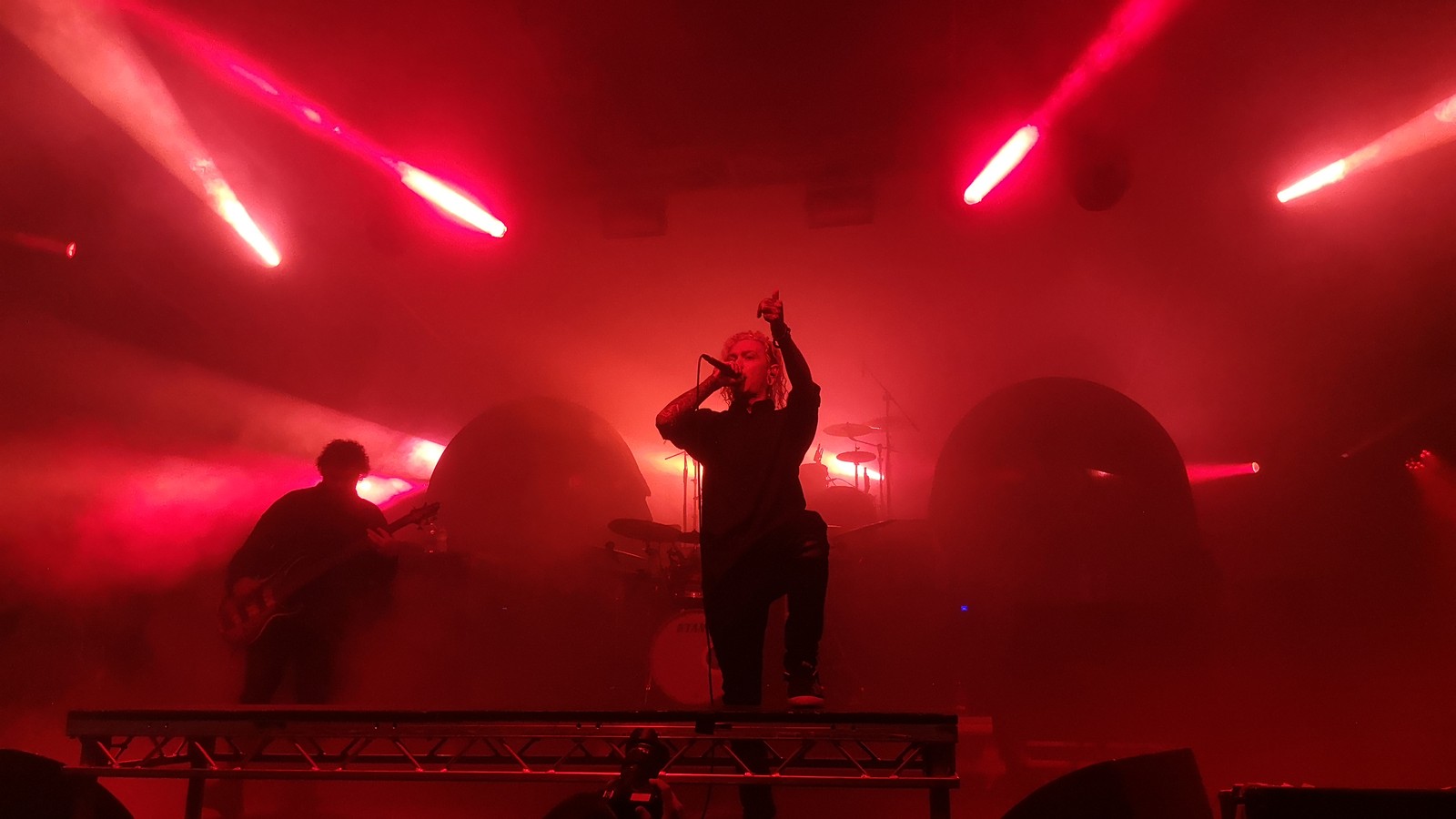
Asked by Vincent Grundke of the German edition of Vice in October 2015 what had become of the genre he had spent most of a decade recording, with hundreds of songs written for other bands behind him and four whole albums made for bands that never said so in public, the New Jersey producer who knew the template from both sides of the desk was Will Putney, and his answer, in translation, was that too much of it now sounded the same: the albums, the singers, the song structures.
He was right about the structures. He was wrong about what that proves.
A deathcore song structure is the most fixed thing in the genre because it is the genre: death metal riffs and blast beats poured into the frame of a hardcore song, with a half-time drop riveted in at every joint where the two meet. Swap the tuning, the singer, the producer or the decade and the music is still deathcore. Tear the drop out of the frame and the song falls back into one parent or the other, and nobody argues about the name.
Look down by the kick pedal at an all-ages show and the whole theory is gaffer-taped to the stage: the lid of a pizza box torn off in the green room, the song's parts marked down it in black marker for a fill-in drummer, BLAST, GROOVE, BUILD, DROP, BLAST, DROP. Nobody reads it after the first night. By the last night of the tour the top words are still sharp and the bottom one has been stamped clean through by a right heel slamming down on the first beat of every breakdown, a ragged hole in the cardboard and a dent in the boards beneath it. Every word on the lid exists to walk the foot to that hole.
Deathcore song structure: a hardcore frame with death metal inside
Hardcore supplied the frame. Its songs are short and built in blocks, and each block is written for what it makes a room do: the fast part for running, the slow part for the floor, and between them nothing that would make a crowd stand and listen. A hardcore song repeats its blocks rather than developing them, and it is usually over before anybody has thought to miss a bridge or a solo.
Death metal supplied what goes inside the blocks: the blast beat, the tremolo run, the chromatic riff that crawls down the neck, the voice dredged up from the bottom of the chest. What each of those does under the fingers belongs to the deathcore riff. In the song they are tenants. The frame is the landlord.
Recorded with Chris "Zeuss" Harris, who had engineered Hatebreed's Perseverance in 2002 and produced that band's The Rise of Brutality in 2003 and Supremacy in 2006, and released by This City Is Burning in July 2007, the San Diego County quartet that hauled death metal's blasts into a beatdown producer's room was Carnifex, and Dead in My Arms runs eleven tracks in about 33 minutes, not one of them reaching four and a half. That is hardcore arithmetic. The riffs riding on it are not hardcore at all, and the pedigree of the record sits exactly in that mismatch.
How the two scenes came to share a stage in the first place is the genre's whole arc. In the song, the meeting has a precise address, and it is always the same one.
The half-time drop is the weld
A death metal song can pass one fast riff to the next for minutes on end without ever touching the brake. A deathcore song cannot do that, because the frame will not let a fast section end anywhere except on a drop. The tempo on the click stays where it was; the pulse the room feels is cut in half; and at that instant the death metal half of the song gives way and the hardcore half takes the weight. Every drop is a handover. Count the drops and the song is counted.
Watch the gas delivery at a club's back door in the afternoon, the truck that brings the CO2 for the beer lines. The driver walks a full cylinder to the lip of the liftgate, gives it one shove, and for half a second a hundred and fifty pounds of steel and pressure hang over the alley with nothing under them. Then it slams onto the rubber mat, the gate chains jump, the loading door rattles in its frame, and the cylinder that left the supplier's truck is lying on the club's concrete. Nobody hears the shove. Everyone hears the landing, and the landing is where the load changes hands.
Death metal hands the song over at full speed, and hardcore catches it at half.
Where those landings fall is what separates one deathcore song from the next, far more than which riffs fill the space between them. A song that drops early and often reads as a hardcore song with death metal sorties in it; a song that holds its blasts for two minutes and drops once, late, reads the other way. Most of the genre sits between the two, with two or three drops to a song and the heaviest kept for last. The tunings, the drum patterns and the studio work that serve those drops belong to the account that frames it; the order is what turns the parts into a song.
"Lie to My Face" is the song Carnifex chose to carry the album's fifteenth anniversary: it runs barely over three minutes on Dead in My Arms, and in July 2022 the band released it again, re-recorded with Adam Warren of Oceano sharing the microphone with Scott Lewis, a different decade around the same song, and under it the same frame, a blast handed to a drop at the same joint.
Blast, build, breakdown in four minutes
Released by Metal Blade on 19 June 2012 as the last of ten tracks on a self-titled album and sent out with its own video on 6 November that year, the four-minute song that stands in here for the template is "Possibilities of an Impossible Existence", and the Knoxville band that built it on three guitars was Whitechapel.
Four minutes is room enough for the whole sequence: a fast opening, a build that holds the room back, and a drop where the fast half is shoved off the ledge and the slow half takes the floor with it. The pattern is the genre's own, and a hardcore frame with death metal bolted into every block that is not the drop is the shape most of its songs take.
The build is the block a casual listener notices least and a band labours over most. It has no identity of its own. It is a riff repeated past the point of comfort, a chord left ringing, a figure chopped shorter on every pass, and its only purpose is delay: it holds the room at the lip of the drop for one bar longer than the room wants to be held. A song without a build still drops. It lands on a crowd with its weight on the wrong foot, and the floor takes the difference.
Longer songs, the same order
| Year | Record | Tracks | Running time (min) | Longest track (min) |
|---|---|---|---|---|
| 2007 | Carnifex, Dead in My Arms | 11 | 33 | 4.3 |
| 2007 | Whitechapel, The Somatic Defilement | 10 | 32 | 5.3 |
| 2012 | Thy Art Is Murder, Hate | 10 | 37 | 4.5 |
| 2012 | Whitechapel, Whitechapel | 10 | 38 | 4.7 |
| 2022 | Lorna Shore, Pain Remains | 10 | 61 | 9.2 |
| 2025 | Whitechapel, Hymns in Dissonance | 10 | 43 | 6.2 |
The songs got longer. In the MySpace years a deathcore song that passed five minutes was the exception on its own record, the title track of The Somatic Defilement among the few, and by the 2020s the closing track of a major album could run past nine. What filled the extra minutes was not a new kind of block. It was more of the old ones, and above all longer builds, stretched with orchestras, choirs and guitar solos until the delay before a drop became a passage in its own right.

Self-released on 7 October 2010, with five tracks on it, a record that has been described as metalcore, the first EP of the New Jersey band that would later haul an orchestra and a choir into the space before its breakdowns was Triumph, by Lorna Shore. Twelve years later the same band closed Pain Remains, released by Century Media on 14 October 2022, with a track of more than nine minutes, and the drop still decides where each section ends.
Whitechapel took the middle road. Hymns in Dissonance, released by Metal Blade on 7 March 2025 with Brandon Zackey on drums, runs ten tracks in about 43 minutes and closes on "Nothing Is Coming for Any of Us" at just over six: longer than anything on the 2012 album, shorter than the symphonic bands' suites.
That is the answer to Putney's complaint. A genre with a fixed song structure is not a genre that has stopped moving; the blues has kept twelve bars for a century and nobody calls that a grave. Deathcore keeps the hardcore frame, fills it with death metal, and decides everything else at the places where one gives way to the other. Bands that keep the frame and change the contents are still deathcore bands. Bands that throw the frame away have left, whatever their records are filed under.
