

Every book is a quotation; and every house is a quotation out of all forests, and mines, and stone quarries; and every man is a quotation from all his ancestors.Ralph Waldo Emerson, Quotation and Originality
Back in the studio for Roadrunner in 1995 with Doug Bohn on the drum stool Mike Smith had walked away from after Breeding the Spawn, and armed with technical riffs that run fast until the band kicks the floor out from under them and drops into a slow, heavy crawl, the Long Island crew whose slow parts hardcore kids learned to stand under was Suffocation, and the record it made that year was Pierced from Within.
That is where the borrowing starts.
The deathcore death metal influence is usually told as one loan, the breakdown, and on the evidence of the records it was at least five: the slow part, the groove, the slam, the chromatic crawl and the gravity blast, with a guttural voice riding over all of them. Formed in Maryland in 1991, and by 2000 hammering New York hardcore grooves into death metal songs hard enough to split the floorboards of every hall it played, the band that supplied the second of those loans was Dying Fetus. The rest came by stranger roads.
Picture a hatchback in the parking lot of a death metal show in the middle of the nineties, two twelve-inch subwoofers bolted into the well where the spare tyre used to ride and a Suffocation disc in the dash, and every time the band on the speakers stops blasting and drops into the crawl the licence plate shakes loose from its screws and the rear window blows out of its rubber seal onto the asphalt. The kids crowded round the open hatch, half of them in hardcore shirts, never look up during the fast parts. They wait for the eight bars that broke the window. Those were the bars they took home.
What crossed over from Suffocation's slow part
The mechanics of that slow part belong to death metal, and the long account of how a Long Island scene learned to stop dead belongs to the New York brutal death metal school. What crossed the fence was the physical recipe: the tremolo cut off, the blast gone, and the guitars and the kick drum dropping their whole weight together onto one low, palm-muted figure.
"Thrones of Blood", the second song on Pierced from Within, works that way, its slow stretches excised from the run and stitched back in before anybody in the pit has finished landing. Frank Mullen's voice grinds along underneath it like a second bass guitar dragged across the floor of the mix, a subterranean growl phrased to the riff rather than above it, and Terrance Hobbs and Doug Cerrito nail the guitars to the kick drum through every change of gear.
Deathcore took that recipe whole. The bands that carried it into the all-ages rooms kept the low unison and the dead stop, kept Mullen's register underneath, and handed the package to a crowd that had learned to move from hardcore. The slow part had found a new floor.
The tuning drove the loan deeper. Deathcore guitars are tuned down, and the characteristic breakdown hammers a single note into a low open string until the palm-muted note stops sounding like a note and starts sounding like a stack of amp cabinets going down a cellar stair somewhere below the stage.
Dying Fetus and the groove that drags a room in circles
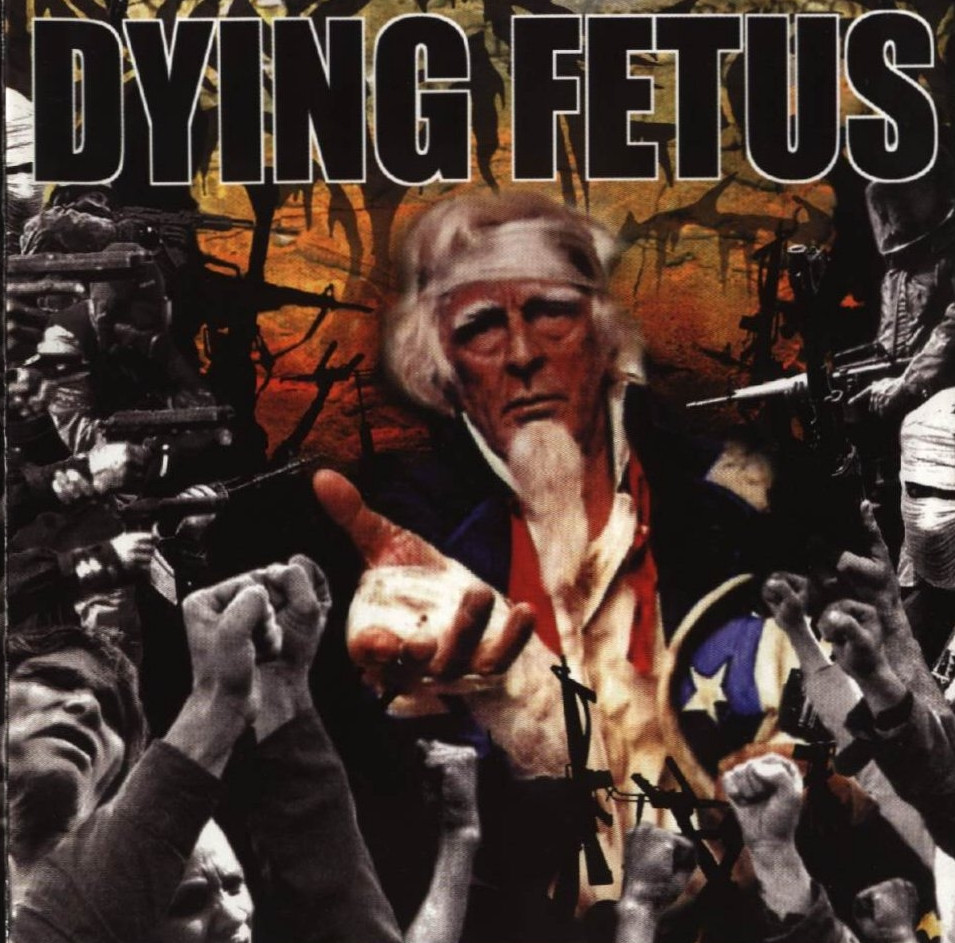
Released by Relapse on 3 October 2000, with John Gallagher and Jason Netherton tearing the vocal lines between them and Kevin Talley battering the kit, the record on which the Maryland band's design comes fully into focus is Destroy the Opposition. The design is simple to state. In the label's biography Gallagher says he wanted to take some of the groove of early Agnostic Front and Madball and put it into death metal, and he names the dual vocal approach of Carcass among the things he blended in.
"Praise the Lord (Opium of the Masses)" is that design at full weight. The riffs are fast and technical, and the song drops into a breakdown and a groove that a hardcore floor already knows how to move to. That groove pulls a room the way a rotary floor buffer pulls the janitor of a VFW hall who leans on it wrong: the pad bites the linoleum and the machine drags him in a circle, slamming him into the stacked folding tables and chewing a black ring into the floor. A Dying Fetus circle pit is that ring with bodies in it.
The groove outlived the line-up that cut it and carried on into Stop at Nothing in 2003. Decibel, inducting Destroy the Opposition into its Hall of Fame in 2012, called it positively influential, a handbook for genre-blend bands, and the bounce before the drop and the two throats trading lines are what the deathcore bands that followed took from it.
Dying Fetus is the death metal band that handed deathcore its groove, and took nothing back.
Is Dying Fetus deathcore?
No. Filed by Metal Archives as brutal death metal and grindcore, with no deathcore or metalcore anywhere in the genre string, released on Relapse from Destroy the Opposition onward, and built, by the account in the label's own biography, out of the slam of Internal Bleeding and the two-voice trade of Carcass, the Maryland band that gets dragged into the deathcore argument is Dying Fetus, and it is a death metal band. Gallagher credits the whole New York scene with a large part in its development.
The frame gives the answer. In "Praise the Lord" the groove lands like a crate of tire chains dropped through the bed of a pickup, caving the planks and rattling every bolt in the tailgate, and the axles underneath are still the ones the band bolted together in 1991 out of tremolo, blast and technical riff. Lift the crate out and the truck still drives.
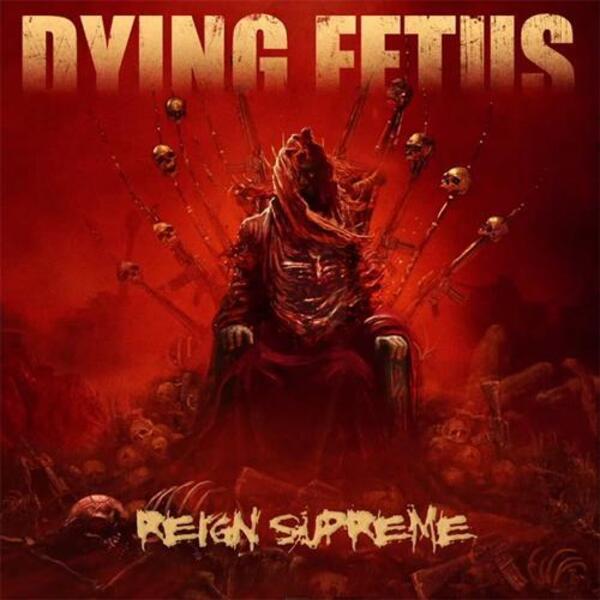
So why does the question get asked? Because the bounce is what a deathcore fan hears first. "Subjected to a Beating", from Reign Supreme, released by Relapse on 19 June 2012 with Trey Williams on drums, is the second song on the record and spends its five minutes on groove, technical riffing and tremolo sections, with the tremolo and the blast still doing most of the work. The circuits have merged around the band too: in the autumn of 2023 Dying Fetus headlined a tour of the United States with Despised Icon and The Acacia Strain in support. Sharing a bill is not sharing a genre. Dying Fetus is the death metal band that handed deathcore its groove, and took nothing back.
The riff vocabulary: slam, crawl, gravity blast and guttural
Named, by the account of Internal Bleeding's own members, in the early nineties and hammered flat into a whole style by the end of the decade, on records such as Devourment's Molesting the Decapitated in 1999, the slam riff was the third loan. A slam riff is a slow, syncopated, palm-muted figure on the lowest strings, repeated until the figure is nearly all there is of the song. Deathcore's own appetite for breakdowns sent a new generation back to it in the mid-2000s, and Devourment reformed into that audience.
The chromatic crawl came from the same shelf, and deathcore changed its job. A riff that slides down the neck one fret at a time is the dissonant, chromatic sound a Metal Archives reviewer of Pierced from Within traced back to Slayer's Reign in Blood, and in deathcore it can hang over the last bar before the drop, each step down the fretboard lowering the room toward the breakdown.
The gravity blast is the strangest of the loans, because it began in a drum method rather than on a death metal record. The freehand roll behind it was popularized in modern drumming by Johnny Rabb, whose Hudson Music method book The Official Freehand Technique teaches rhythms played with a single hand, and in a blast it lets one hand on the snare keep pace with two feet on a double bass pedal. In a deathcore song it can arrive in a burst just before the drop, an impact wrench run down the edge of a stage riser, a dozen lug bolts spun home in a second and the deck pinned to its frame, so that the breakdown has something bolted down to stand on.
The guttural came last in importance and first in volume. Metal Archives calls Frank Mullen of Suffocation one of the first to use a very deep death growl, and deathcore vocals alternate between that low growl and a high scream, the trade Dying Fetus had already run with two singers. The band from Quebec that made that trade its trademark, two throats tearing one verse apart from both ends of the register, was Despised Icon, by common consent the exponent of the two-voice attack.
What deathcore borrowed from death metal, and what it left behind
Raided record by record, death metal gave up the slow part, the groove and the slam, with the guttural and the low tuning riding over all three, the crawl came by way of Slayer and the gravity blast by way of a drum method book, and deathcore hauled the lot out of Long Island, Maryland and Texas and into the all-ages rooms. Some things stayed on the shelf. The long chain of riffs inside a single song stayed behind, and so did the guitar solo, which turns up in deathcore only now and then.
The bands that carried the loans across said where they came from. Asked by Guitar World about the influences on The Black Crown in 2011, Mark Heylmun of Suicide Silence named Suffocation and Morbid Angel alongside Korn and Pantera, and that list is the genre in miniature: death metal riffs, Korn's bounce and Pantera's groove, laid side by side and run into the same drop. Other bands made the trip in reverse. Job for a Cowboy, filed under deathcore for the Doom EP of 2005, spent Genesis in 2007 and Ruination in 2009 walking the loans back to the shelf they came from.
The other parent supplied what death metal never had: the breakdown written for a hardcore floor, the all-ages room, the shouted vocal and the van. That half of the story runs through Syracuse, Cleveland and Victory Records and belongs to Earth Crisis, Integrity and the hardcore roots of deathcore. The two halves only add up to a genre when they meet in one song.
Texas, the Bay Area and Montreal, where the two halves first shared a bill, belong to the account that frames it. Take a deathcore song apart and most of its machinery was built in the nineties, on Long Island, in Maryland and in Texas.
The loans were never paid back. They were played lower and louder to rooms full of hardcore kids, and a debt run up that hard turns into a genre of its own.

