
DR4. That is the figure listeners have logged in the Dynamic Range Database for the self-titled EP that Suicide Silence put out in 2005, a debut by a Riverside band barely three years old, and DR4 is also the figure the same database logs for the compact disc of a record that arrived seventeen years later with strings and a choir.
Produced, engineered, mixed and mastered by Josh Schroeder at Random Awesome! Studios in Bay City, Michigan, released by Century Media on 14 October 2022 with an orchestra laid over the guitars and a kick drum built to punch holes straight through the string section at blast speed, the New Jersey band whose Pain Remains marks how far deathcore production had gone by 2022 is Lorna Shore. Same number. Different planet.
So loudness is not where the change lives. The squeeze was on the first records already. What changed between the EP and the orchestra is everything that happens before the squeeze: drums dragged onto a grid, drums swapped for samples, guitars recorded as bare signal and handed an amplifier weeks later. None of it is a single trick you can point at. You hear it as a breakdown that lands the same way on a phone speaker, a car stereo and a festival rig.
Pull a van that shakes above sixty into the tire shop at a truck stop, and the tech in the back bay bolts the bad wheel onto the balancer and spins it up to highway speed. The machine finds the heavy spot. He rips the old lead weights off the rim with a pair of pliers, hammers fresh ones onto the opposite lip, spins it again, hammers again, until the wheel turns without a flicker. Out on the interstate the difference is violent: an unbalanced wheel at seventy beats the steering column until the driver's wrists ache and the mirrors blur, while a balanced one carries the same loaded van and the same trailer of cabinets without a tremor. A balanced wheel is not a lighter wheel. The edit finds the hit that sits late, the sample is the lead hammered onto the rim, and the point of both is a breakdown that arrives at full speed and full weight without shaking itself apart.
A balanced wheel is not a lighter wheel.
The grid arrived with the genre
Look at the dates first. Digidesign shipped Beat Detective with Pro Tools 5.1 in 2000, on TDM systems only, the tool that cuts a drum track at every hit and slides the pieces onto the tempo grid, and the records now filed as the start of deathcore came out in the five years that followed, while that kind of editing got cheaper every season. The machine and the music grew up in the same rooms. The same tools reshaped modern metal production at large, but in deathcore they met a song form that needed them more than most.
The reason is the breakdown. Inside it the kick drum follows the guitar's palm-muted hits one for one, and between the hits a gate has cut the guitar to dead silence. A kick that lands a hair behind its chug has nowhere to hide. In a fast section the blur swallows the mistake, but in a gapped half-time bar the late kick sounds as two blows where the song wanted one, a flam that rips the seam out of the riff in front of a room stamping on that exact beat. Quantising closes the seam. Every hit goes onto the line, and the breakdown comes off the screen as one die-cast block.
The reasons a breakdown is built that way at all, half time over an open string with the kick doubling the guitar, make up the full account of how the genre is assembled. Production decides something narrower and just as brutal: whether that bar survives the trip from the drum room to your ears in one piece, or arrives with its seams torn open.
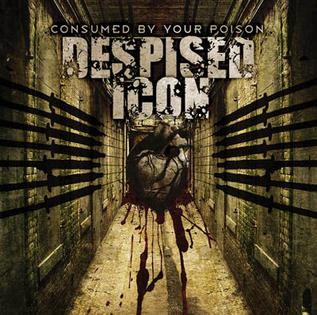
The genre started remixing its own past almost at once. Issued by Galy Records on 2 October 2002 with Yannick St-Amand producing, then handed back to the same man for a new mix when Century Media reissued it on 4 April 2006 with the first two songs recorded again as bonus tracks, the Montreal debut that the chroniclers of the genre keep returning to is Consumed by Your Poison by Despised Icon. Alex Erian, the band's drummer on the original and its singer by the reissue, said in March 2006 that the new mix sounded "way heavier" than the original. The listeners' database agrees in its own terms: the original is logged at DR6, the reissue at DR5. Four years, one notch tighter.
Samples under the kit
Replacing a recorded drum with a sample is older than deathcore, and it got easy at the same moment the grid did. By February 2003 Sound on Sound was reviewing Drumagog, a plug-in that listens to a drum track and fires a sample in its place on every hit, and through the decade the libraries grew until a producer could rebuild a whole kit after the drummer had driven home. In deathcore the kick drum needs it most, for the same reason it needs the grid: it has to be heard as a separate blow underneath guitars tuned down into its own range.
The sample changed shape along the way. In a mix walkthrough of "To the Hellfire" that Nail The Mix published on 29 May 2025, the kick Josh Schroeder builds for Lorna Shore starts from Steven Slate Drums' "Kick 10", a sample infamous among engineers for turning up everywhere, and is then worked over until nobody could recognise it: the envelope cut until the drum has almost no sustain and no release, a narrow dip near 102 hertz, a parallel bus of distortion for grit, and dynamic equalisation pulling the low end down by a decibel or two as the pattern speeds up.
Read that chain as a statement about the low end and it is blunt. The kick drum built this way is barely a drum at all. It is a click with a short thud welded underneath, trimmed so it clears out of the way of the guitars the instant after it lands, because in a fusillade of kicks at blast speed sustain is the enemy and every hit has to be gone before the next one arrives or the bottom of the mix smears into a single drone. The kick surrenders its tail, and the breakdown is what fits in the space it leaves.
The amplifier you choose after the band goes home
The guitars went the same way as the drums. On a modern session the guitarist plays through a direct box, the clean signal of the strings goes into the computer untouched, and the amplifier becomes a decision that can be put off for weeks, a process engineers call reamping. That changes what a deathcore guitar part is. A breakdown tracked in June can be dragged in September through any amplifier the producer can lay hands on, real or modelled, a cabinet the guitarist never touched slamming the same palm-muted hit into a microphone in a room he has never seen, until the low string sits exactly where the trimmed kick left space for it. The performance is fixed. The sound stays negotiable to the last day of the mix.
The guitarist who ran Graphic Nature Audio in Belleville, New Jersey, and who told Mix magazine in July 2019, in the same month Fit for an Autopsy put out "Mirrors" as the first single from The Sea of Tragic Beasts, that he does "the bulk of my work in the computer" is Will Putney. He also told the magazine that an STL Tones plug-in was "the first time I was ever convinced that software could be as good as if I pulled the amps up right now". One of the producers who shaped the deathcore sound, in other words, came round to the amplifier in a laptop, and only once it could stand next to the real thing.
The same interview carries the counterweight. Putney said records "can very quickly become sterile and overproduced", and that he leaves his own "a little more raw and a little less sampled". Read the two remarks together and the method is plain. The software is a tool for getting the tone right after the fact; it is not a licence to remove every trace of the people who played.
Loudness, and why the breakdown survives it
The squeeze at the end of the chain is older than any of this. A brickwall limiter shaves the peaks off a master and lifts everything else to the ceiling, and the cost of that across all of metal is the loudness war. Deathcore joined it on day one. In the Dynamic Range Database, where listeners log measurements of their own copies, the compact disc and download figures for the genre run like this, a lower DR meaning a flatter, more squeezed master.
| Year | Band | Record | DR |
|---|---|---|---|
| 2002 | Despised Icon | Consumed by Your Poison | 6 |
| 2005 | Suicide Silence | Suicide Silence (EP) | 4 |
| 2006 | Despised Icon | Consumed by Your Poison (reissue) | 5 |
| 2007 | Suicide Silence | The Cleansing | 5 |
| 2009 | Despised Icon | Day of Mourning | 4 |
| 2011 | Suicide Silence | The Black Crown | 6 |
| 2014 | Whitechapel | Our Endless War | 6 |
| 2017 | Suicide Silence | Suicide Silence | 6 |
| 2021 | Lorna Shore | ...And I Return to Nothingness (EP) | 4 |
| 2022 | Lorna Shore | Pain Remains | 4 |
| 2025 | Lorna Shore | I Feel the Everblack Festering Within Me | 3 |
The figures do not tell the story everyone expects. There is no slow climb from open to crushed: the 2005 EP is as flat as Pain Remains, and the most open figure in the table, DR6, turns up in 2002 and again across the 2010s. Vinyl copies of Pain Remains are logged far higher, at DR9 to DR12. The streaming services have meanwhile taken the prize away from the loud ones: Spotify plays everything at minus 14 LUFS by default, so a master squeezed harder than that is simply turned down to meet the rest.
Why does a DR4 deathcore record still hit? "Of the Abyss" comes from the ...And I Return to Nothingness EP that Century Media released on 13 August 2021, and the database logs that EP at DR4. The answer is in the stops. A master that flat is a hall sold two hundred over its capacity, bodies jammed from the lip of the stage to the bar, the barricade bowed on its feet and nobody able to lift an elbow: nothing in it has room to get bigger. What deathcore keeps even there is the gap. The guitar is gated to silence between its hits, and a limiter cannot turn silence up, so when a band cuts out for a beat before the drop the packed room goes dead, and the first chug comes down into that hole with the whole squeezed weight of the master behind it. Its dynamics live in time, not in level. That is the one thing the loudness war never managed to take from this music.
Raw on purpose
It's not gonna be full of computer trickery.
Mark Heylmun of Suicide Silence, Wall of Sound, August 2016
One band tried to walk back out of the grid. Made with Ross Robinson, the producer of the first two Korn albums, and released by Nuclear Blast in February 2017 with "Dying in a Red Room" among its videos, the record on which the band whose 2007 debut album had helped write the template went looking for a way out of it was the second self-titled release by Suicide Silence. Mark Heylmun on guitar described the method to Wall of Sound in August 2016: real microphones on real drums, real amplifiers, real takes, no samples, and the whole thing recorded to tape. The database logs it at DR6.
The experiment isolated a single variable. Same band, same kind of breakdown, and the grid and the samples taken out. What changes is not the weight of a riff but the shape of each hit. A real kick drum blooms and decays at whatever speed the drummer's foot gives it, the gaps in a breakdown fill up with the sound of the room, and a chug that lands a fraction late stays late. The drum take sits on the record the way a basement floor sits after a show, every boot print left where it was ground into the beer, nothing mopped and nothing painted over.
Nothing else in the table follows it back out. Lorna Shore's next album after Pain Remains, released on 12 September 2025, is logged at DR3, the flattest figure of all these records.
That is the real shape of deathcore production across twenty years. The loudness was there from the first EP. What arrived afterwards was control: every hit moved to the line, the kick rebuilt as a short click that leaves room for the guitars, the amplifier chosen at the end instead of the start. The records got more exact, not much louder. The cost is the room and the human drift, and a band that wants those back now has to decide to keep them, because the default has gone the other way.

