
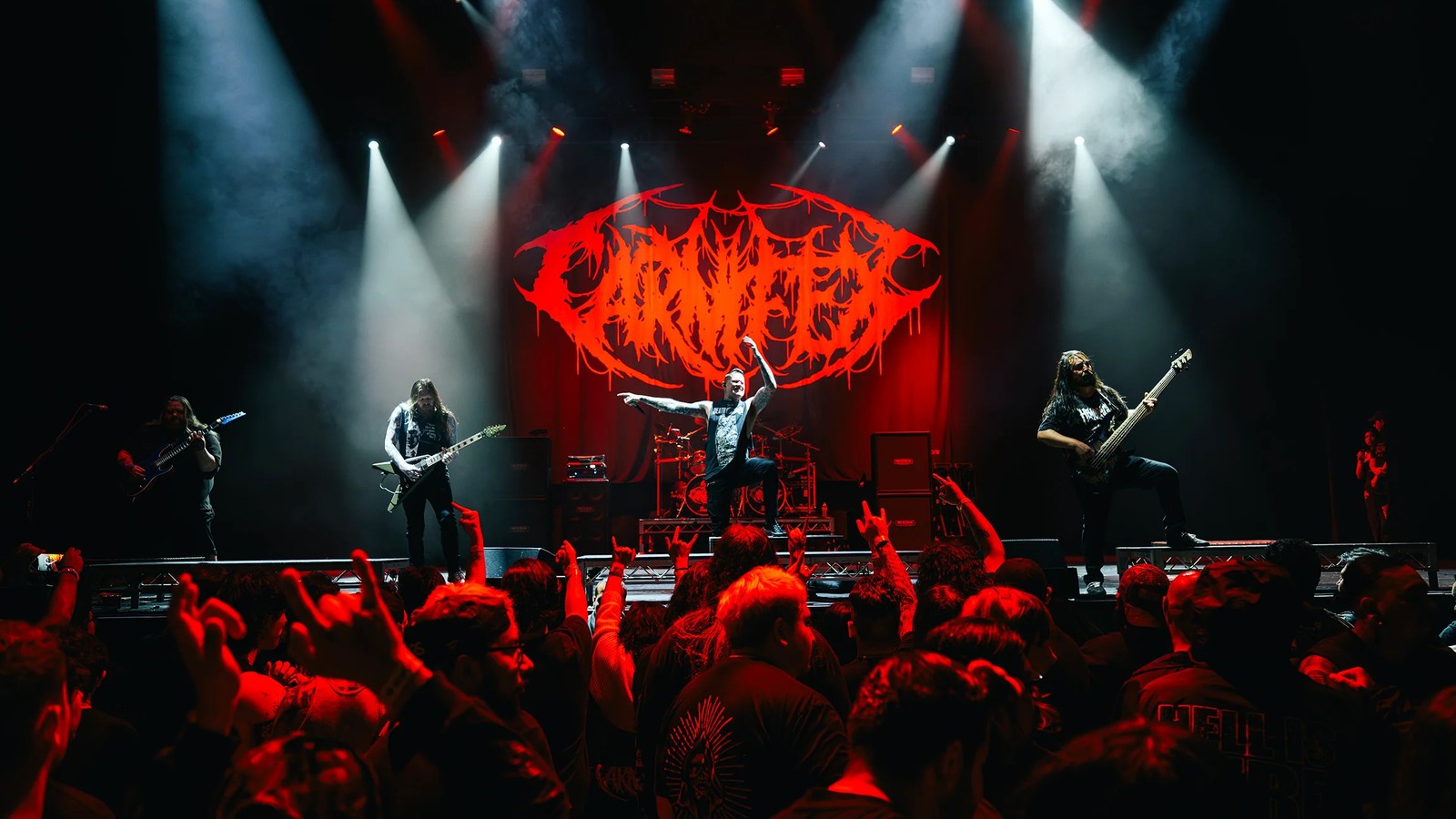
"Never quite fully committed." That was how Teeth of the Divine summed up Carnifex's dealings with the symphonic and blackened side of deathcore before Necromanteum, in its review of that record on 2 October 2023, and it undersells what had been happening. The commitment was real. It just took thirteen years and seven albums.
Signed to Victory Records when Hell Chose Me came out in February 2010, on Nuclear Blast for every album from Die Without Hope in 2014 through 2023, and still built around the drummer who founded it in 2005 and plays the keyboards himself, the San Diego band that let black metal seep into its riffs one album at a time, until Necromanteum in October 2023 ripped the last of the old deathcore riffing out from under the drop, is Carnifex, and that slow change is the cleanest lesson there is in what blackened deathcore actually means.
Blackened deathcore is deathcore with its guitar and drum language rewritten by black metal. The riffs are tremolo-picked, one note hammered as fast as the wrist allows and walked through minor keys and dissonant intervals, so the line travels instead of pounding a single string; the blast beats hold for whole sections instead of firing in bursts; a high, lacerating shriek stands next to the growl; and in places the guitar tone runs colder and thinner, with the low end pulled back. The breakdown stays. Take it out and the record is blackened death metal, which is another genre with another forebear.
Picture a band rehearsing in a rented unit at a self-storage yard when a hailstorm comes through, a million stones hammering the corrugated steel roof so fast that no single hit can be told from the next, one high, freezing roar pressing down from overhead and stripping the paint off the ridge, while underneath it the amps and the drum kit sit on the bare concrete slab where they always were, and the moment the band hits the drop the slab takes the blow and the whole row of units shudders on its footings. That is the branch. Black metal moves in over the roof. The breakdown stays in the floor.
What black metal changes, and what it leaves alone
The tools come from the second wave of black metal, the early nineties records that made the tremolo line and the sustained blast into a language of their own, and the craft of that language belongs to black metal. What matters is what the tools do when they are bolted into a deathcore song. A chugging riff sits on one note and hits it; a tremolo riff picks every note so fast it smears into a held tone and then moves that tone somewhere, so the guitar starts carrying a melody, a cold one, in the place where the chug used to be. The blast beat, which plain deathcore fires in short salvos before the drop, now runs under the tremolo for twenty or thirty seconds at a stretch. The vocalist pushes the high scream into a black metal shriek. And the breakdown arrives exactly where it always did, which is why nobody in the room needs to be told what genre this is when the floor opens.
In deathcore through its history, the black metal arrives late, after the template had been fixed in the MySpace years, and from two directions at once: from black metal bands that tried breakdowns and from deathcore bands that tried tremolo.
The imagery shifts with the riffs. Gore and the horror film give way to the occult, the sleeves go dark, and the spelling changes with them: Ov Sulfur carries it in its name, Worm Shepherd called its first album In the Wake ov Sòl, and Mental Cruelty put out a song called "King ov Fire", all using the archaic "ov" that Behemoth had already put on "Ov Fire and the Void", a track on Evangelion in 2009. The spelling is a flag. The riff is the proof.
The first to cross the line
Founded in Phoenix in 2004 by Ken Bergeron, who later took the stage name Ken Sorceron, the Arizona band that set metalcore influences under symphonic black metal on the Legend EP for Candlelight in October 2006, and then threw them out within two years, was Abigail Williams. It came to the border from the black metal side. By In the Shadow of a Thousand Suns in 2008 the metalcore influences of the early songs were gone, and In the Absence of Light, on Candlelight in September 2010, was black metal and nothing else. The band crossed the line, looked around and went home.
Tagged blackened death metal in some catalogues and symphonic deathcore in others on Neverbloom in 2012, the Perth band that walked up to the border from the deathcore side, as Abigail Williams had from the black metal side, was Make Them Suffer. Two tags for one record show how close the blackened and symphonic branches ran at the start. The band kept walking, away from both, toward metalcore.
Carnifex took longer than either and went further. Black metal touches are attested as early as Hell Chose Me, and every record after it went over the last like another coat of black spray paint over the logo on the side of a band van, a can emptied per album, the white letters still showing through on Die Without Hope in 2014 and Slow Death in 2016, flipping back into view on World War X in 2019 and Graveside Confessions in 2021, which Teeth of the Divine heard swinging between a Whitechapel-style deathcore and the blackened one, until the last coat drowned them. On Slow Death, one Metal Archives reviewer heard how much of black metal's classic ideas had settled into the record, and named the result blackened deathcore.
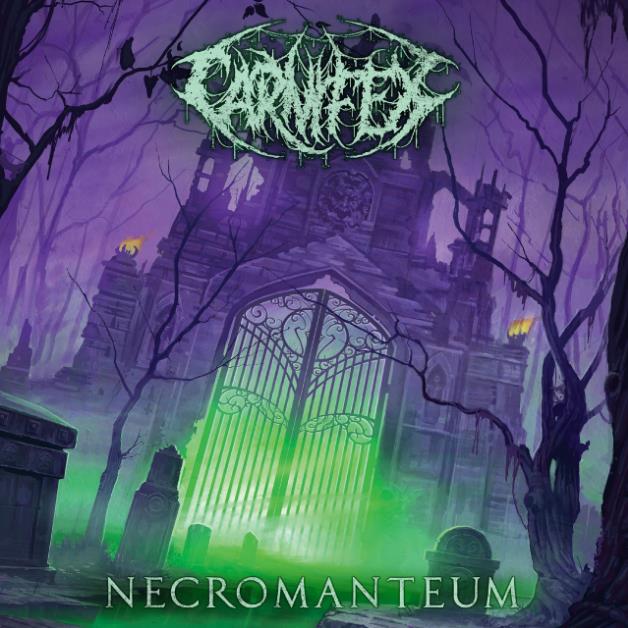
Produced by Jason Suecof, released by Nuclear Blast on 6 October 2023, with Shawn Cameron writing the keyboards and choirs behind his own drum kit, Neal Tiemann adding lead guitar and Tom Barber of Chelsea Grin guesting on "Death's Forgotten Children", Necromanteum is the record where Carnifex finally committed: Teeth of the Divine called it the full-on blackened and symphonic deathcore the band had been hinting at for years, and arguably the best album of its career. Thirteen years, one direction.
The title track, which Nuclear Blast released with an official video, is the quickest way into it, with Scott Ian Lewis trading growls for shrieks and the drop still landing where a pit expects it. Mute the keyboards in your head while it plays. What is left is the test.
Signed to Density Records for a first full-length released on 9 June 2015, with Tom Barber at the microphone three years before he left for Chelsea Grin, and still years away from the orchestra that turned it into the biggest name in the genre, the New Jersey band whose debut critics heard as deathcore with blackened leads was Lorna Shore, and the record was Psalms. Angry Metal Guy's review picked out the "breakneck blackened leads" of "From the Pale Mist" between creeping breakdowns. Among blackened deathcore bands it is one name among several. It got bigger later, for other reasons.
Blackened deathcore bands of the 2020s
The branch grew fastest after 2019, when a run of bands built their sound on it from the first record instead of drifting into it, and when the bands already on the circuit started rewiring their riffs on purpose.
Formed in Karlsruhe in 2014 as a slam-heavy brutal deathcore band, signed to Unique Leader for Inferis in 2019, and pointing by its guitarist Marvin Kessler's own account to Behemoth, Dimmu Borgir, Lorna Shore and Fleshgod Apocalypse, the German five-piece that kept every slam riff and strung black metal along the top of them on A Hill to Die Upon in May 2021 is Mental Cruelty. "King ov Fire", which Unique Leader released with an official video, is the song Angry Metal Guy's reviewer picked for the best slam riff on the record, and that same review, agreeing with a colleague, heard a band that could not choose between death metal and black metal and was glad of it.
The spelling is a flag. The riff is the proof.
The record works like razor wire coiled along the top of the brick wall behind a venue's loading bay: the brick takes the weight and holds it, the wire does the cutting, shredding the jacket of every kid who tries to climb in without a ticket. The slam is the brick. The tremolo is the wire. Mental Cruelty took a wall it had spent seven years building and put the wire on top, and the slam riffs, which another band would have bulldozed to make room for the black metal, are still there underneath, carrying the weight.

Formed in 2020 and filed as blackened deathcore, symphonic deathcore and blackened death metal all at once, the Brockton, Massachusetts, band that was born in the branch rather than converted to it is Worm Shepherd. Teeth of the Divine called its third album, Hunger, stellar, with the fair note attached that the band was working the Lorna Shore sound with hardly an original note, though among the best at it.
"Whispers Ov A Buried Land", a single released with an official video on 23 January 2026, closes the Dawn of the Iconoclast EP. Three full-lengths in, Worm Shepherd is still adding to the branch, not leaving it.
Formed in Las Vegas in 2020, the band that carried the archaic "ov" from its own name into the title of The Burden ov Faith in 2023, with Ricky Hoover at the microphone, is Ov Sulfur. The orchestra puts it with the symphonic bands. One review heard black metal screeches in its debut, and that keeps it in the branch.
Where the cold riff ends and the orchestra begins
On the family tree the blackened branch sits right beside the symphonic one, and the two share members without sharing mechanics. Orchestration adds a layer on top of the band, strings and choirs that carry the harmony while the guitars hold the rhythm. Blackening rewrites what the guitars and drums already play. Worm Shepherd, Mental Cruelty and Lorna Shore do both, and that is why the same names turn up under two labels.
The question that sorts any single record is short: mute the keyboards. If the riffs still sound like black metal, tremolo lines moving through minor keys over a blast that will not let go, the record is blackened. If the riffs collapse into chugs and the black metal was all in the strings, it was symphonic all along. A tremolo line carries a tune of its own, cold as it is, which leaves one more border to draw, the one around melodic deathcore bands, and where melody stops being symphonic, and that one is settled by who carries the tune, not by how cold it sounds.
| Band | Formed | Record to start with | What the black metal does |
|---|---|---|---|
| Abigail Williams | 2004, Phoenix | Legend EP (2006) | Symphonic black metal over metalcore influences, dropped by 2008 |
| Make Them Suffer | 2008, Perth | Neverbloom (2012) | Keyboards over deathcore, blackened death metal in the early tags, before the turn to metalcore |
| Carnifex | 2005, San Diego | Necromanteum (2023) | Creeps in from 2010, takes over the riffs in 2023 |
| Lorna Shore | 2009, New Jersey | Psalms (2015) | Blackened leads between the breakdowns, before the orchestra |
| Mental Cruelty | 2014, Karlsruhe | A Hill to Die Upon (2021) | Melodic black metal laid over slam riffs that stay |
| Worm Shepherd | 2020, Brockton | Hunger (2024) | Built in from the first record, with an orchestra on top |
| Ov Sulfur | 2020, Las Vegas | The Burden ov Faith (2023) | Blackened and symphonic at once |
Lay the dates side by side and they do the arguing. The two bands that only visited both left, one back to black metal and one on to metalcore. The bands that stayed are the ones that kept the breakdown exactly where it was and let black metal rewrite the riff, and by the 2020s that was no longer a band trying something. It was a branch with a record shelf, and a label behind it.

