
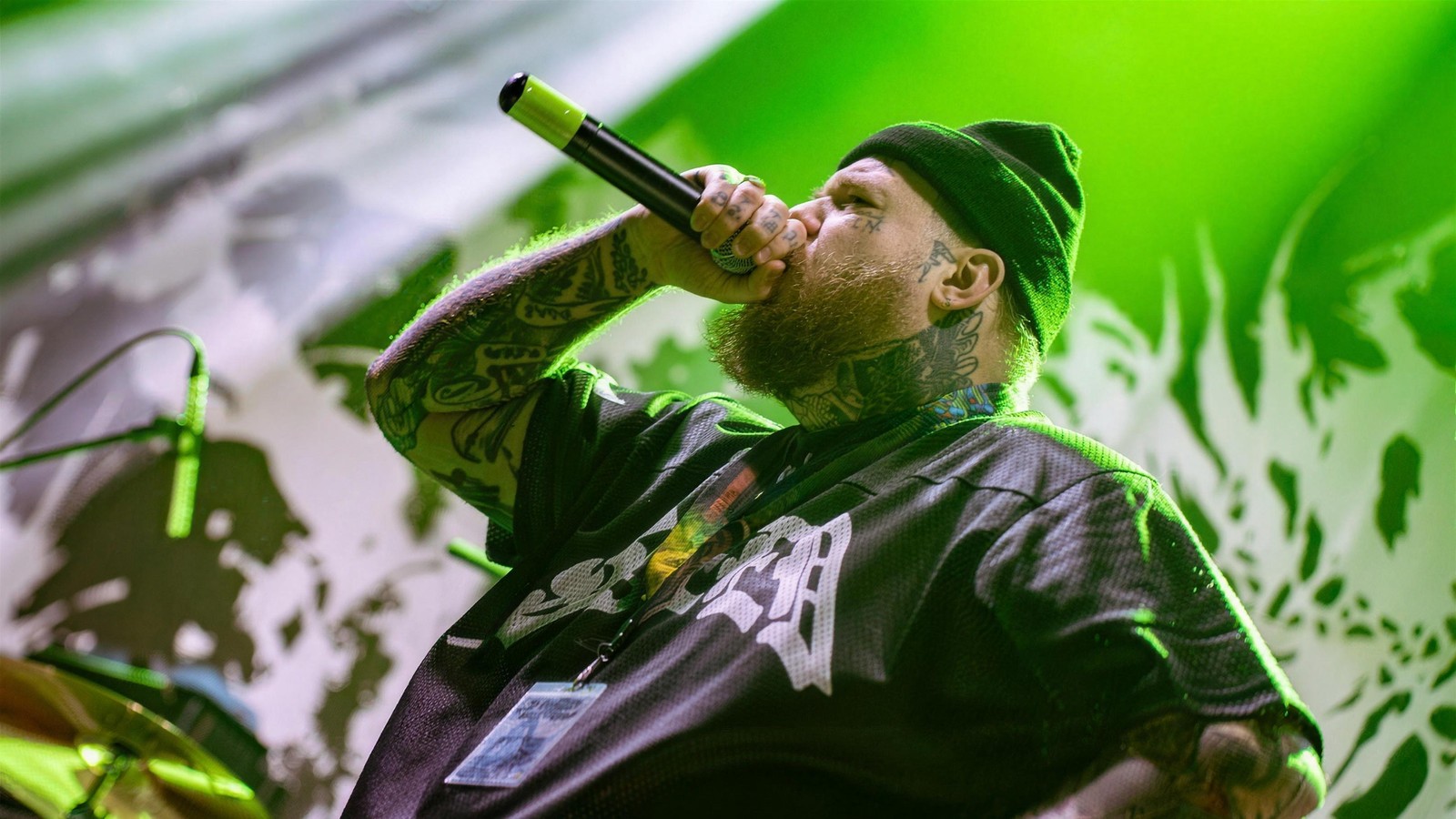
Eight studio albums in twenty years, and on the eighth the singing was done by the guitarists. Formed in Manchester in May 2006, held together ever since by Sean Hynes on guitar and Lyn Jeffs on drums, and left without a frontman weeks before its first record for Metal Blade was due, the band that ripped its departed singer's tracks off Denigration and had its two guitarists scream every line again before the album came out on 8 May 2026 is Ingested. Nobody outside was asked to fix it. The guitarists fixed it.
That record is the British habit in miniature. The UK deathcore bands that count are, nearly all of them, bands that did the job with whatever was standing in the room: a recording rig on a guitarist's computer in Hessle, a band member at the mixing desk in Sunderland, one drummer in two bands in Hull, two guitar players at the microphone in Manchester. Where the island sits among the other scenes, beside Montreal, Yekaterinburg and Blacktown, is laid out in the account that frames it. The bands are the evidence, one at a time.
Picture the bow ramp of a cross-Channel ferry coming down on the quay, a ton of hinged steel deck dropped onto concrete with a bang that rocks every splitter van waiting in the hold, the drivers turning their keys before the echo has died off the harbour wall. That is the first downbeat of a British breakdown. It was built to be driven off the boat by the people who played it.
UK deathcore bands from Lowestoft, Manchester and Sheffield
The forebear sits on the Suffolk coast. Started in Lowestoft in 2006, out with the Welcome to Sludge City EP the next year, signed to Nuclear Blast in March 2009 and released by the German label on 22 January 2010 with II: The Reign of Darkness, the fishing-town band whose drum stool Lyn Jeffs of Ingested held from August 2008 to September 2009 was Annotations of an Autopsy. The band stopped in 2013. It did not stay stopped. In June 2025 it was announced for the British dates of Slaughter to Prevail's Grizzly Winter tour beside Suicide Silence and Dying Fetus, and in January 2026 it took the 2007 EP to London, Manchester and Birmingham. A 2007 EP played to a headline crowd nineteen years later is the band's claim, and it comes first because the others grew out of it.

Ingested's claim is staying power, which in this genre is rarer than speed. Pressed first by Siege of Amida and Candlelight with Surpassing the Boundaries of Human Suffering in June 2009, passed to Century Media for The Architect of Extinction in 2015 and to Unique Leader for The Level Above Human in April 2018, the Manchester crew reached a fifth album with Where Only Gods May Tread on 14 August 2020 and kept the slam riff grinding through every label change without a gap longer than four years between records. In November 2019 it played its whole debut, start to finish, on a European run called the Decade of Human Suffering tour, with Within Destruction, Signs of the Swarm and Distant underneath it on the bill. Ten years after the debut, still headlining it.
The microphone is where the band has been tested. Jason Evans, a founder, left on 25 November 2024. Josh Davies replaced him that December and left in February 2026. The guitarists then re-recorded every vocal on Denigration, and the band said it was looking for a new singer.
Sheffield gave the list its most famous name and lost it inside two years. Bring Me the Horizon put out Count Your Blessings on Visible Noise in 2006 and left the death metal half of the bargain behind with Suicide Season in 2008. Its claim rests on one album, and on how quickly the band itself walked away from that sound.
Glasgow and Lincoln, both raised on Lamb of God

Two of the British bands wear the same American group on their sleeves. Formed in Glasgow in 2005 by teenagers who first played together working through Lamb of God songs at a youth club, introduced by Humanity on Rising Records in 2009, signed by Century Media in August 2012 and sent out with Uprising on 25 March 2013, the Scottish five that walked the longest road away from the genre without ever setting fire to the bridge behind it is Bleed from Within. Its singer, Scott Kennedy, moved over the years from the deathcore split of scream and growl to a single throaty growl, and in 2017 Steven Jones joined on guitar and clean vocals.
The title track of Uprising, which Century Media put out with an official video, marks the turn. Three months after the record came out the band was opening for Megadeth on four British dates in June 2013, after a spring support run in mainland Europe under Testament, and by November 2021 it had signed to Nuclear Blast, which released Zenith on 4 April 2025. The band is the proof of where the British exit door leads. The garrison left. The first record did not.
The UK deathcore bands that count are, nearly all of them, bands that did the job with whatever was standing in the room.
Lincoln took the other road and stayed. Playing under the name since 2008, out on Siege of Amida with the In Shadows EP in 2012 and back on the same label with Century Media beside it for No Hope No Morality at the end of April 2014, the band that tacked a cover of Lamb of God's "Redneck" onto the end of its second album as a bonus track is Martyr Defiled. That cover says more than any press release. A band from the East Midlands closing a deathcore record with the Virginia groove band's anthem names its forebear out loud, the same forebear a Glasgow youth club had been working through since 2005. The lineage runs through Richmond, not through California.
Hull: one band that stayed in the computer, one that slowed to a crawl
The Humber estuary gave Britain its two most copied ideas. Started in 2012 in Hessle, on the western edge of Hull, by Eddie Pickard on guitar and Aaron Kitcher on drums, with a singer from Indiana found online for The Palpable Leprosy of Pollution on 12 December 2012 and Dickie Allen, also American, for the two records after it, the trio that reached Billboard's Heatseekers chart with The Elysian Grandeval Galèriarch in July 2016 while working as a studio project is Infant Annihilator. It never needed the van. Its songs left Hessle as files and hit the internet like a breeze block lobbed through a shop window, glass across the pavement and nobody seen running, which is how a technical band that existed only as a studio project ends up on an American sales chart. The Battle of Yaldabaoth followed on 11 September 2019.
The same drummer and the same guitarist built the opposite band a year later. Built in Kingston upon Hull in 2013 by Kitcher and Pickard with Alex Teyen at the microphone, signed by Century Media on 10 June 2014 on the strength of two EPs, Falsifier and Born Hanged, the Hull five that dragged the breakdown down to a crawl and gave the slow branch of the genre its best known record is Black Tongue, and The Unconquerable Dark came out on 4 September 2015.
"Eclipse", which premiered as a video on 27 August 2014, is the method in four minutes. Hear it as a removal lorry reversing down a terraced street too narrow for it, every warning beep a downbeat, a drainpipe torn off the brickwork on one hit and the tailgate gouging a gutter off its brackets on the next, the gearbox grinding at walking pace while the whole row of houses shakes. Slow is the weapon. The band uses nothing else.
The record had a cost abroad. In October 2015 Black Tongue was due to support Carnifex across the United States with Lorna Shore on the bill, and on 21 October it announced that its US visas had been denied and that it would not play the tour. Nadir followed in October 2018. Reviewers have credited the Hull band with starting what got called downtempo deathcore, and that much is beyond dispute.
Sunderland and Farnham, the Unique Leader years
The younger British names went to Unique Leader, the Californian label that had already taken Ingested in 2018. Started in Sunderland in 2012, fronted by Ricky Lee Roper and signed by Unique Leader for Kingdom of Lies on 3 May 2019, the Wearside crew whose own guitarist, Andy Mallaby, engineered and produced its later records is Osiah. That self-sufficiency is the point. Loss followed on 7 May 2021, its lead single "The Eye of the Swarm" carrying a guest turn by Ben Duerr of Shadow of Intent, and Kairos came out on Unique Leader on 8 December 2023, engineered and produced by Mallaby and mixed and mastered by Christian Donaldson.
Surrey answered last and slowest. Emerging in 2016, on Unique Leader for The Hand of Violence in 2019, with the Eternal EP and the Penance album both following in 2021, then gone from view for three years of writing before A Mind Too Sick to Heal came out on 13 March 2026, the Farnham band that keeps the rampart of the slow breakdown standing for the generation after Black Tongue is Bound in Fear. "Chasm", one of the singles the label released with a video ahead of the album, is where to start. It proves that the slow branch Hull opened did not close behind it.
| Band | Home town | Formed | Start with |
|---|---|---|---|
| Bring Me the Horizon | Sheffield | 2004 | Count Your Blessings (2006) |
| Bleed from Within | Glasgow | 2005 | Humanity (2009) |
| Annotations of an Autopsy | Lowestoft | 2006 | II: The Reign of Darkness (2010) |
| Ingested | Manchester | 2006 | Where Only Gods May Tread (2020) |
| Martyr Defiled | Lincoln | 2008 | No Hope No Morality (2014) |
| Infant Annihilator | Hessle | 2012 | The Elysian Grandeval Galèriarch (2016) |
| Osiah | Sunderland | 2012 | Kingdom of Lies (2019) |
| Black Tongue | Hull | 2013 | The Unconquerable Dark (2015) |
| Bound in Fear | Farnham | 2016 | A Mind Too Sick to Heal (2026) |
Look at how each of these records got made and the pattern is plain. None of these bands waited for a scene or a city to make the record for it. Two guitarists sang an album because the singer had gone, a drummer and a guitarist built two different bands a year apart, a band member produced his own band's album, and a Lincoln band paid its debt to Richmond in public. Britain's deathcore was built by bands that did their own labour, which is why so many of them are still releasing records twenty years in. A city on the other side of the Atlantic got there through an established death metal craft instead, and that story belongs to Montreal and the Quebec deathcore scene.
