

Three high school students, nine songs, thirty-five minutes, and by the last track the human race is finished.
Recording with Bob Swanson at Mayhemness Studios in Sacramento, self-releasing the result on 25 May 2010 while its three players were still in class, and carrying a track called "Invasion" before closing on fifty-seven seconds called "End of Humanity", the studio project that marched an alien army across a deathcore debut from the first song to the last was Rings of Saturn. The record was Embryonic Anomaly. Earth lost.
Aliencore is the band's own word for what it does, and it began as a joke: the AllMusic biography reports that the group "humorously deemed" its brand of technical death metal aliencore, and by July 2014 its own label was introducing the band as the self-proclaimed masters of the word. The joke stuck because it named something a listener can actually hear, riffs that rip a run of notes up and down the neck faster than a hand seems able to follow, synthesizer patches and ambient passages wedged between the attacks, and lyric sheets in which the planet is invaded, harvested and then erased.
Heard in a small room, aliencore is a bug zapper hung from the porch rafter of a house show in July, the violet grid crackling while every moth in the county hurls itself into the wires faster than anyone could count the pops, until the first breakdown kicks the hook out of the rafter and the whole cage smashes on the concrete steps and goes dark. The crackle is the run. The steps are the drop.
The science fiction lyric sits beside gore, heartbreak and grief in the history it belongs to, but one band made the sky its entire catalogue, and that catalogue travelled somewhere nobody predicted in 2010. It started with an abduction. It ended with a war on heaven.
From abduction to a war on the gods
"Abducted" was the song that started it, posted online in 2009 by a project that then had Lucas Mann on guitars, bass and keyboards, Peter Pawlak singing and Brent Silletto on drums, and it pulled in listeners fast enough that Unique Leader, the California label built on brutal death metal, signed the band before 2010 was out. In February 2021 the band remade the whole record for its tenth anniversary, with new drums by Marco Pitruzzella and production by Sammy Morales, and gave "Abducted" an official video. The plot had not changed in eleven years. Something comes down out of the sky and takes people.
Then the aliens acquired a theology. Dingir, the second album and the first with Ian Bearer at the microphone, borrowed its title from the Sumerian word for a god, the sign that scribes wrote in front of a deity's name. For six years every album title after it reached back into ancient Mesopotamia.
Out on 14 October 2014, produced by Brette Ciamarra at Studio 344 in Pittsburgh, with Aaron Kitcher of Infant Annihilator sitting in on drums and the lyrics by Bearer, Lugal Ki En is where the alien lyric crossed into myth outright. Mann laid out the plot himself: long after the invaders conquer humanity, they evolve past space, time and reality and carry the conquest up into the realm of the gods, where they make war on angels and demons. He glossed the title as king of the earthlings, lord of the cosmic world. Abduction had become a crusade.
| Album | Released | What the title means | Where the story goes |
|---|---|---|---|
| Embryonic Anomaly | 25 May 2010 | English, no myth yet | Invasion, abduction, the end of humanity |
| Dingir | 5 February 2013 | Sumerian for a god | The invaders take on a sacred name |
| Lugal Ki En | 14 October 2014 | King of the earthlings, lord of the cosmic world (Mann's gloss) | The conquerors climb into the realm of the gods |
| Ultu Ulla | 28 July 2017 | Time immemorial (Mann's gloss) | An ancient entity that threatens all existence |
| Gidim | 25 October 2019 | Sumerian for a ghost of the dead | The last album with a singer |
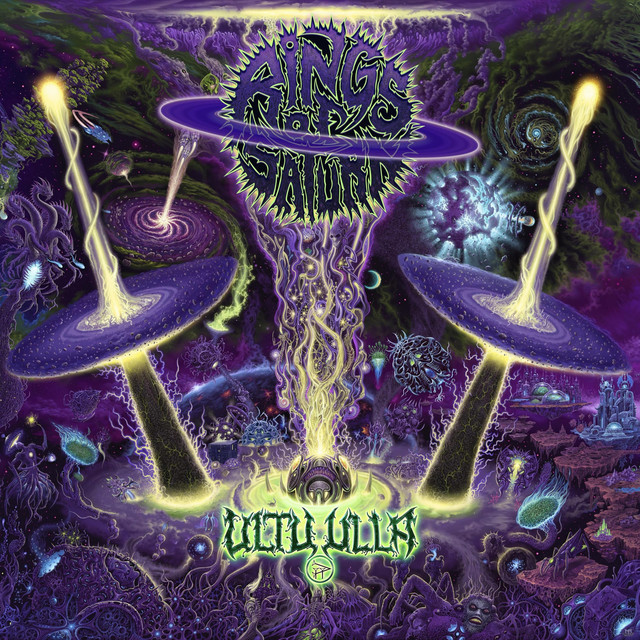
Released by Nuclear Blast on 28 July 2017, the band's first record for the label after signing in May 2016, Ultu Ulla pushed the story further back than history goes. Mann described it as aliens transcending space and time and digging up an ancient, incomprehensible entity that threatens the fabric of existence, and Mark Cooper of Mind Rape Art, who had painted the two sleeves before it, said his cover shows gods from beyond time and space invading three-dimensional reality and taking it over. The invaders had stopped being the biggest thing in the sky. Something older was waiting for them.
"Parallel Shift", the second single from that record, put out in July 2017 with a lyric video, comes from an album on which Mann is credited with the keyboards, the synthesizers and the programming as well as the guitars. The band's ambient pads behave like a tour van's CB radio picking up truckers three states away through a wall of static, the hiss and the warble of a voice from somewhere the van has never been, and every breakdown is the driver slamming the handset back into its cradle so hard that the bracket cracks off the dashboard. Transmission, then impact.
Gidim followed on Nuclear Blast on 25 October 2019, with the vocals tracked by Mark Lewis and Dan Watson of Enterprise Earth singing on "Hypodermis Glitch", and the band took it on the road that month with Enterprise Earth, AngelMaker and Brand of Sacrifice as support. It was the last album with a voice on it. In May 2021 Bearer was gone and the band announced a strictly instrumental direction, and the self-titled record of June 2022 has no lyric sheet at all.
Progressive alien deathcore and the other aliencore bands
A tag arrived to describe the shelf. On 26 December 2019 a writer for Ultimate Guitar, compiling a list of strange metal subgenres, described progressive alien deathcore as atmospheric, progressive deathcore set in space, with meticulous technicality and sound effects meant to feel alien, and named Rings of Saturn beside two far smaller names, Necropia and Mankind Grief. One reader answered under the piece that progressive alien deathcore is just technical deathcore. The objection is half right. The technique is shared with the whole technical branch; what the tag adds is the subject and the atmosphere wrapped around it, and that is a real difference on the record even if it changes nothing in the fingers.
The precedent was already a year and a half old when Embryonic Anomaly appeared. The Faceless had put an alien hand on human history across Planetary Duality in November 2008, but it made the record as a technical death metal band, so it handed deathcore a subject rather than a sound. The deathcore version needed a band that kept the drop.
Self-releasing its debut Servitude in December 2011, putting out a single called "Hollow Planet" on 15 September 2013, signing to Nuclear Blast in 2014 and touring Europe early in 2016 with Rings of Saturn on the same bill, the Australian band that wrote alien invasion into its country's deathcore was Aversions Crown. Its encyclopedia entry carries the same tag, progressive alien deathcore, for the speed of the playing and for lyrics about aliens taking the Earth.
The other routes into the sky ran through names and titles. Settling on its name in 2007, the Chicago-suburb band that took it from the Egyptian god Osiris and the story of his son Horus was Born of Osiris, and by 2021, long after it had moved over to progressive metalcore, it was still asking the same question in the title of Angel or Alien. Infant Annihilator self-released The Battle of Yaldabaoth on 11 September 2019, naming the record after the false creator god of the Gnostic texts. And Dan Watson, who sang the first Infant Annihilator album before forming Enterprise Earth, turns up on Gidim: the aliencore bands trade singers and share bills, and the progeny of 2010 is a handful of bands borrowing each other's players rather than a movement.
The joke stuck because it named something a listener can actually hear.
Gods without a spaceship
The cosmic lyric did not need the flying saucer for long. Once Rings of Saturn had walked its invaders into heaven, the next step was obvious: leave out the spacecraft and keep the gods, the multiverse and the end of everything.

Formed in Durban in 2014, signed to Unique Leader in May 2021 and back that September with a fourteen-song record produced by Christian Donaldson of Cryptopsy, the South African band that wrote the genre's most complete cosmic myth is Vulvodynia, and Praenuntius Infiniti (17 September 2021) is the book. The band's own synopsis tells of an interdimensional godlike being cast out into the abyss by the elder gods, who starts devouring the known multiverse while the heavens are torn apart and the other gods scramble for a plan. The earth had already been eaten, the band explained, at the end of its 2015 EP Finis Omnium Ignorantiam. The track list closes on "Funeral Ov the Gods" and "Deicidal Finality". Nobody survives the sortie.
"Eternal Wasteland of Galaxies", released as a single with a video on 22 June 2021, is, in the band's description, a small chapter in which the main character has swallowed the world and everything afterwards happens in his belly. The riff under that story is a storm drain under a festival car park in a cloudburst, the grate choking and then giving way, the flood sucking a whole campsite into the dark, tents, coolers, a folding table and a van's torn-off wing mirror all spun once round the opening and gone. The slam does not chase the listener. It drags him down into the low register and keeps him there.
That is the cosmic and mythic lyric the symphonic years carried, and the orchestra gave it a size that the alien lyric of 2010 only gestured at with synth pads. Even Lorna Shore's Pain Remains, a record built around a dreamer escaping his own life, puts a song called "Apotheosis", the old word for a mortal raised to a god, in the middle of its running order. Slaughter to Prevail went to the forest witch of Slavic folk tale, Mental Cruelty to the aurora of the old Norse stories, and in 2024 Vulvodynia itself came down from the far galaxies to African folklore. Fiction borrowed whole from a manga, a game or a film is a separate shelf, the one that holds berserk, halo and the horror film, and Shadow of Intent, which took its name from a starship in a game, belongs on that shelf. The gods in this shelf belong to nobody's franchise.
Why the sky suits the breakdown
The reason science fiction and old myth suit deathcore so well is mechanical. A guttural lyric is mostly inaudible in the room. What carries a subject to the floor is the title, the sleeve and the sound, and a sound that already arrives inhuman, a run of notes firing too fast for a hand to seem possible, a pad that hangs over the riff like weather, a voice dredged from somewhere under the stage, wants a subject bigger than a breakup. A god eating the multiverse is in scale with a full-band breakdown. A girlfriend is not.
The breakdown, in turn, is what keeps the cosmic story from floating away. Every aliencore record and every one of those myth records still lands on the same concussive drop the basement bands built, and that drop is what places Rings of Saturn and Vulvodynia inside the survey that covers it rather than in technical death metal or slam. The sky is the costume. The floor is the genre.
The strongest evidence came when the words left. Rings of Saturn has had no singer since 2021, and the self-titled record still sounds like the band that called itself aliencore, because the alien was never in the lyric sheet nobody could hear. It was in the speed of the runs, the hum of the synths and the gap before the drop. The planet, the gods and the king of the earthlings were the oracle's story. The guitars were the rampart that held it up.
