
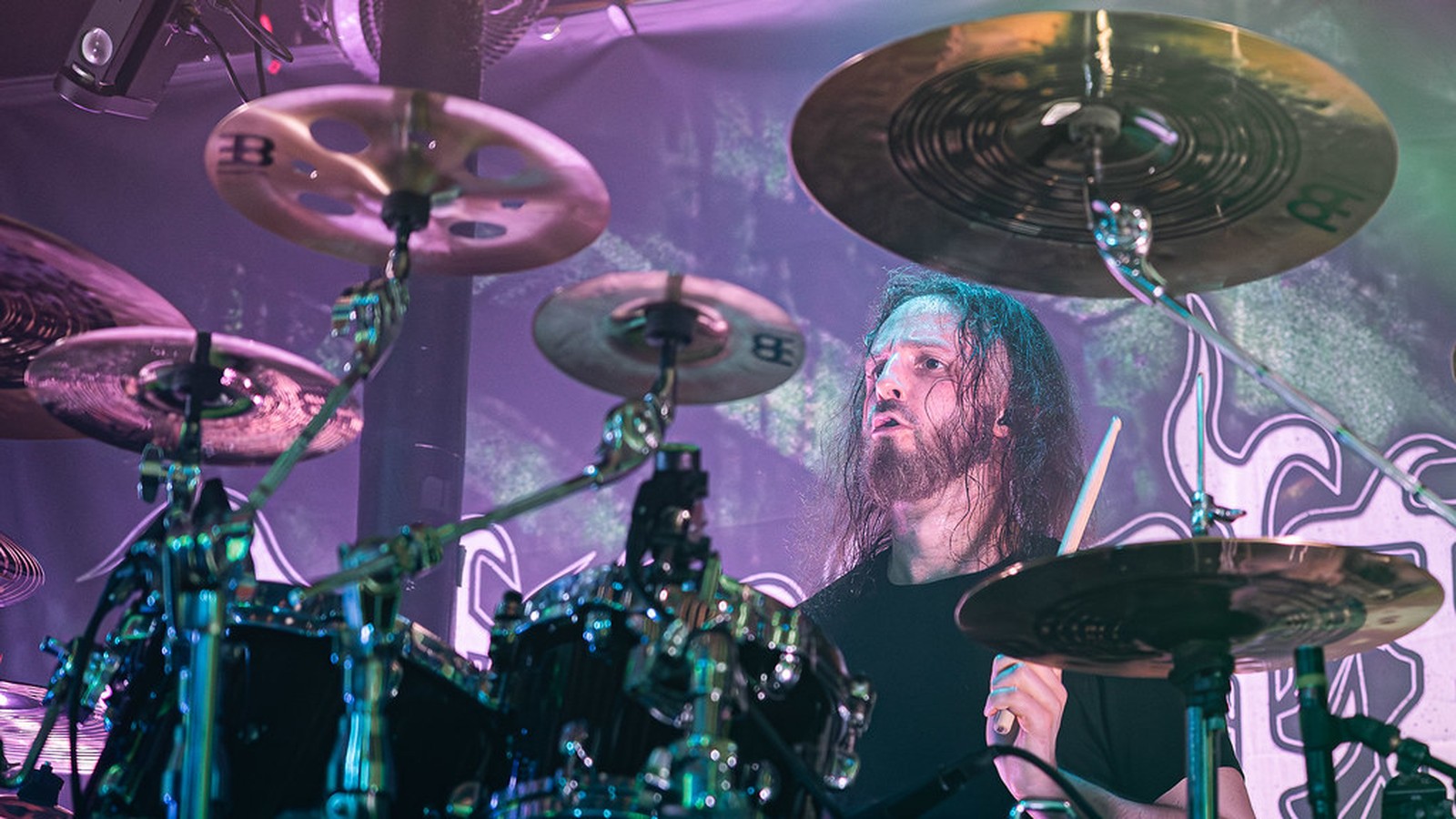
In 1996, in the Polish town of Krosno, a twelve-year-old sat down behind the drums of the death metal band his fifteen-year-old brother was starting.
The schoolboy who would spend the next eleven years making a drum kit argue with the guitars instead of following them was Witold Kiełtyka, known to everyone as Vitek, and the band was Decapitated. Recording its first album for an Earache imprint while he was still fifteen, cutting three more before he was twenty-three and a death metal band on every record, Decapitated made records on which the blast tears the snare head to ribbons at full speed and then slams shut on a groove, and that hand brake, more than any tempo, is what a deathcore drum part is built around.
Speed gets the headlines. Deceleration does the damage.
Out on the interstate in a cloudburst, the band van is doing seventy with the wipers on their fastest setting, two blades thrashing across the glass in a blur nobody could count. Then the driver slams the stalk down to the slow sweep without lifting his foot. The engine is still screaming at the same revs and the road is still pouring under the wheels at the same speed, but now the blades drag across the glass once for every two passes they made a second earlier, the rubber shrieking, the arms juddering on their spindles, until on the heaviest pass the driver's side arm rips off its spindle and cartwheels into the next lane. That is half time, the engine untouched and the pulse cut in two. In this music the drummer has his hand on the stalk.
Blast, brake and the bar of silence
Death metal owns the blast beat, with its family tree and every name for every branch of it. Deathcore borrows the thing and uses it as a runway. A blast in a deathcore song seldom lasts long enough to become the point: it carries a salvo of tremolo riffing and high screaming, it fixes the top speed the song will ever reach, and then it is thrown away, because the only thing a deathcore drummer really needs from a blast is something to brake out of.
The brake has three common forms. The first is a fill crammed into the last beat before the drop. The second is a cymbal grabbed and choked dead on the final count, so the ring is strangled before it can blur the downbeat. The third is nothing at all, a beat or a whole bar in which the drummer stops, the sticks hang in the air and the room leans forward into the hole. Then the crash, the kick and the first chug land together on the one, a single concussive blow that sets the new pulse in the time it takes to hear it.
The only thing a deathcore drummer really needs from a blast is something to brake out of.
The gravity roll is the fill made for that last beat. It does not count strokes, it throws them. Think of the zipper on a road-worn duffel bag at the back of the trailer, ripped open in one pull so that a hundred teeth part in a second with a single tearing rasp, the bag falling open in the drummer's lap: the roll empties a whole burst of snare hits into one sound, too fast to number, and the breakdown spills out of it. Where a tom fill walks down the kit toward the drop, the gravity roll gets there in a single motion, and that is why it so often sits on the last beat rather than across the whole bar.
The kick under the breakdown: how a deathcore drum part marks half time
Inside the breakdown the drummer's hands and feet stop doing the same job. The hands keep the clock: the snare drops back to a single stroke on the third beat of the bar instead of two, and a china or a crash is struck on every quarter note, the wide, trashy cymbal that the whole floor stamps to. The feet leave the clock behind and play the riff, the kick drum following the guitarist's palm-muted chugs stroke for stroke, so that the rhythm of the breakdown is struck twice, once on a string tuned near the floor and once on a drumhead.
That split explains why a breakdown can be syncopated and still impossible to lose. The chug pattern can land early, late and in odd groupings, the kick hammering out every irregular hit right along with it, while the cymbal on the quarters never moves, and so the room always knows where the one is even when the guitars are sitting in a gap. Take the cymbal away and the riff turns into a puzzle. Take the kick away and it loses its weight. A deathcore drum part needs both, on the same bar, from the same body.
The Knoxville band that has stacked three guitarists on the same chug since 2007 and leaned the whole lot on its drummer's right foot is Whitechapel, and on 24 July 2012 Metal Blade posted a drum playthrough of "Hate Creation", from the self-titled album the label had released that June, with Ben Harclerode at the kit. A playthrough strips the guitars out of the picture and leaves the drummer alone with the part, which is the place to watch for the split between the hands and the feet.
The rest of the machine around the kit, the riffs, the low tunings and the studio, is laid out in the survey that covers it. The drummer's share of it is time: how long a section lasts, and how hard the next one lands.
Why the kick drum is triggered
A seven-string guitar tuned to drop A puts its lowest open note at 55 hertz, squarely inside the range where the body of a kick drum lives, and when three guitars, or four stacked takes of one guitar, pile into that register on a breakdown, the acoustic kick is buried alive. You feel it in your sternum. You stop hearing it as a separate instrument. A drummer whose whole job in the breakdown is to play the riff on the kick cannot afford to disappear inside the riff.
The trigger is the way out. A sensor on the drumhead fires a sample with every stroke, and what the sample adds is mostly attack, the click of the beater, which sits well above the guitars' low end and cuts straight through it. Untriggered, a kick under three guitars that low is a fist pounding a mattress propped against the trailer wall: the trailer rocks and nobody outside hears a thing. The trigger screws a sheet of steel to the mattress, and every punch rings off it across the lot.
The death metal drummers deathcore grew up on were making the same call. Steve Asheim of Deicide told Modern Drummer in January 2007 that he put ddrum triggers on his kicks and nowhere else, because a fully triggered kit makes a band sound "like a machine", and that line, kick yes and the rest of the kit no, is a compromise plenty of heavy drummers still make. In January 2017 Conor Sullivan of Ice Nine Kills told the same magazine that his band blended a kick trigger with the natural drum for "a clean and consistent sound" out front.
Consistency is the second reason, and on a long blast it matters as much as the first. A foot that has been working for a minute at full speed does not strike the head as hard as it did at the start, and a sample does not care: it holds every kick to machine tolerance. Sensor, module and sample are the same hardware every metal drummer bolts on, and how drum triggers are used in metal runs from the pads to the samples; what deathcore needs from them is the register, and the clean gap between one kick and the next that a breakdown is built on.
Decapitated and the two habits that crossed over
The two habits were built in Krosno: a blast that breaks off without warning, and a kit that plays a line of its own instead of keeping time under the guitars. Annable Courts, reviewing Organic Hallucinosis for Antichrist Magazine on 4 December 2020, heard Vitek fill the record with "solo-riffs on the drums" and make the drums "go their own way rather than just being mere support for the guitars", while the songs swung from blast beat anarchy into a slower groove. The same review counts "tons of impressive fills" on the 2006 record, a kit kept busy as well as free.

Vitek is the drummer on "Spheres of Madness", from Nihility, the second Decapitated album, released by Earache in February 2002, and the label's channel carries the song as an official video. His brother Wacław, called Vogg, played guitar beside him. Every record he made was a death metal record.
In late October 2007 the band's tour bus collided with a truck near the border between Russia and Belarus. Vitek died of his injuries on 2 November 2007. He was 23.
Vogg rebuilt the band in 2009. The bills tell the rest. In 2010 Decapitated headlined the Summer Slaughter tour across North America with All Shall Perish, Veil of Maya and Carnifex beneath it, and in 2017 Thy Art Is Murder set out on a long co-headlining run with Decapitated, Fallujah and Ghost Bath, CJ McMahon telling Decibel on 18 July that year that the band had decided it wanted to share the top of the bill with the Polish band.

The record shows the traffic ran both ways. On Carnival Is Forever, released by Nuclear Blast in July 2011 with Kerim Lechner, called Krimh, on the stool, Larry Owens of Teeth of the Divine heard a record that put "even more emphasis on groove" and singled out "Pest" for a breakdown "just past the halfway mark" that "absolutely pulverizes". A death metal band that had given deathcore its brake was now dropping into the floor-level breakdown deathcore had made famous. In March 2025 Chris Garza, the guitarist who founded Suicide Silence, sat Vogg down on his own podcast and cut a clip from the episode around one of Decapitated's death metal riffs. A deathcore founder, handing the microphone to the man who wrote it.
The hardest parts on the kit
The parts drummers treat as the hardest in this music are rarely the fastest. Speed is a number, and it can be practised up to. What breaks drummers is the turn: coming off a full blast into half time with no ramp, landing the first kick of the breakdown exactly on the first chug after a minute of blasting has already drained the legs, then keeping the right foot locked to an irregular riff at the slowest tempo in the song, where every late hit stands alone in the silence and everybody in the room can hear it.
The drummer filmed for the label's own channel playing "King Ov Deception" is Austin Archey, and the song comes from Lorna Shore's Immortal, released by Century Media on 31 January 2020, a record Metal Insider's review of 15 January heard packed with "tons of blistering blast beats" while urging the listener to get up off the floor after "that ridiculous breakdown right in the middle" of this very track. Century Media put the official drum playthrough out on 16 April 2021. Blasts on one side, a breakdown in the middle, the same two feet carrying both: that is the hard part, set out on a single song.
The other thing that lands with the first kick of a breakdown is not on the kit at all. On many records the sub drop goes off on that same downbeat, a falling tone out of the band's sampler that sinks under the kick into the bottom of the PA, and the two have to hit on the same count or the first blow of the breakdown splits in half. Where the low end goes after the kick, and what the band plays before the first blast, belongs to bass drops, samples and the horror intro.
Put the pieces in order and the drummer's work in deathcore is easy to state and hard to do. The blast sets the top speed. A fill, a choke or a bar of silence ends it. The hands mark the new, wider pulse on the snare and the cymbal while the feet play the riff with the guitars, and a trigger makes sure that riff can be heard under the strings. Decapitated showed that a drum kit could stop dead and swing in the same song, and deathcore made that lineage into a whole genre built on the stop.

