
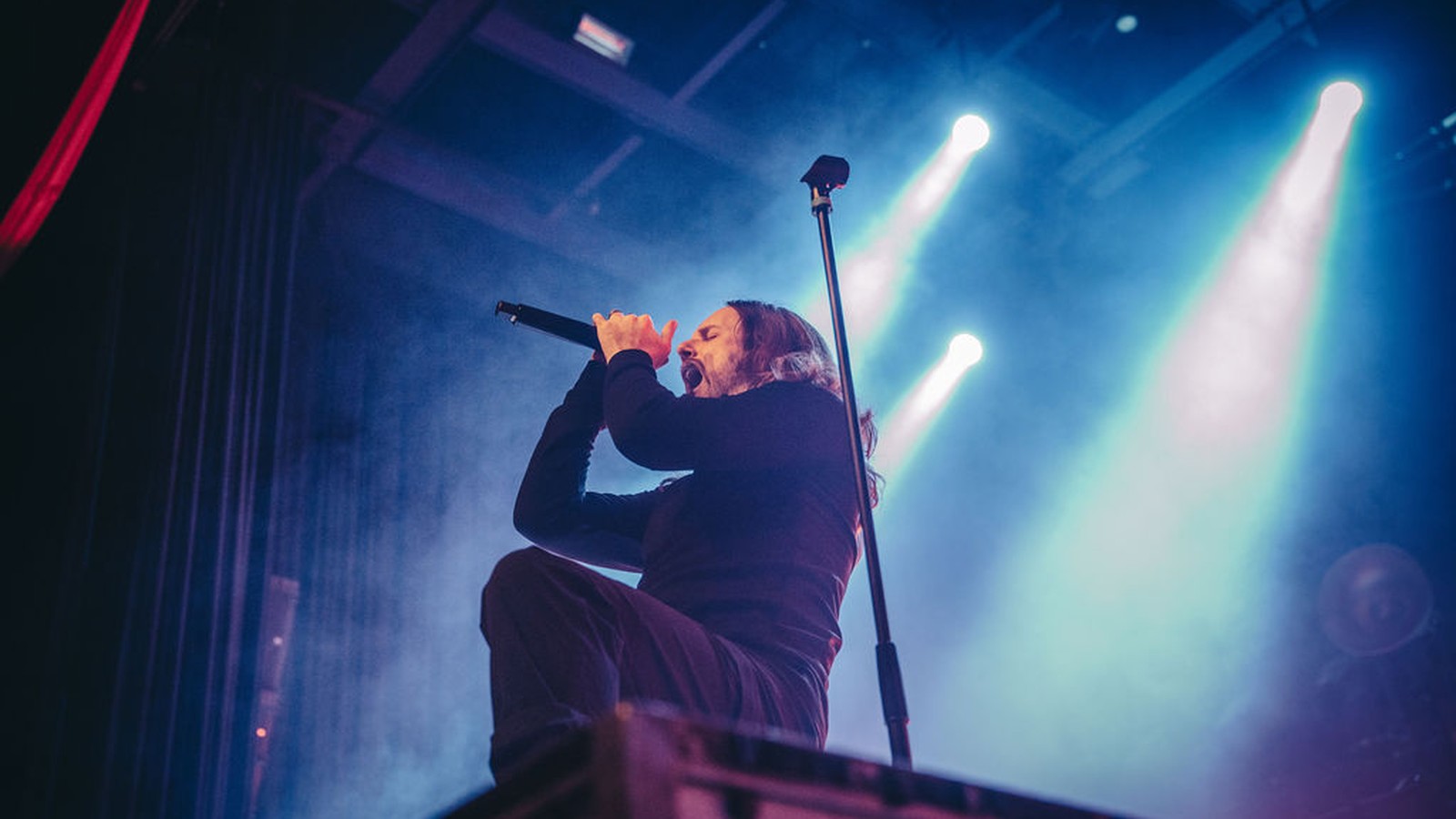
Nobody in deathcore wrote a softer breakdown to carry a harder subject. Released by Metal Blade on 29 March 2019, built out of its singer's childhood in Hardin Valley, Tennessee, and carrying in "Hickory Creek" the first song the band had ever sung clean from the opening bar to the last, the seventh album was The Valley, and the band with three guitarists that had been grinding club floors into splinters since 2006 was Whitechapel. The rest of the record did what Whitechapel records do. The guitars chewed through the low strings, the kick drum stamped dents into the stage, and every breakdown fell on the floor as a salvo, on schedule.
Nothing about the breakdown changed. The voice did.
Picture the luggage bays under a sleeper bus at the end of a run: two 4x12 cabinets, a bass rig, the drum shells and three bins of unsold shirts shoved in with a shoulder until two roadies have to throw their full weight against the bay door to make it latch, and wedged in the middle of all that tonnage, pinned so tight it cannot shift an inch over six hundred miles of interstate, one acoustic guitar case. That is how a confessional deathcore record is packed. The breakdowns are the cabinets. The clean song rides in the middle, and it arrives in one piece because of the weight leaned against it on every side.
Phil Bozeman told Exclaim! in April 2019 that there was no real preparation for the clean parts and that he simply winged them. He added that his singing voice comes easier after he has been screaming, because the screaming loosens everything up. The first clean vocals on a Whitechapel record had come three years earlier, on Mark of the Blade in 2016.
Deathcore mental health songs of the 2010s and 2020s took depression, addiction and grief as their subjects, written by musicians from their own lives or from what fans told them. Most of what is known about these songs comes from the musicians themselves, in line-up statements, interviews and album features. The songs changed. The drop underneath them stayed as heavy as it had ever been.
The older subjects, slasher films, breakups, scripture and starships, belong to the account that frames it. The confessional lyric differs from them in one respect only. Its characters are people with names and birthdays, and the details about them reach the public through the band that wrote them down.
A cold December in Belleville
Tracked in December 2015 at Graphic Nature Audio in Belleville, New Jersey, produced, engineered, mixed and mastered by Will Putney and released by Nuclear Blast on 12 August 2016, the split record that loaded the low strings of three touring bands onto one sleeve was The Depression Sessions, and the three were Thy Art Is Murder, The Acacia Strain and Fit for an Autopsy. The collective statement Nuclear Blast issued with the release said months of heavy touring and a cold New Jersey backdrop had set the tone for a dark, honest and moody record. Fit for an Autopsy filled one of its slots with a cover of "The Perfect Drug" by Nine Inch Nails.
Three rhythm sections tuned that low shared one record. Nobody had to open the lyric sheet to learn the subject. The title was on the front.
Thy Art Is Murder's share, an original and a Rammstein cover, was the last music the band recorded before CJ McMahon left, according to Nuclear Blast's release notes. The band announced his departure on 21 December 2015. He gave money as the main reason, telling fans the members had earned between 16,000 and 18,000 dollars each over six or seven years, as Music Feeds reported on 22 December. On 14 January 2017 he rejoined the band on stage at the Unify festival in Victoria, and told the crowd he had been a drug addict, as Blabbermouth reported that night. On 22 January he wrote on Instagram that he had made himself a drug addict, and Blabbermouth reported that he blamed his addiction for his departure.
Nick Arthur of Molotov Solution sang the band's European and British dates the month after he left, and other guest singers covered the twelve months that followed. McMahon sang on Dear Desolation, released later in 2017. He spoke about his addiction on stage a year after he left. The split had been tracked thirteen months before he said so.
Deathcore mental health in a line-up statement
The Salt Lake City band that had spent a decade stacking a shrieked top line over its own guttural low and dropping both onto seven-string breakdowns was Chelsea Grin, and in early 2018 it was recording a fifth album in Los Angeles, produced by Drew Fulk and Joshua Travis. The record was finished by April. Its founding singer was not on it.
On 27 April 2018 the band said Alex Koehler had decided to leave after a stay in rehab and the changes he had made in his new sobriety. The statement said the members had a mutual understanding that touring was too volatile an environment for a recovering alcoholic. Koehler posted his own account the same day. He wrote that he had struggled with depression and alcoholism for a long time, and that he had relapsed while the band was recording in Los Angeles, after a few sober months. He wrote that his manager Mike Milford, Kevin Lyman and the MusiCares charity had helped him into a treatment facility. Three weeks into treatment, he wrote, he learned that the band had dropped its tour, and at the next visit the members told him the album had been finished without him. He described stepping down as his own decision, made during his rehabilitation, and said he was three months sober.
Koehler did not stop writing. He started a solo project called Grudges, and he put out the video for its first single, "Misery", alongside his statement, and said he wrote the song while he was in rehab. The band put Tom Barber, formerly of Lorna Shore, in front of the microphone and said it would play live as a four-piece.
The statement that explained the line-up also premiered "Dead Rose", the first single from Eternal Nightmare, and said the four-piece would play the Warped Tour that summer on the Monster Mutant Red Dawn stage. Rise released the album on 13 July 2018, with Barber on vocals.
Nobody in deathcore wrote a softer breakdown to carry a harder subject.
Written from what the fans said
Released by Solid State on 14 September 2018, the record on which the Texas band hauled the sung chorus out of the back of its songs and bolted it to the front was Dark Skies, and the band was Fit for a King. A chorus over a breakdown riff works like a cardboard sign held up by a kid riding the crowd's shoulders above the barricade: underneath him the pit slams into the steel rail and security hauls bodies over it two at a time, and the sign stays up, letters facing the stage, the one thing in the room that can still be read. That is the trade a heavy band makes when it wants its words heard. Ryan Kirby told Heavy Consequence on 22 October 2018 that choruses had always been an afterthought for a band known for heaviness, and that this time the band spent far more hours on them.
"Shattered Glass" is the song on that record that carries the subject. Kirby was careful about whose experience it was. He told the same interviewer that he had social anxiety growing up but had never personally dealt with depression, and that on the song he was trying to describe what depression feels like to somebody who does not understand it. In a February 2019 interview with Substream he said he had talked to hundreds of fans who were depressed or had been, and that the song was his attempt to put what they feel into words.
That is a different kind of confession, and an honest one. Kirby wrote down what fans had told him, and said in print that he was doing so.
Family losses on three records
Back on The Valley, the story Whitechapel told was the singer's own. Bozeman told Exclaim! on 2 April 2019 that the album is told from several points of view: his own as a child, his own as an adult looking back, and his mother's, in her own words. He had kept a journal his late mother wrote, and he put passages from it directly into the lyrics.
Kin continued the story on Metal Blade in October 2021. Then the band took both records home.

Recorded at the band's seventh annual Christmas benefit show at The Mill & Mine in Knoxville on 22 December 2022, engineered, mixed and mastered by the band's guitarist Zach Householder and released digitally by Metal Blade on 26 January 2024, the live record that opens on six songs from The Valley, follows them with five from Kin and closes on two older songs, "This Is Exile" and "The Saw Is the Law", is Live in the Valley. Three guitars on one low string, a bass and a kick drum: the percussive weight of the whole set pounds a hometown floor three days before Christmas. The band said the recording was a way to close the chapter on those two albums before it started its ninth.
Two live videos were shot for the release, and the first one out, on 14 November 2023, was "Lost Boy", from Kin, filmed by Marshall Wieczorek. The band played both albums back in Knoxville, the city beside Hardin Valley, where the first of them is set.
Out as a single in January 2023, two months before the debut album The Burden ov Faith came out on Century Media on 24 March, "Earthen" is the song Ov Sulfur wrote about a death in Ricky Hoover's family. Hoover said in a statement published by Wall of Sound on 19 January 2023 that it is about his nephew, who died of cancer at sixteen, after bone marrow transplants failed and the boy decided to stop treatment. He said it is about witnessing that and being there, holding him when he died. He said the song was very emotional for him and that he was crying in the studio while he tracked the vocals.
Century Media put the song out with an official video. Wall of Sound, writing about the single the day it came out, noted that the chorus is the only clean section of the track.
Lorna Shore's fifth album went a step further and put the family story first. Released by Century Media on 12 September 2025, I Feel the Everblack Festering Within Me opens with "Prison of Flesh", and the album takes its title from a line in that song. Rock Sound, in a feature built on an interview with Will Ramos and published on 28 August 2025, wrote that "Prison of Flesh" is about Ramos watching members of his family decline with dementia, and that "Glenwood" is about his estrangement from his father.
The same feature wrote that "Unbreakable" and "Lionheart" are about overcoming adversity. "Prison of Flesh" runs seven minutes, and "Glenwood" is the fifth track.
What the confessional turn changed
Set side by side, the records make the pattern plain. The confessional turn changed the paperwork around deathcore: a split record named after its mood, a line-up statement that let a departing singer explain himself in his own words, an interview in which the singer said he was writing from his fans' accounts, a magazine feature that set out what the opening song was about, a live album recorded at a hometown benefit. It gave clean voices a whole song on The Valley and a single chorus on "Earthen". It never asked the breakdown to slow down. The drop stayed an anvil.
The same bands also turned their lyrics outward, toward churches, governments and a pipeline in North Dakota, and Thy Art Is Murder and Fit for an Autopsy wrote some of the plainest of those songs. That outward turn runs through Holy War, Hate and the planet. The confessional songs kept their subjects close to home, and left the plain version to the statements and interviews.
