
One Law for the Lion & Ox is Oppression.William Blake, The Marriage of Heaven and Hell
Kicked off the shelf by death metal's record collectors, waved away as a fad by a guitarist from inside it, and still dragged through the comment thread under every clip twenty years after its first tours, the genre that two older genres keep measuring with their own rulers, and finding short every single time, is deathcore.
Why is deathcore hated? Because its critics read it the way an inspector would read a car built for the demolition derby. The windows knocked out, the back seat ripped out and dumped behind the grandstand, the trim, the lights and the radio torn off, the doors chained shut and the gas tank hauled inside behind a roll cage: every item on the inspector's list is missing, and every one of them was stripped on purpose, so that the car is still moving when the last wreck in the pit has stalled. The critics are right about what is gone. They are wrong about why.
Count what the complaints actually name and there are five of them. The riffs, said to run a few bars and quit. The breakdown, heard as the song stopping dead. The production, triggered and edited until it sounds as if nobody played it. The look and the timing, a genre that arrived on MySpace wearing a haircut. And the voice, a bag of tricks with a squeal at the bottom of it. Each one is a claim about a part, which means each one can be checked against records, and the story of deathcore from its first records to its revival supplies more of those than one listen can take in.
Why do people hate deathcore? Two rulebooks, one record
Two older genres hold a claim on this music, and each brings its own rulebook to the hearing. Death metal's book rewards the riff that develops, the solo that earns its minute, and the song that keeps changing shape and seldom plays a section the same way twice. Hardcore's book wants the breakdown, but as one cue among the shout-alongs and the two-step, a few bars for the floor before the song gets on with being a song. Deathcore breaks a rule in each book on purpose. Read it from either book alone and you hear a mistake.
That is the mechanism of the backlash, and it has nothing to do with taste. Whether deathcore counts as metal at all is a border question, settled part by part in the history it belongs to; why the answer still makes people angry is a question about which book is open on the desk while the record plays.
The label took the first blows. Justin Longshore of Through the Eyes of the Dead told Decoymusic in March 2007 that he hated the term and heard in it the new thing the kids were following. Three years later Scott Lewis of Carnifex told Noisecreep that his band was not one of those trying to escape the banner of deathcore, and that plenty of the bands who acted as if the word were a problem sounded very much like it. A guitarist and a singer, one word, and under the word the same parts in both bands' songs.
Deathcore is an often maligned term that can instantly diminish a band's credibility.
Bryce Lucien of Seeker, Terrorizer, 4 November 2013
Credibility with whom is the part the sentence leaves out. With a death metal crowd, the word on a flyer warns of one thing above all, a song that will stop running and drop into half time on the lowest string. With the crowd that came for exactly that, the same word is a promise. The sticker has never changed. The reader holding it has.
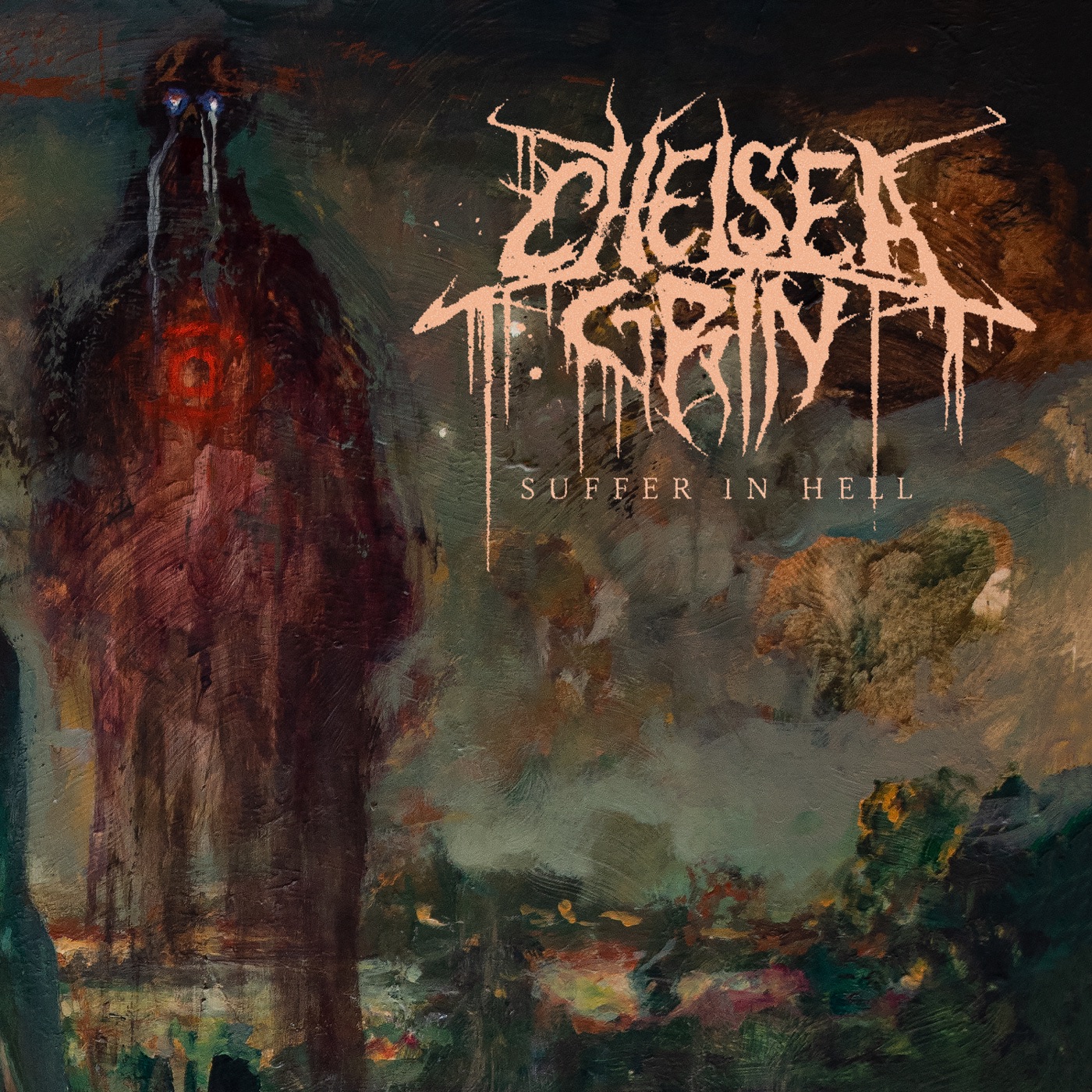
The death metal side of the quarrel has never been as tidy as its loudest voices. Formed in Salt Lake City in 2007, filed under deathcore from its first EP onward, and back on 11 November 2022 with Suffer in Hell, the first half of a double album, released through ONErpm with Tom Barber, formerly of Lorna Shore, at the microphone, the band that handed a track of its own record to a melodic death metal singer is Chelsea Grin.
"Forever Bloom", the second track, carries a guest vocal by Trevor Strnad of The Black Dahlia Murder. Strnad died in May 2022, aged 41, and his bandmates announced it on 11 May. The song was released as a single on 21 October 2022, five months later.
The song itself settles the technical point. A singer from the death metal side recorded for a deathcore band, and the two sets of parts shared one song. Nobody had to translate anything. The quarrel between the two rulebooks was never about whether the parts can share a song, because they have shared songs for twenty years, but about which part the song is built to reach.
The riff that is never allowed to finish
The commonest charge from the death metal side is about riffs. A deathcore riff, the complaint runs, plays for a few bars, never develops, never hands over to a solo, and exists only to be thrown away the moment the drop arrives. Measured against a death metal record where the riffs are the destination, that is an accurate report of what happens. It is not an accurate report of what the riff is for.
A deathcore riff aims. The tremolo line and the chromatic crawl down the low strings carry speed toward one point, the way the puck on the air hockey table in a club's back game room carries the speed of every rebound, rail to rail too fast to follow, until somebody slams it at the slot so hard it jumps the table and cracks the plasterboard behind it. Nobody faults the puck for leaving the table. Every rebound was loading that last hit.
Nobody faults the puck for leaving the table. Every rebound was loading that last hit.
The solo charge took its own beating in 2022. Released by Century Media on 14 October 2022 and produced by Josh Schroeder, carrying guitar solos by Adam De Micco over orchestral arrangements and still landing its songs on the drop, the album that tore the solo argument down to its studs was Pain Remains, by Lorna Shore. It went to number 6 in Germany and number 5 on the UK Rock & Metal Albums chart. A solo did not lift the record out of deathcore, and its absence never pushed any record in.
Riff economy is a choice about where the weight goes, not a shortage of ideas. A death metal song spends its invention across the riffs. A deathcore song spends it on the approach to one moment, and judges every bar by whether it makes the drop hit harder. Different budgets. Same currency.
The breakdown is not a reset button
The second charge is the one most often aimed at the breakdown itself. The song stops, the complaint goes, all the momentum built by the blasts is thrown away, and the band starts again from nothing at half speed, as if somebody had pressed a reset button in the middle of the track.
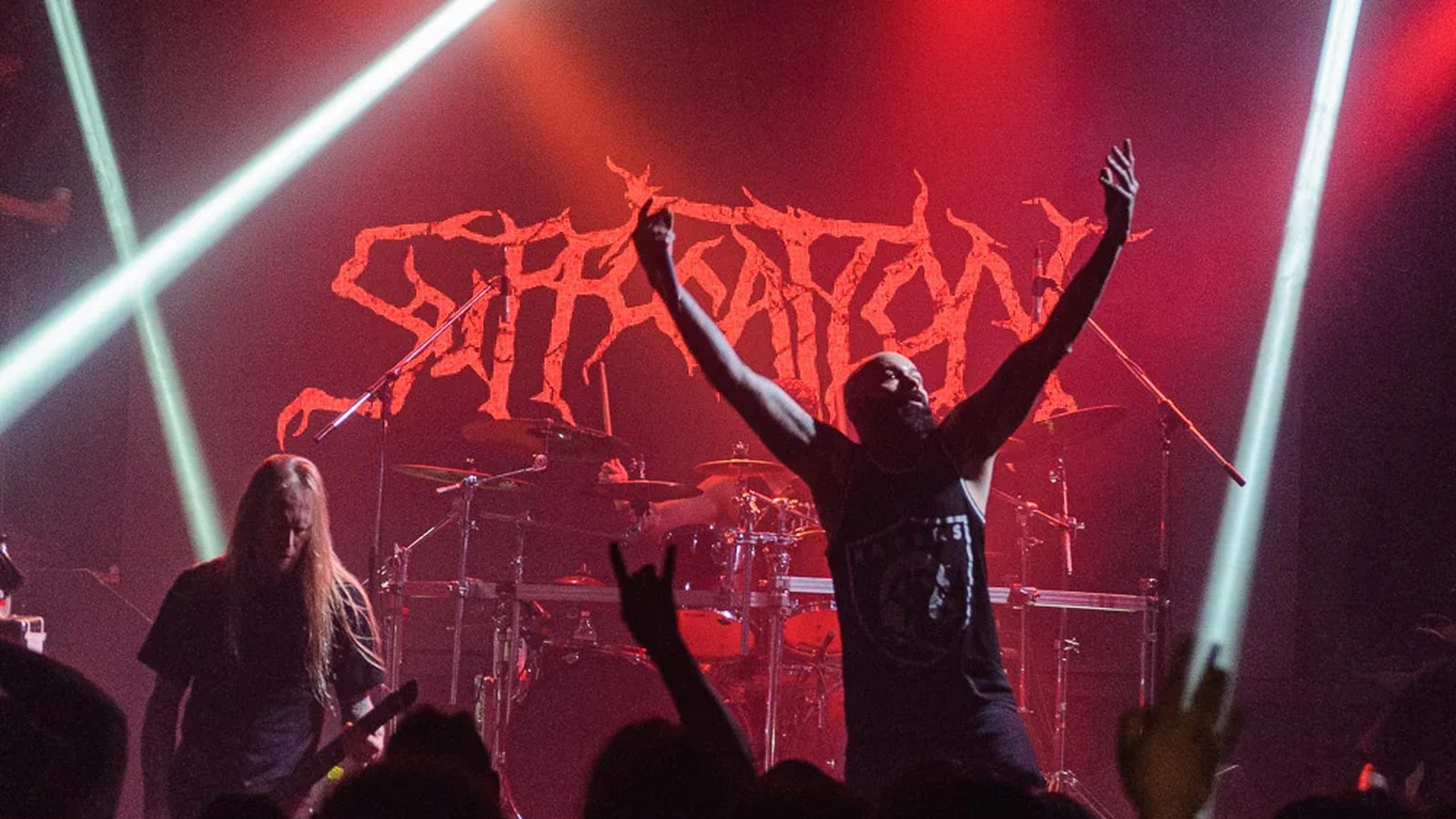
A reset sends a machine back to its first state. A breakdown sends a room forward. The pulse never stops in half time: the drummer's hands slow while the kick drum doubles the guitar, the open low string is hit on the same grid the blast was running on, and the bar that felt like a sprint becomes a bar that feels like a stamp. Nothing is restarted. The same tempo is felt from the floor instead of from the ceiling, and the crowd that stood still for the fast parts moves on the slow one.
| Charge | What its critics say is missing | What the part does | A record to test it |
|---|---|---|---|
| Riff economy | Development, the solo | Carries speed toward one point | Lorna Shore, Pain Remains (2022) |
| The breakdown | Momentum, continuity | Keeps the pulse, moves the floor | Carnifex, Graveside Confessions (2021) |
| Production | A human performance | Separates kick and low string in one register | Suffocation, Effigy of the Forgotten (1991), for the precedent |
| Image and timing | Seriousness, staying power | Nothing; the haircut is not a part | Carnifex, "Slit Wrist Savior", 2007 and 2021 |
| Vocal tricks | Singing, a single honest voice | Percussion and a cue for the drop | Lorna Shore, "Pain Remains I: Dancing Like Flames" |
Metalcore uses the same device and spends it on something else, and that difference is the cleanest line through deathcore vs metalcore: a metalcore song tends to leave its breakdown for a sung chorus, while a deathcore song leaves one breakdown to reach a heavier one. Both bands are working the floor. Only one of them is selling a hook on the way out.
That debt cuts against the reset charge from the death metal side's own shelf. Formed on Long Island and on record for Roadrunner by October 1991, the band whose slow parts the deathcore generation lifted wholesale and tuned lower was Suffocation, and the death metal fans who call the breakdown an outsider's habit are holding a record that already had one in it.
Triggers, grids and the studio charge
The third charge is about the studio. Deathcore records, the critics say, are triggered, edited and replaced until they sound as if nobody played them, every kick drum lined up on the grid and swapped for a sample, every band in a label's catalogue run through the same desk until the records blur together.
The editing is real. Picture a mason laying a concrete block wall behind a club's loading dock, a string line pulled tight from corner to corner: every block that sits proud of the line gets a knock of the rubber mallet until it drops level, and the ones that will not drop get split with a hammer and thrown in the skip, a fresh block set in their place. That is a quantised drum track with samples underneath, every hit tapped onto the line and the stray ones smashed out and replaced. The wall comes out straight. Straight is what a breakdown needs.
It needs it for a reason you can hear. In half time, on a guitar tuned to A, the low note and the kick drum sit in nearly the same register, and the music is as much in the gaps between hits as in the hits themselves. A kick that lands a few milliseconds off the chug smears two sounds into one, and the gap the room is waiting for fills with mud. The grid is a tool for keeping a gap clean.
The charge also forgets that one studio, one producer and one desk is the oldest answer to it. Morrisound Recording in Tampa, founded by the brothers Jim and Tom Morris in 1981, called the Mecca for death metal by Suffocation's Terrance Hobbs, engineered and mixed the Florida death metal records of the late 1980s and early 1990s, and the studio's run with Scott Burns covers Obituary, Death, Cannibal Corpse, Deicide and Morbid Angel. The sound of the genre that judges deathcore was built on the same kind of desk, by the same kind of practitioner. By common consent those records are now classics. The method never decided that. The songs did.
Swoops, squeals and the MySpace clock
The last two charges arrive together, because they arrived together. Deathcore broke between 2006 and 2009 on profile pages, to a young audience, with the haircuts and band shirts of the first photographs anyone saw, and a good part of the backlash was a judgement on those photographs. Hair is not a part of a song. The timing explains how fast the audience arrived, not what the music does, and the honest test of a song written in that window is to play it again when the window has closed.

Released by Nuclear Blast on 3 September 2021, produced by the band with Mick Kenney at Back Lounge Studio in San Diego, and closed with three songs re-recorded from a debut that had sold its first copies in the MySpace years, the album that put the old material back on trial in front of a new audience was Graveside Confessions, and the band behind it was Carnifex.
"Slit Wrist Savior", first heard on Dead in My Arms in July 2007, returned as a single with a new video on 13 August 2021. The haircuts in the old band photos did not survive the decade. The song did, and it came back as the closing salvo of a Nuclear Blast record, cut again fourteen years later.
The vocal charge is the oldest creed in the case against the genre: the squeal is a trick, the low growl is a studio effect, and none of it is singing. The squeal, performed on the inhale or the exhale, is not there to carry a tune. It does a drummer's job. Dropped on the off-beat of a breakdown or into the bar before one, it works like a van's locked tyres shrieking across a wet loading lot, the sound that tells everyone in earshot the bumper is about to fold against the dock. Nobody asks a skid to carry a melody. It is there to announce the crash.
The studio-trick half of the charge has had a long answer in the 2020s. "Pain Remains I: Dancing Like Flames", released as a single on 14 September 2022, came from a record on which Dom Lawson of Blabbermouth heard, in Will Ramos, a vocalist of inhuman gifts and a versatile delivery. A trick that has to be repeated live night after night is a technique with a tensile strength nobody fakes, and the singers who use it train it the way a drummer trains a blast.
Put the five charges side by side and they share one habit. Each names something deathcore leaves out, accurately, and each stops before asking what that part would have cost the song. A solo costs the approach a minute. A chorus costs the drop its weight. A loose kick costs the gap. Twenty years of complaints have the facts right. What they hear as faults are decisions, and every one of them was taken to make one bar land harder.
