
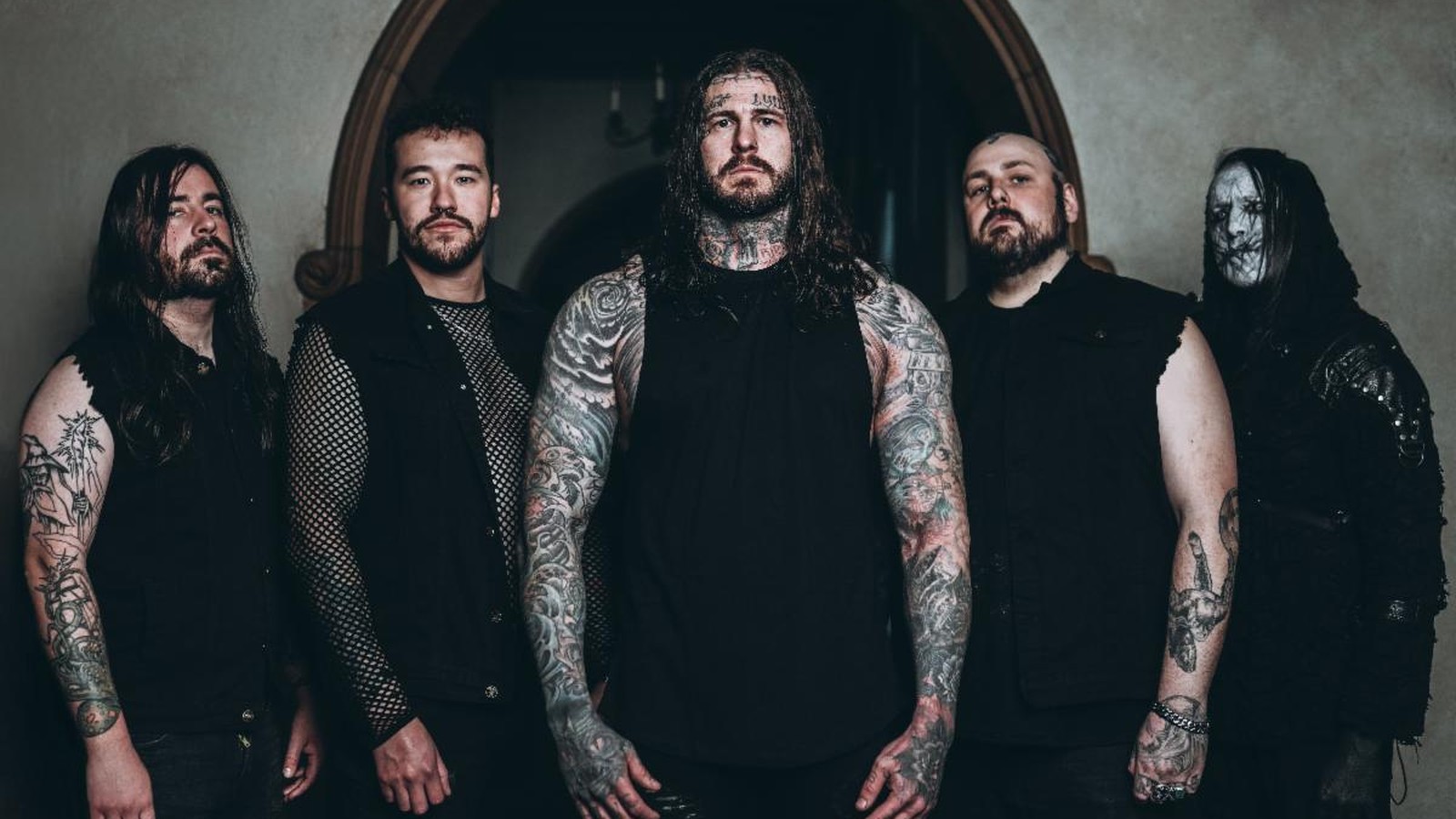
In March 2023 Century Media released The Burden ov Faith, the first album by a deathcore band whose name, by its singer's own account, means "of hell".
Named for fire and brimstone, flying a symbol built partly out of the leviathan cross, and writing songs its singer described to New Noise Magazine as all very anti-religious, the Las Vegas band with hell in its name and a declared atheist at the microphone is Ov Sulfur. Hell on the sleeve. No devil in the creed.
So is deathcore satanic? Almost never in what its writers believe, and only now and then in what they borrow. The sigils, the archaic spellings and the talk of damnation came into the genre with the black metal riff, which spread through it in the 2010s, the way the autopsy table had come in with the death metal riff a decade earlier, and the music under all of it neither prays nor curses. A breakdown knocks the ceiling tiles out of their grid the same way whatever the man at the microphone thinks about God.
Picture the hall of a Catholic parish that rents its basement for all-ages shows on Saturday nights, the bingo caller's table shoved against the back wall with the wire cage still bolted to it and seventy-five numbered balls inside. The first breakdown shakes the table off its folding legs, the cage smashes onto the linoleum, its little door bursts open and the balls scatter under the pit, and when the house lights come up a kid holds up a six he found by the stage and announces that it means something. The drop scattered every number exactly the same way. The kid chose which one to pick up.
That is the whole question, in one basement.
Is deathcore satanic where the black metal came in?
Where the devil does turn up in deathcore, he comes in through the black metal door. When the blackened branch spread through the genre in the 2010s, its bands took the tremolo line and the shriek from the second wave of black metal, and a few of them took the iconography that had travelled with those tools since the early nineties: Latin titles, altars and priests on the track list. The riff came with its luggage. Some bands unpacked all of it, most kept only the clothes.

Founded in 2014 in Karlsruhe, putting out Inferis through Unique Leader in 2019, and filed by Metal Archives under Satanism, occultism, blasphemy and death worship for its early records, the German band that came closer than any other big name in the genre to an outright satanic lyric sheet is Mental Cruelty. The track list of Inferis reads like an order of service turned upside down, with "Priest of Damnation", "Blood Altar" and "Godhunt" on it, and Metal Purgatory's review in May 2019 heard the record working through Satanism, Armageddon and misanthropy as metaphor, with little trace of anything biblical.
"Planet of Misery", the song Unique Leader put out with an official video, shows how little the theology changes the machinery. The slam riffs land like the safe from the pawn shop next door to a club sliding off a tow truck's flatbed when the chain parts, a ton of steel going straight through the sidewalk slab and leaving the concrete cracked in a star around it, and the lyric above that impact could be a black mass or a shopping list for all the floor can tell. The pit does not read the booklet. It reads the drop.
Then the band turned. Metal Archives lists Norse mythology, folklore and the personal for the later records, and the songs Century Media has since released with official videos carry titles like "Raise the Raven Banner" and "The Serpent of Midgard". The devil did not last. The record shows the band that read most like a satanic sect in 2019 writing sagas a few years later, and the riffs barely noticed the apostasy.
What the lyric sheets carry instead
Take the database that catalogues extreme metal band by band and read the field it keeps for lyrical themes. For twelve of the genre's established names, it gives the following.
| Band | Formed | Themes listed |
|---|---|---|
| Despised Icon | 2002 | Misanthropy, anti-capitalism (early); madness, society (later) |
| Job for a Cowboy | 2003 | Death, apocalypse, society, politics |
| Carnifex | 2005 | Death, depression, isolation, hatred, suicide, violence |
| Impending Doom | 2005 | Christianity, repentance, salvation, Armageddon, social critique |
| Winds of Plague | 2005 | Hatred, murder, war, domination |
| Whitechapel | 2006 | Whitechapel murders (early); anti-religion, corruption, inner struggles, conceptual stories (later) |
| Thy Art Is Murder | 2006 | Misogyny (early); anti-religion, violence, murder, politics |
| Shadow of Intent | 2013 | Halo games (early); death, depression, war, darkness (later) |
| Mental Cruelty | 2014 | Satanism, occultism, blasphemy, death worship (early); Norse mythology and folklore, personal (later) |
| Signs of the Swarm | 2014 | Anti-religion, apocalypse, death, misanthropy |
| Ov Sulfur | 2020 | Anti-religion, death |
| Worm Shepherd | 2020 | Negativity, death, depression, anti-religion |
Satanism appears once in that column, and only against one band's early records. Anti-religion appears five times. Christianity appears once. Everything else is death, war, murder, depression, society and a video game, which is what you would expect from a genre whose parents were death metal and hardcore, because neither parent ran on the devil. Death metal handed over the morgue, hardcore handed over the grudge, and the young bands of 2005 fired both kinds of ordnance at the same open string.
The oldest layer, the one that crossed over from death metal with the blast beat, is the subject of gore, horror and misanthropy, and it carries far more blood than brimstone. A slasher in the woods is a horror film, not a liturgy.
The newer layers moved inward and outward at once, toward childhoods and grief on one side and pipelines and wars on the other, and the full map of the themes of the genre shows how little room any of that leaves for a horned god. Read the subjects in order and the devil is a rare guest. Murder turns up more often.
Against the church is not for the devil
The confusion that sends parents to a search bar usually starts with the anti-religious bands, because a song that attacks a church sounds, from the next room, like a song that worships its enemy. It is the opposite. A satanist needs a devil to believe in. An atheist has none.
Ricky Hoover of Ov Sulfur put it as plainly as anyone has. He told Distorted Sound in May 2023 that almost two decades of studying theology had shown him a sense of control as the thing the Abrahamic religions and the others share, and then gave the album's aim in one sentence: "The whole goal with the album for me is to open minds and to speak to the people who are supposedly destined to go to hell and to empower them." In March 2024, on the Beyond the Eternal tour, he told New Noise that he had not grown up in a religious household, had gone to church later in his teens and had been treated badly there, and that some of the songs come from his reasons for being an atheist. The debut's title names a burden. Nothing in his account of it kneels to anything.
A satanist needs a devil to believe in. An atheist has none.
The same column in the table holds Whitechapel, Thy Art Is Murder, Signs of the Swarm and Worm Shepherd, and the anti-religious deathcore song works like the back wall of a club answering the street preacher who sets up his bullhorn on the sidewalk at doors: the first breakdown comes through the brick, rattles the glass out of the fire door's little window, swallows the bullhorn whole, and nobody inside has knelt to anything. The unbelieving are shouting back. They are not holding a service.
Put the two bands from that single side by side and the whole spectrum fits on one stage. One spent its early records inside satanic imagery and walked out of it, the other declares itself atheist and hangs hell on its name as a provocation, and both build their songs on the same orchestral layer and the same drop.
The other side of the same question
Turn the question around and it answers itself a second time. Christian deathcore is a working scene with its own labels and its own festival, and Impending Doom, its best-known band, is listed by Metal Archives under Christianity, repentance, salvation, Armageddon and social critique. Armageddon also turns up in Metal Purgatory's reading of Inferis. The same end of the world, written from opposite pews.
Play an Impending Doom breakdown and a Mental Cruelty breakdown back to back with the vocals muted and nobody in the room could say which band prays and which band blasphemes, because the low string, the half-time drum and the gap before the hit carry no belief at all. Both camps came out of the same hardcore matinees and the same death metal tape trading, a history traced in how a scene became a genre, and both inherited a breakdown that had never been asked what it thought about God.
That is the mechanical answer. Belief lives in the words, the artwork and what a band says in interviews. It cannot live in the riff, so the riff can never be evidence for it.
Is Lorna Shore satanic?
No, and the band's own explanations of its songs point somewhere else entirely. The question attaches itself to Lorna Shore for understandable reasons: the song that pulled a new audience into the genre in 2021 is called "To the Hellfire", the band's sleeves are dark, the choirs on its records sound churchly, and Will Ramos can produce sounds that a first-time listener takes for something not quite human.
Start with the voice. The high shriek that sends people looking for demons is closer to brake pads worn down to their steel backing plates on a band van riding them down the last grade before the venue, the rotors scored and smoking and the whole axle screaming, a noise made by hardware pushed past its limit rather than by anything summoned. The low growl under it is the same one the genre has always had.
The song title is just as easy to check. Ramos told Metal Insider in August 2021 that the three songs of ...And I Return to Nothingness were built on the idea of life, death and rebirth, with "To the Hellfire" standing for death, the next song for floating through the ether afterwards and the last for being reborn. He wrote them after a tour, during the pandemic, in a dark place by his own description. Just before the pandemic he had lost his uncle. The 2022 album that followed the EP, Pain Remains, opens with a track called "Welcome Back, O' Sleeping Dreamer", and nobody is summoned in the title either.
I Feel the Everblack Festering Within Me, released by Century Media on 12 September 2025, turned the lyric sheet toward the singer's own family. Rock Sound reported in August 2025 that the opener, "Prison of Flesh", is about members of Ramos's family declining with dementia, that "Glenwood" is about his estrangement from his father, and that "Unbreakable" and "Lionheart" are about getting through hardship. Those are the subjects. None of them involves a devil.
Lorna Shore sits on every list of the genre's essential names, and its place beside Despised Icon, Whitechapel and Slaughter to Prevail is set out in the survey that covers it. What the band writes about, by its singer's account, is death, rebirth, illness, family and the will to carry on.
So the answer holds for the genre as for its biggest band. Deathcore is not satanic. A few of its bands borrow occult iconography along with black metal's riffs, one well-known band wrote from it for a few years and moved on, several argue against religion outright, and a Christian scene plays the same breakdowns for the opposite reasons. The way to know what any band believes is to read its words and its interviews, and the way to know what genre it is, is to listen to what it plays.
