
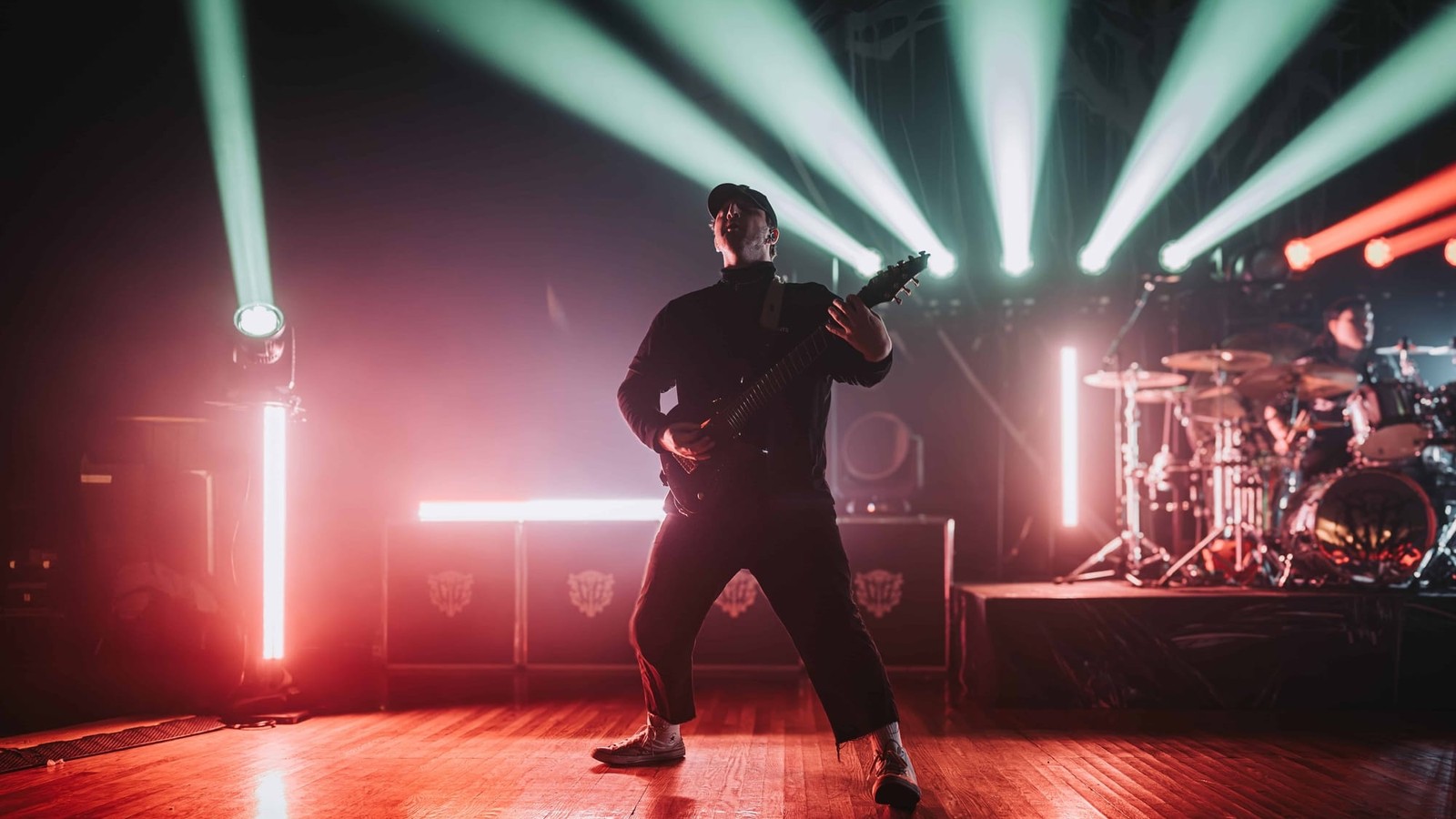
Deathcore travelled through a screen at least as much as through a stage, and the music video did the carrying. It still does.
Sent out by Century Media one clip at a time between 13 May and 14 October 2022, opening with "Sun//Eater" and closing with the third part of the title song on the morning the record reached the shops, six songs from Pain Remains were shot, lit, graded and fired into the feed, most of them months before anyone could hold the album, and the New Jersey band that turned a record launch into a five-month campaign of deathcore music videos was Lorna Shore. Six songs, six videos, one album, one hundred and fifty-four days. The album arrived to find its songs already played to pieces.
Only the scale was new. From the first label-backed clips of the mid-2000s the video was the thing that kicked in the bedroom door of a kid three states away from the nearest show and showed him what the room was supposed to look like when the drop came: which way the pit tears open, where the singer plants his feet, how low the guitars hang, how many bodies a VFW hall can hold before the barricade buckles. The warehouse taught that first. The film set raised the budget and kept the lesson.
Picture one of them with the sound off and the machinery shows. On a rented soundstage a camera crane swings its arm out over the drum riser with a stack of steel counterweight plates bolted to the back end, and the operator rides it up through the build, holds it at the top through the bar of silence, then drives the arm down onto the kit on the first hit of the breakdown so hard that the plates jump their pin and smash onto the concrete. Every lamp and lens on the set is balanced against that one beat. Take the breakdown off the back of the arm and the camera has nowhere to fall.
The camera is one strand of a culture that also runs through painted sleeves, readable logos, package tours and pits, which the longer account lays side by side. Its own road runs from rented rooms in Montreal and Riverside to LED walls with technicians assigned to them, and every mile of it is dated.
Deathcore music videos before the budgets, 2005 to 2010
Signed to Century Media in January 2005, putting The Healing Process out through the label on 5 April that year with two lead vocalists, Steve Marois and Alex Erian, and sending "The Sunset Will Never Charm Us" out as a video, the Montreal sextet that gave deathcore one of its first label-backed videos was Despised Icon. IMVDb credits the direction to Jean-Philippe Bernier, and an MTV page from 2007 credits him with "In the Arms of Perdition".
Century Media put the clip on its YouTube channel on 19 July 2006, when the site was not yet a year and a half old. A metal label was already filing its catalogue there. When the band issued its first DVD, Montreal Assault, on 27 January 2009, every music video it had made went onto the disc beside a multi-camera shoot of a sold-out hometown show and a documentary. The clips were already half of what the band was selling.
Picture the cheap version. A rented warehouse, a borrowed camera on a milk crate and the milk crate on a four-wheeled furniture dolly hired from a moving company, shoved across the concrete by whoever was not in the band while sixty friends from the last show pack the frame, until the first breakdown hurls a body sideways into the dolly, the wheels shoot out from under the crate and the camera slams lens first into the floor and keeps recording. The shot of the ceiling goes in the edit. The crowd was the camera move.
Filmed on 4 June 2010 while the band headlined a sold-out night at The Boardwalk, a club in Orangevale, California, released that July, and credited by the band's own channel to Stefan Anderson as director, the clip for "Sonnet of the Wretched" turned a concert into a video, and the Salt Lake City band that filmed its own crowd was Chelsea Grin. The audience was the set.
Victory Records ran the same economy with a director it kept coming back to. Frankie Nasso directed "10 Signs You Should Leave" for Emmure, a clip dated 2007 on the band's channel, and the band's VEVO channel, which carries Victory's copyright line, credits him with "Sound Wave Superior" and "False Love in Real Life" as well. Victory kept the same director for the run.
Posted by Metal Blade on 1 July 2008, a week ahead of the album that shared its title, and directed by David Brodsky after a shoot Lambgoat announced in May, the clip for "This Is Exile" belonged to a Tennessee band whose label put the picture out before the record had a chart position to show for it, and that band was Whitechapel. A second clip, for "Possession", followed on 16 November. The album debuted on the Billboard 200 on 5,900 copies in its first week. The clip had done the spadework first.

Released by Century Media on 18 September 2007, debuting at number 94 on the Billboard 200 on 7,250 copies in its first week and promoted with label videos that began with "The Price of Beauty" on 14 September 2007 and took in "Bludgeoned to Death" on 3 March 2008, The Cleansing became one of the best-selling debuts in its label's history, and the Riverside quintet behind it was Suicide Silence. The videos were part of the pitch.
The next clips went to horror outlets. The video for "Wake Up", the opening song of 2009's No Time to Bleed, premiered on Fearnet, a horror network's website, and "Genocide" got a clip made together with Bloody Disgusting, the horror news site, while a remix of the song went onto the soundtrack of Saw VI. The horror audience and the deathcore audience shared a room, and the music video was the door between them.
Label money and the directors it hired, 2011 to 2014
Hired for The Black Crown, filming Suicide Silence from 5 June 2011, premiering the clip on 12 July, the day the album came out and set off on a run that took it to number 28 on the Billboard 200, and seeing it reach Century Media's channel on 18 July, the director who put "You Only Live Once" on film was Nathan Cox, who had co-directed Linkin Park's "In the End", named Best Rock Video at the MTV Video Music Awards of 2002. That is what a label budget bought in 2011. A band that had spread on MySpace now had a director who had won on MTV.
Cox came back for "Slaves to Substance", which Century Media posted on 11 April 2012. Mitch Lucker, the band's singer, died on 1 November 2012 after a motorcycle crash in Huntington Beach. Eddie Hermida of All Shall Perish was named the band's vocalist on 2 October 2013. Cox also directed "You Can't Stop Me", the title song of the first album with Hermida, which Nuclear Blast posted on 1 July 2014. Three clips, two labels, one director.
Stefan Anderson made the same climb with Chelsea Grin. After the Boardwalk night he directed "Don't Ask, Don't Tell", the closing song of the Evolve EP, which Artery Recordings released on 19 June 2012 and whose video the label posted on 13 November; IMVDb lists him as its director. The director stayed the same, and the label's channel was now the one carrying the picture.
Directed and shot by Chris Elder for a record that first came out on Halfcut Records, an Australian independent, on 19 October 2012 and was reissued by Nuclear Blast on 2 April 2013 in the United States and 5 April in Europe, the clip for "Reign of Darkness" went up on the band's own channel on 24 September 2012, almost four weeks before the original release, and on Nuclear Blast's channel on 14 March 2013, three weeks before the reissue reached European shops, and the Sydney band whose video crossed from one label to the next was Thy Art Is Murder. The clip moved first. The record followed it.
The crowd was the camera move.
| Director | Band | Videos | Years |
|---|---|---|---|
| Jean-Philippe Bernier | Despised Icon | The Sunset Will Never Charm Us; In the Arms of Perdition | 2005 to 2007 |
| Frankie Nasso | Emmure | 10 Signs You Should Leave; Sound Wave Superior; False Love in Real Life | 2007 to 2009 |
| Stefan Anderson | Chelsea Grin | Sonnet of the Wretched; Don't Ask, Don't Tell | 2010 to 2012 |
| Nathan Cox | Suicide Silence | You Only Live Once; Slaves to Substance; You Can't Stop Me | 2011 to 2014 |
| Chris Elder | Thy Art Is Murder | Reign of Darkness | 2012 to 2013 |
| David Brodsky | Whitechapel; Lorna Shore | This Is Exile; Worship the Digital Age; Cursed to Die; Pain Remains I, II and III; Prison of Flesh | 2008 to 2025 |
| Jessy Fuchs | Despised Icon | Beast; Death of an Artist | 2016 to 2025 |
| Joey Durango | Lorna Shore; Signs of the Swarm | Fvneral Moon; Immortal; ...And I Return to Nothingness; Amongst the Low & Empty | 2017 to 2023 |
| Eric DiCarlo | Emmure; Lorna Shore; Chelsea Grin | Gypsy Disco; To the Hellfire; The Isnis | 2020 to 2022 |
| Takasuke Kato | Babymetal and Slaughter to Prevail | Song 3 | 2025 |
The film set, from Whitechapel to Pain Remains
Credited by name on the label's own upload, posted by Metal Blade on 13 June 2014, six weeks after Our Endless War came out, the man behind the clip for "Worship the Digital Age" was David Brodsky of MyGoodEye, who had already directed Whitechapel's "This Is Exile" in 2008. Eight years after "Worship the Digital Age" Century Media handed him four videos for one album.
Metal Blade had walked the same record up a ladder of cheaper formats first. "The Saw Is the Law" went out as the first single with a lyric video on 26 February 2014, the title song got a lyric video of its own on 16 April and a full official video on 14 May, and only then did Brodsky's clip arrive, four clips across less than four months. The lyric video is the clip a label sends when it wants a song in circulation without a shoot. It kept the cycle turning between the full videos, and it still does.
Posted by Century Media on 27 July 2022 as the third single from Pain Remains, after "Sun//Eater" and "Into the Earth", the clip for "Cursed to Die" lists its crew the way a film does: Brodsky directing, shooting and finishing it, Allison Woest producing and editing, Adam Pernick as lighting director, and two technicians for the LED wall. A cheap clip might have one lamp on a stand. This one had a crew for the backdrop.
Brodsky then shot the three parts of the title song as a sequence, "Pain Remains I: Dancing Like Flames" on 14 September, "Pain Remains II: After All I've Done, I'll Disappear" on 29 September and "Pain Remains III: In a Sea of Fire" on 14 October, the day the album came out, so the closing suite reached viewers as three episodes and the last salvo of the campaign landed on release morning, beside the record itself. The album peaked at 150 on the Billboard 200. The videos had been working on it since May.
Not every set was a soundstage. Joey Durango directed "Fvneral Moon" and "Flesh Coffin" for Lorna Shore in 2017, when the band was on Outerloop Records, then "Immortal" in 2019 and "...And I Return to Nothingness" in 2021, and the clip for the title song of Signs of the Swarm's Amongst the Low & Empty, which Century Media posted on 13 April 2023, carries his name three times, as director, director of photography and editor. One person, one camera, one edit. The money went into his hours rather than into a crew.
Play-throughs, single takes and a camera that cannot lie
The play-through is the warehouse clip with the crowd taken out. Metal Blade was posting them for Whitechapel by July 2012, and by the 2020s the genre's labels ran them as a format of their own, a fixed angle on one player and a whole song with nothing cut away.
Filmed by Brett Miller of BKM Video at the South Orange Performing Arts Center in New Jersey, edited by Michael Yager and put out by Century Media on 16 April 2021, Lorna Shore drummer Austin Archey's play-through of "King Ov Deception" runs the whole song with no cutaway to hide a stroke, and the man holding the camera was Brett Miller. The proof needed a camera operator and nothing else.
Then the singers stepped in front of the lens. On 17 February 2023, seven months after the official clip, Lorna Shore's own channel posted Will Ramos performing "Cursed to Die" in a single take. The format puts the voice in front of the lens with nothing built around it. A studio vocal can be assembled from many passes and tuned between them; a single take on one face cannot, so every squeal, every guttural and every high scream has to come out of the same mouth in real time.
The 2020s cycle: a single, a video, and the next one
The release model of the 2020s works like the coin pusher by the ice machine of a highway motel on a tour night. A band drops one coin through the slot every four or six weeks, a single with a video bolted to it, and the steel shelf shoves the pile a little nearer the edge, until somebody loses patience on album day, shoulder-slams the cabinet and the whole ledge pours into the tray at once. The shoves are the singles. The slam is the record.
Brought back to life by Nuclear Blast after the band reformed, posted on 20 May 2016 and directed by Jessy Fuchs, who went on to direct "Death of an Artist" for the band in 2025, the clip for "Beast" returned Despised Icon, the Montreal band that had filled a DVD with its videos to the format it had worked since 2005, and the reunion arrived the way everything else in the genre now arrived, as a video before a record. The band had a new director for a new decade. The method was eleven years old.
Line-up changes went the same way. In April 2018 Chelsea Grin parted ways with its singer Alex Koehler, and on 27 April Rise Records posted the video for "Dead Rose", directed by Brandon Barone and Sam Shapiro, with Tom Barber, formerly of Lorna Shore, at the microphone. Fans met the new voice on a screen before they met it on a stage, and Eternal Nightmare followed on 13 July.
Directed by Eric DiCarlo, who had made "Gypsy Disco" for Emmure, released on 13 March 2020, and who went on to direct "Origin of Sin", "The Isnis" and "Forever Bloom" for Chelsea Grin's Suffer in Hell in 2022, the clip for "To the Hellfire" came out on 11 June 2021 together with the news that Will Ramos was the band's new singer, and the band whose new voice reached the world as a music video two months before it reached a record was Lorna Shore. The EP that carried the song, ...And I Return to Nothingness, followed on 13 August. The video was the audition, held in public.
By 2025 the cycle ran on more than one director. I Feel the Everblack Festering Within Me, released on 12 September 2025, went out with four videos, "Oblivion" on 16 May, "Unbreakable" on 25 June, "Prison of Flesh" on 14 August, by Brodsky again, and "Glenwood", by Dylan Hryciuk, on the day of the album itself. The record reached number 129 on the Billboard 200 and number 4 in Germany. Four videos, one coin at a time.
Posted on 28 May 2025 on the channel of Babymetal, the Japanese band it was made with, directed by Takasuke Kato and climbing to number 21 on Billboard's Hot Hard Rock Songs chart in the week of 14 June, "Song 3" put deathcore in front of Babymetal's audience, on somebody else's channel and in somebody else's visual language, and the band whose singer had first built a following with vocal covers on YouTube was Slaughter to Prevail. The spearhead of the crossover was a video. It always had been.
Seventeen years separate a Montreal band's first label-backed clip from a lighting director and two technicians assigned to an LED wall, and the job never changed. A deathcore video tells a viewer where to stand, what the drop will do to the floor and who else will be in the room, and the frame has always shown who deathcore is for: the people in it, filmed in 2010 at The Boardwalk, and filmed again in 2023 one face at a time. The budget grew. The audience was the subject from the first clip to the last.
