
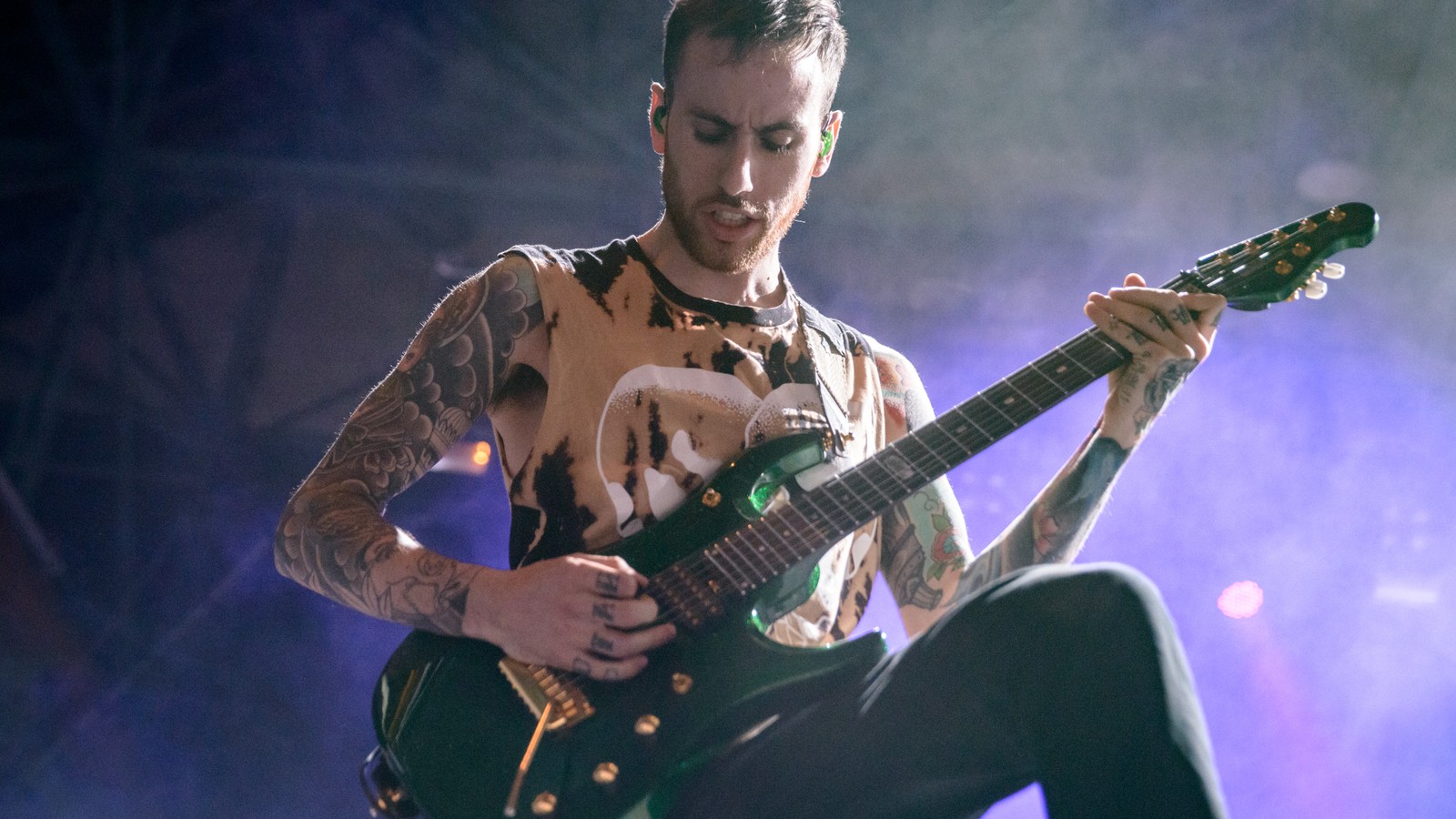
The great deathcore guitarists are not the ones who play fastest. They are the ones whose part a record could not lose. Pull their guitar out of the song and the song falls through the floor.
Still playing guitar in Antagony, the band formed in December 1999 out of the crust punk outfit Y.F.H., when he started a second band in 2002, and still holding down both until he quit the first in 2004, the Bay Area player who carried a crust punk right hand into the founding records of the genre and then never gave up the rhythm chair of the band he built is Ben Orum. The second band was All Shall Perish. He is on all four of its albums, from Hate . Malice . Revenge, put out on 19 August 2003 by the Japanese label Amputated Vein, to This Is Where It Ends in July 2011, and on every one of them the chug under the drop is his, palm-muted hard enough to buckle the lid of a road case parked in front of the stage. Nobody writes a magazine cover about that job. Every band in this music depends on it.
That is the test, and it is narrower than it sounds. Not speed, not gear, not followers. What the hand did on the record, and whether the record would stand without it.
What the great deathcore guitarists leave on tape
Picture the house guitar of a basement that books shows, a beat-up seven-string that lives under the stairs for any band whose player snaps a string or forgets a cable, six bands a night and two hundred nights a year. The chug players grind a trench into the first frets of the low string until the nickel is sawn down to a stub. The lead players file the top of the neck flat. The heel of every right hand rubs the black finish off the bridge down to raw wood, and one night a breakdown rips a saddle off its screw and fires it across the concrete into the drum kit. Pull that guitar out years later and the wear tells you exactly who played it and what they did. A record keeps the same kind of evidence.
Read that way, deathcore guitarists leave four kinds of mark. There is the rhythm part the whole song is built on, the open low string and the rests around it. There is the lead, which the genre threw out early and spent fifteen years bringing back. There is the writing, because in band after band the guitarist is the person who sits down with an empty session and comes back with the songs. And there is the room around the guitar: who produced it, who arranged the strings that sit on top of it, who decided where the riff stops and the singer starts.
Every player of this kind belongs to a band with its own place among the deathcore artists who built the sound, and the bands get their due there. The question for the guitarist is smaller and harder: which part of the record belongs to the person holding the guitar.
The first right hands, 2002 to 2008
Orum built the rhythm. The lead in All Shall Perish belonged to the chair beside him, and the player who sat in it from 2006 to 2009 was Chris Storey. The Price of Existence in 2006 was his first record with the band. Awaken the Dreamers, tracked at Castle Ultimate Studios in Oakland with Zack Ohren producing and released by Nuclear Blast in September 2008, was his second, and it entered the Billboard 200 at number 126 on just under 5,000 copies in its first week.
The band treated that chair as the thing it could not do without. When Storey left in February 2009, the replacement was Jason Richardson, who held it for about a year before Born of Osiris hired him, and after him came Francesco Artusato, the lead player on This Is Where It Ends. Three lead guitarists in three years, and the rhythm player under all of them never moved. Storey came back in 2015, and again for the reunion of 2024.
Founded in Montreal in January 2002, with Eric Jarrin writing on guitar from the debut and Yannick St-Amand beside him by 2004, the band in which St-Amand, the second guitarist, was also the person at the desk, producing The Healing Process for Century Media in April 2005 while he still played on it, and then The Ills of Modern Man in 2007 after he had stepped away from the instrument, is Despised Icon. Al Glassman was the second guitarist on that 2007 record. Ben Landreville is the second guitarist on Purgatory in 2019.
Jarrin is the constant, and by his own account the way he works kept the band from following the scene that grew up around it. Talking to J. Andrew of Decibel on 15 November 2019, the day Purgatory came out on Nuclear Blast, he said the band had written "a bunch of moods and riffs" for a while and only later tried to fit them into songs, and that for every riff or breakdown that made the album there were five or six others that did not. The five years apart, he said, meant the band never got influenced by the direction the genre took while it was gone. A riff bank that throws away five or six ideas for every one it keeps. That is a quarry, not a sketchbook.
Together on every Suicide Silence record from The Cleansing in 2007 to Remember... You Must Die in 2023, seven-strings in hand from the debut onward, the founding rhythm guitarist who has held the Riverside band's floor since 2002 and the lead player who joined him in 2005 are Chris Garza and Mark Heylmun. Matt Mills, interviewing Heylmun for Guitar.com on 1 June 2023, put the band's priority plainly: low, rhythmic muscle has always mattered more to these songs than lead lines played at a million miles an hour.
Mitch Lucker sang on the band's first three albums. He died on 1 November 2012.
Eddie Hermida took over the microphone in 2013. Garza and Heylmun stayed where they were. The records after the change bear that out. A Suicide Silence album from 2020 still has the same two guitarists on it that made The Cleansing, one riveting the floor down while the other decorates it, and the voice is the only thing that moved.
One more first-wave band matters for a single record. Under the pig squeal that made Job for a Cowboy's Doom EP, released in late 2005 by the Arizona label King of the Monsters and reissued by Metal Blade in 2006, the two guitars were played by Ravi Bhadriraju and Andrew Arcurio. The squeal got the attention, and AllMusic's Cosmo Lee wrote that hordes of MySpace copycats sprang up almost overnight behind it. Job for a Cowboy had left that sound behind by the time anyone was copying it.
Three guitars, a lead chair and a solo on almost every song
Recorded at The Sound Lair in Knoxville with Miah Lajeunesse and released on 31 July 2007 through Siege of Amida in Europe and Candlelight in North America, The Somatic Defilement had three guitarists on it, Ben Savage, Alex Wade and Brandon Cagle, and it is the only Whitechapel album with Cagle. He was injured in a motorcycle accident and could no longer play. Zach Householder replaced him. Householder was in the band by the time it went back into the studio.
Tracked in March 2008 at Backyard Studios in Milford, New Hampshire, with Jonny Fay producing alongside the band, and released by Metal Blade on 8 July 2008, the record that put the finished three-guitar front line on tape for the first time, Savage on lead with Wade and Householder beside him, was This Is Exile. It sold 5,900 copies in its first week and entered the Billboard 200 at number 118. The line-up of guitarists has not changed since. Eighteen years, three players, and not one breach in the wall they built.
Savage's own case rests on the part of the job that deathcore was supposed to have abolished. On "Orphan", from Kin in 2021, he told Steve Ritchie of MetalTalk on 22 October 2021 that he had worked out the first fifteen seconds of the solo and improvised the rest, and that he had taken lessons from Jake Cinninger of Umphrey's McGee and applied the tricks across the record. Fifteen seconds planned, the rest left open. Think of a band push-starting the dead van down the hill behind a venue at one in the morning: four of them shoving, the plan good for exactly as long as the slope lasts, and then the driver pops the clutch, the engine catches with a bang that knocks the muffler loose from its bracket, and from there it goes wherever the motor takes it. Metal Blade put the playthrough on its own channel. In 2025 Householder produced Hymns in Dissonance himself, with Brandon Zackey on drums, which puts one of the three guitarists in charge of how the whole record is heard.
Out in San Diego County the lead chair moved and the rhythm chair did not. Cory Arford has played rhythm for Carnifex since 2007, with only the band's 2012 to 2013 break as a gap. The lead player beside him on Hell Chose Me, released by Victory on 16 February 2010 after sessions with Zack Ohren at Castle Ultimate, and on Until I Feel Nothing, released by Victory on 24 October 2011 and co-produced by Tim Lambesis, was Ryan Gudmunds. The first entered the Billboard 200 at 175 and the second at 159, two records hammered out in twenty months with the rhythm chair bolted in place beside him, and the second was his last. Jordan Lockrey took the chair from 2013 to 2020.
Touring lead player from 2020 and made a full member on 9 September 2022, the former DevilDriver guitarist who turned Carnifex into a band with a solo on nearly every song is Neal Tiemann. On Necromanteum, released by Nuclear Blast on 6 October 2023, there is only one song without a solo, as Scott Ian Lewis told Everblack on 1 October. Andrew Kapper, reviewing it for Wall of Sound on 2 October, heard Tiemann bring melodic and technical flair to the lead passages and singled out "Heaven And Hell All At Once" for a solo spot among the riffs, the drums and the strings. Over Arford's chug his leads go up like a Roman candle fired off the bed of a pickup in the venue lot, each ball of fire punching out over the rumble of the idling engine below and slamming into the dark above the power lines. The engine keeps running. The fire is what the lot looks up at.
The shredder who passed through All Shall Perish earned his place in his own right. After a year in that lead chair and a stint with Born of Osiris on The Discovery in 2011, Jason Richardson joined Chelsea Grin in Salt Lake City and played lead on the Evolve EP of 19 June 2012 and on Ashes to Ashes, released on 8 July 2014 by Artery and Razor and Tie, before leaving in September 2015 for a solo career. Three bands in six years. Each one hired him for the same chair.
Three bands in six years. Each one hired him for the same chair.
The writers behind the riffs
Brought in at the end of 2010, after the band's founding lead guitarist was gone and with Sean Delander moving across to bass to make room, the lead player and co-writer on every Thy Art Is Murder album since Hate in 2012 is Andy Marsh. Delander came back to guitar in 2015, and the two have played side by side ever since. What Marsh says about the writing is unusually frank. Speaking to Valentino Petrarca of The Aquarian on 11 September 2023, eleven days before Godlike was released, he described a band that tries a hundred strange ideas to keep seven, and said it had more or less done its dash on speed and technicality.
Whose moment is it here and how does it best make the song hectic?
Andy Marsh, The Aquarian, 11 September 2023
He also admitted the COVID layoff had untrained the muscle memory, so the riffs for that album felt "new, foreign, and different" and came harder than usual. The question in the quote is what a writer asks, not what a soloist asks. It is about the song first and the hand second.

Moved from bass to lead guitar in 2009, four years after the band formed in Glasgow, the player who carried Bleed from Within from the deathcore of its first records toward something more melodic without ever cutting the drop out of it is Craig Gowans. Steven Jones joined in 2017 on rhythm guitar and clean vocals, which gave the band a guitarist who sings, and the two of them made Fracture, released by Century Media on 29 May 2020.
"The End of All We Know" went out on 29 November 2019 as the first look at that album. When the tab publisher Sheet Happens filmed Gowans for its Riff Playbooks series in August 2021, he played a section of "A Depth That No One Dares" from the same record, cycling between picking and tapping across a handful of variations of one idea. Tapping, in a band built on the breakdown. The hand that holds the riff now plays the hook as well.
The British guitarist who formed a band with a singer from Yekaterinburg in 2014 and writes its songs with him is Jack Simmons. He came from the London band Acrania, and Slaughter to Prevail is the band he co-founded. Talking to Acta Infernalis on 28 July 2021, just before Kostolom came out on Sumerian that 13 August, he said he writes pretty much everything with Alex Terrible: he brings in an idea, which can be "just one riff", the two trade it back and forth until it reaches its finished form, and only then does it go to the drummer, who rewrites the drum parts. He said he cares less about technical playing than about "good riffs, catchy melodies". It is a modest description of the job.
The Hessle guitarist who started a band with a drummer in 2012, wrote, recorded and edited its first album's instrumental tracks with him on his own computer, plays both the guitars and the bass on its records, is Eddie Pickard. Infant Annihilator is the clearest case of a guitarist as the whole studio, every riff dragged through one computer and blasted out the other side as a finished album. The Elysian Grandeval Galèriarch, released on 29 July 2016, was the band's second album.
Founded in 2004, the Minnesota band whose two guitarists produced their own second album, one of them engineering it and the other programming every drum hit and mixing it, is After the Burial, and the two were Trent Hafdahl and Justin Lowe. Rareform, released by Sumerian on 22 July 2008, credits Hafdahl with lead guitar, backing vocals, production and engineering, and Lowe with rhythm guitar, drums, programming, production and mixing. Two guitarists, and between them the whole record.
Lowe left the band in June 2015. He died in July 2015, aged 32.
Hafdahl took over the rhythm guitar and the programming as well as the lead. Dig Deep came out on 19 February 2016 with one guitarist doing what two had done.
Sweeps, orchestras and the solo's return
Started in 2009 as a high school studio project with one person on guitars, bass and keyboards, the Bay Area band whose records were so dense that the band was accused of being unable to play them is Rings of Saturn, and the person was Lucas Mann. In April 2015 the band posted a dual-guitarist playthrough of "Godless Times", from the previous year's Lugal Ki En, with Mann and Miles Dimitri Baker playing it side by side. It was released in answer to those allegations. The parts are a ping-pong rally on a table in the basement of a band house at four in the morning, two players slapping the ball back and forth faster than the eye can follow until it is a white smear over the net, and then one smash splits a paddle down the handle and drives the ball clean through the drywall. You can argue about whether that is a song. You cannot argue about whether it was played.
Holding the lead guitar in Lorna Shore since 2010, through every change at the microphone and the jump from small labels to Century Media, the New Jersey player who is the longest-serving member of the line-up is Adam De Micco. He covered bass in the line-up as well, from 2017 to 2021. On Pain Remains, released on 14 October 2022, the credits list De Micco on lead guitar and Andrew O'Connor on rhythm guitar and orchestrations, which means one of the band's two guitarists wrote parts for an orchestra that is not in the room. The record went to number 6 in Germany and in Austria. De Micco told The Harvard Crimson in September 2025 that nailing a really difficult solo just feels good. A genre that once cut every solo had raised a scion who says a difficult solo, nailed, just feels good.
The deathcore guitarist who also produces, engineers, writes the keyboards and sings backing vocals is Chris Wiseman. Shadow of Intent started in 2013 as a project between him and Ben Duerr, and Elegy, released on 14 January 2022 through Blood Blast Distribution, credits Wiseman with guitars, backing vocals, production and engineering, and Francesco Ferrini of Fleshgod Apocalypse with keyboards and orchestration. Talking to Ricky Aarons of Wall of Sound two days before release, Wiseman said the aim was "the grandest orchestrations" the band had ever attempted, and named Ferrini, Randy Pasquarella and Kelsie Hargita as the people who had widened what he could write for keyboards. A practitioner of the tensile kind: the strings stretched as far as they go without the riff underneath snapping.
Lined up, the players split almost evenly. Orum, Garza and Arford held rhythm chairs through every change around them. Storey, Savage, Tiemann, Richardson and De Micco carried leads in a genre that started out with almost none. Jarrin, Marsh, Simmons, Pickard, Mann and Wiseman are writers first, and three of them built their bands from a computer before they built them on a stage. Hafdahl and Lowe did all of it on one record. What they share is a part the song cannot do without. The guitar decides where the song can go, and the drop decides where it lands.
Some of those bands sit on any short list of the greatest deathcore bands of all time, and some never will. The guitar part does not care which. It is on the record either way.
