
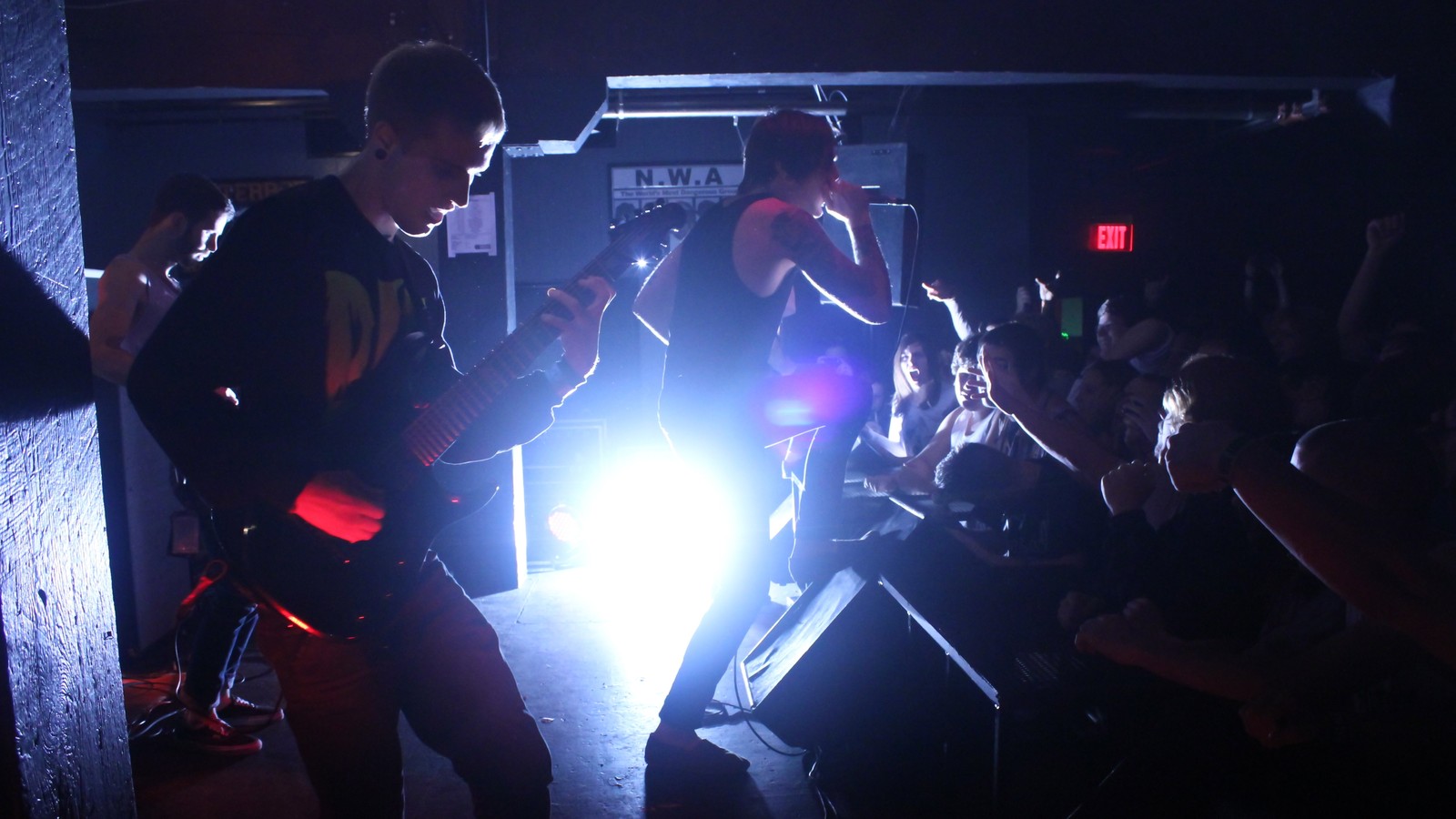
In late 2005 an Arizona label called King of the Monsters released Doom, the first EP by a Glendale band whose members were still teenagers, and the singer on it squealed.
The Arizona teenager behind that squeal, cutting it at Blue Light Audio Media in Phoenix in May 2005 and then watching it pass from one MySpace profile to the next until singers in basements all over the country were chewing the foam off their microphones trying to copy it, was Jonny Davy of Job for a Cowboy. One sound. A decade of echoes.
Ten years on, the echo was still the yardstick. In May 2015 a reviewer at Heavy Blog Is Heavy heard Tom Barber's lows on Psalms, the first full-length by the New Jersey band Lorna Shore, as "nigh unintelligible", and found his doubled highs better for coming "from the Jon Davy playbook".
That is how deathcore vocalists are measured. Not by followers or merch sales or who headlined. By what the throat does on a record, and by whose voice a later singer is heard through.
Picture a roadie at load-in in the gravel lot behind a two-hundred-capacity club, with an aluminium extension ladder and the band's banner. He kicks the feet into the gravel until they bite, racks the fly section up until the top rail grinds into the brick under the roofline and scrapes off a strip of forty-year-old paint, then climbs with the rolled vinyl over his shoulder while the whole frame bows and rings under him. A singer's range is that ladder. The feet are the guttural, the top rail is the shriek, and the voice that counts is not the one that reaches furthest but the one that still takes a man's weight at full stretch without folding.
Each of the great deathcore vocalists works inside the trade between a low register and a high one that became the genre's signature sound, and each earns the name for something heard on tape: a span, a technique carried further than anyone had carried it, a record that proves it.
Deathcore vocalists of the MySpace years
Davy's mark is one sound and what it did after it left him. Doom, produced by Cory Spotts and reissued by Metal Blade in 2006, is the Job for a Cowboy record that carries his pig squeal in full, and Cosmo Lee, reviewing it for AllMusic, credited the band's MySpace-era style with spawning many imitators. On tape the squeal is the back door of a band trailer nobody has oiled since the first tour, wrenched open at every truck stop, steel shrieking on steel until every head in the lot turns round. By the Gloom EP of 2011, Josh Neale of mxdwn heard Davy reaching for "black metal-style shrieks" in place of the standard death roar. The squeal had already got loose.
How a squeal is built belongs with the other pig squeals, gurgles and gutturals in the genre's kit. Davy's place rests on the echo, which the 2015 review of a singer in New Jersey proves better than any argument.
Produced in Denmark by Tue Madsen and out on Century Media from 18 September 2007, shoved up to number 94 on the Billboard 200 by 7,250 first-week sales, The Cleansing put the Riverside voice in front of the whole first wave, and the singer whose death growls AllMusic heard laid over black metal shrieks until the album sounded "like a vocal duet" was Mitch Lucker of Suicide Silence. One throat, two voices, stacked.
Lucker sang on the band's first three albums. Lucker died in a motorcycle crash in Huntington Beach, California, on 1 November 2012. In October 2013 Suicide Silence named Eddie Hermida, the singer of All Shall Perish, as its new vocalist.
Hermida's case rests on an earlier record. The singer of All Shall Perish whom Erik T of Teeth of the Divine heard supplying "ample low end growls and strained screams" on 7 August 2006, the day before Nuclear Blast released The Price of Existence, is Hermida, and the record earns him his place for keeping a growl and a scream both in play at the speed of the band behind him. Most listeners met him later, at the Suicide Silence microphone. The proof is older.
Knoxville supplied the deepest voice of the first wave. The singer in the middle of three guitars whose bellow Erik T, reviewing This Is Exile for Teeth of the Divine on 9 July 2008, called "inhumanly deep" and inhaled sounding is Phil Bozeman of Whitechapel, and the record, recorded with Jonny Fay, mixed and mastered by Zeuss and released by Metal Blade that July, entered the Billboard 200 at number 118 with that low hauling three guitars behind it. Inhaled is the word that matters. The sound works like the wet-dry vacuum a club's night porter drags across the floor after the last band, the hose ripping up spilled beer, broken glass and a lost sneaker with a roar that pulls into the machine instead of blowing out of it, so the whole room seems to empty toward the man at the microphone.
Not every one of the chroniclers wanted only the low. Andrew Edmunds at Your Last Rites, writing on 28 July 2008, had found Bozeman monotonous on the 2007 debut and welcomed how much of This Is Exile he spent in "a pretty venomous midrange". The range widened. The bellow stayed, and it has stayed through every Whitechapel record since, which makes Bozeman the genre's most durable exponent of the inhaled low.
Lows that blur and highs that cut
Made by a Salt Lake City band and released by Artery Recordings on 16 February 2010, Desolation of Eden stacked two voices out of one man, and the singer whose high screeches, laid over his own gut growl, made Andrew Roy of SLUG Magazine hear something "a lot cooler than either vocal on its own" was Alex Koehler of Chelsea Grin. Studio layering is ordinary in this music. Koehler wrote the layers to collide.
The San Diego County voice that has fronted Carnifex through every full-length from Dead in My Arms in 2007 to Necromanteum in 2023, dragging the band out of the MySpace pit and into black metal's shrieks without once giving up the floor, is Scott Lewis, and the record that shows the width is World War X, released by Nuclear Blast on 2 August 2019, in which Michael Pementel of Consequence of Sound heard Lewis once again providing "an awesome range in vocal tones" and named "Visions of the End" among its essential tracks. The single Nuclear Blast filmed is that song. Twelve years in, the voice was still adding colours.
Back to New Jersey, and to Psalms. The singer whose lows on that record, released by Density Records on 9 June 2015 with Will Putney producing, came out of the Heavy Blog review as "blurry phrases of low end", ominous and nearly wordless, is Barber, and he belongs among the best deathcore vocalists for exactly the quality the review held against him. That is the low and high trade-off at its sharpest. The further down a voice goes, the less of the word survives the trip, and Barber chose the depth.
The further down a voice goes, the less of the word survives the trip.
The widest vocal ranges: Hessle, Spokane and Yekaterinburg
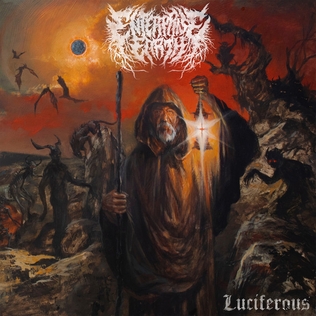
Released on 5 April 2019 through Entertainment One and Good Fight Music, Luciferous is the record on which the singer who had voiced Infant Annihilator's debut carried his range into a band of his own in Spokane, and the voice that Katarina McGinn of Dead Rhetoric heard running "the gamut of extremity, from guttural lows to high shrieks" belongs to Dan Watson of Enterprise Earth. Bottom to top, one throat.
Then he added more. On The Chosen, released on 14 January 2022, Dom Lawson of Blabbermouth, in a review posted that January, heard Watson use "at least two new parts of his voice" on "Where Dreams Are Broken", a chorus hook among them, while still growling underneath. A singer with that many registers could have spread them thin. He stacked them like ordnance.
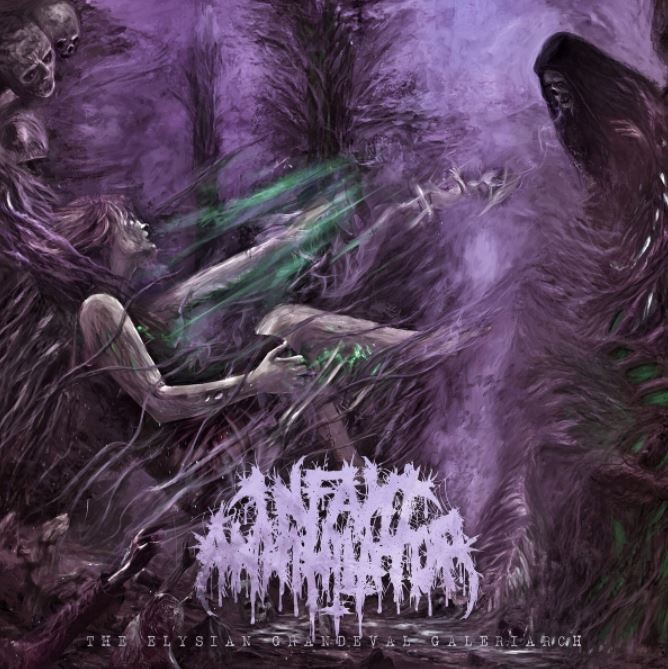
At Infant Annihilator, the Hessle band, the next voice, on The Elysian Grandeval Galèriarch, self-released on 29 July 2016 and carried to number 4 on the Billboard Heatseekers chart, was Dickie Allen's, whose screams Malokai McGuire-Britz of The Cascade, reviewing The Battle of Yaldabaoth on 8 October 2019, put down to "raw talent". A band that writes riffs which change shape every bar needs a throat that changes with them, or the singer becomes the one still object in a room full of moving parts. Two singers have held that seat. Both are wide.
Yekaterinburg sent the loudest argument for width of all. The singer whom Graham Finney of V13 described in August 2021 as a man who could make your eyes water with his guttural vocals, and in whose performance on Kostolom, released by Sumerian on 13 August 2021, the same review found demonic growls, polished cleans and sinister spoken-word passages, is Alex Terrible of Slaughter to Prevail. Phil at Sonic Abuse had heard that record at the end of July, and on "Bonebreaker" he named a "varied, propulsive vocal style". The cleans did not cost him the low end. The gutturals, in Finney's words, stayed "second to none", scorched earth under every new colour.
Best deathcore vocalists of the latest wave
Out on Century Media on 14 October 2022 and closed by a three-part title suite, Pain Remains is the record that settles the case for the singer whom GardensTale of Angry Metal Guy, four days after release, heard producing cavernous growls, throat-ripping screeches and gnarly screams, switching from style to style "on a dime" without ever compromising on technical execution, and that singer is Will Ramos of Lorna Shore. His switching works like the lighting tech at a sold-out club who runs the set by hand, slamming floods, blackout, red wash and strobe on in turn with the flat of his palm as fast as the song changes, the buttons cracking under him by the last week of the tour and not one cue dropped. The same review named Ramos one of the best vocalists in extreme music.
The singer of the Hartford band who sets his lines against orchestral synths, and whose "monstrous vocals" Katarina McGinn of Dead Rhetoric heard complemented by the synths on Melancholy, self-released on 16 August 2019, is Ben Duerr of Shadow of Intent. His merit is plain and rare. A low growl under a full string section can drown. His does not.
The Las Vegas singer whom David Hough of Metal Temple, reviewing The Burden ov Faith on 12 March 2023, twelve days before Century Media released it, heard switching between several vocal styles "at the drop of a hat", is Ricky Hoover of Ov Sulfur. "Stained In Rot", the single the label put out with a video, layers clean and harsh vocals, in Hough's reading. The song sings and tears at once.
Two kinds of range, thirteen voices
| Singer | Band | Record to hear | Why |
|---|---|---|---|
| Jonny Davy | Job for a Cowboy | Doom (EP, 2005) | The squeal a generation copied |
| Mitch Lucker | Suicide Silence | The Cleansing (2007) | Growl over shriek, a duet from one throat |
| Eddie Hermida | All Shall Perish | The Price of Existence (2006) | Low growls and screams at full speed |
| Phil Bozeman | Whitechapel | This Is Exile (2008) | The inhaled low, widened by a midrange |
| Alex Koehler | Chelsea Grin | Desolation of Eden (2010) | High screech laid over his own growl |
| Scott Lewis | Carnifex | World War X (2019) | Range of tones, still growing |
| Tom Barber | Lorna Shore, Chelsea Grin | Psalms (2015) | Depth chosen over the word |
| Dan Watson | Infant Annihilator, Enterprise Earth | Luciferous (2019) | Guttural lows to high shrieks |
| Dickie Allen | Infant Annihilator | The Elysian Grandeval Galèriarch (2016) | A throat as restless as the riffs |
| Alex Terrible | Slaughter to Prevail | Kostolom (2021) | Gutturals, cleans and spoken word |
| Will Ramos | Lorna Shore | Pain Remains (2022) | Every style, switched on a dime |
| Ben Duerr | Shadow of Intent | Melancholy (2019) | A low that holds under an orchestra |
| Ricky Hoover | Ov Sulfur | The Burden ov Faith (2023) | Clean and harsh vocals, layered |
These deathcore singers fall into two kinds of merit. Davy, Lucker, Bozeman and Barber pushed one sound as far as it would go, down or up, at the price of the words. Watson, Allen, Terrible, Ramos and Hoover hold many sounds in one throat and move between them fast. Hermida, Koehler, Lewis and Duerr stand between the two camps, and the lineage runs straight through them: the earlier singers set the extremes, the later ones learned to cross from one to the other inside a bar.
Every one of these voices has fronted a band with its own history, from Glendale and Riverside to Hessle and Yekaterinburg, and the bands get the longer account. A singer is judged on a record, a register, and what the next singer took from it.
