
Asked by Lambgoat in January 2012 what he made of the word printed under his band's name on every flyer, in the same month Earache was stamping out the rumour that Oceano had split and less than two years after the Montreal founders had torn down their backline for what they called the last time, the guitarist who answered that most deathcore bands "slowly stray away from the genre with each release" was Jake Harmond of Chelsea Grin. He was not sneering. He was reading the exits off the tour calendar.
He was also standing in a band whose newest record, My Damnation, had entered the Billboard 200 at number 64 the summer before.
Deathcore is dead: the sentence has been said in interviews, printed in books and typed under clips in every stretch of the genre's life, and each time it was a claim about bands, records and rooms, which means each time it could be checked. Checked against what the labels signed, what the charts logged, which tours went out and which new bands turned up, it has failed on every occasion so far. The people who said it were usually right about what they were looking at. They were looking at the wrong door.
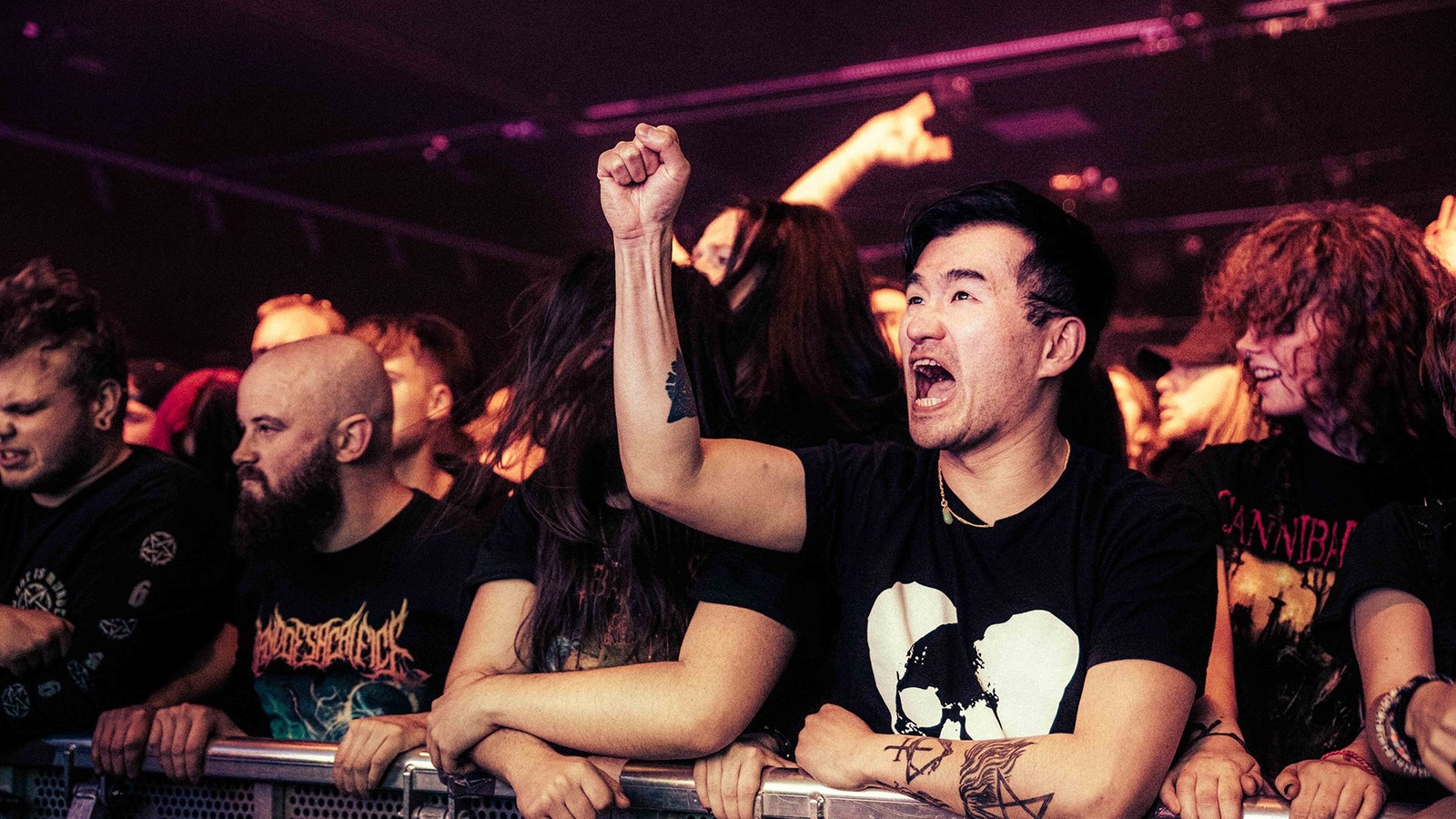
Picture a fire marshal at a VFW hall on a Saturday night, halfway through the second band, running a length of chain through the push bars of the double doors and snapping a lock on it because the head count at the table came out wrong. The house lights come up, the hall is declared closed, and the crowd shoulders the fire exit off its hydraulic closer, hauls the cabinets out by their handles, runs a cord from the taco truck at the kerb and drops the next breakdown onto the asphalt, three hundred pairs of boots slamming down on blacktop where the floorboards used to be. The hall was shut. The show was not.
The first funeral, 2008 to 2011
The first death notice wrote itself out of departures, and they were real ones. Bring Me the Horizon turned toward metalcore with Suicide Season in September 2008, Job for a Cowboy released Ruination on Metal Blade in July 2009 as a death metal record from first bar to last, and the band that announced on 7 April 2010 that it would disband, eight years after it formed in Montreal, was Despised Icon. Three bands of the first class, three exits, inside nineteen months. Plenty of people read the genre its last rites.
The verdict that followed has stuck. By the start of the 2010s, the story went, the genre had swollen and its sound had flattened into one shape. As a description of a crowded shelf it holds. As a forecast it ran straight into the records.
Released by Metal Blade on 8 June 2010, two months after the Montreal announcement, selling around 10,600 copies in its first American week and going in at number 43, the album that hauled the Knoxville sextet seventy-five places up the Billboard 200 from its previous record was A New Era of Corruption, by Whitechapel. A year later Suicide Silence put The Black Crown in at number 28, Chelsea Grin landed My Damnation that same July, and Oceano rode the 2011 Summer Slaughter bill with Whitechapel and The Black Dahlia Murder at the top. The exits were real. The chart entries were higher.
Where each of the departing bands went, and how the rest of the field broke into branches, is the story of how the genre split apart in the decade that followed. What matters for the obituary is narrower. A genre is not the handful of bands that founded it, and the records of 2010 and 2011 show the floor holding after three of the best known names had left or stopped.
Counting the bands that left deathcore as proof of its death treats a band as the genre's property, and it never was. Bands leave every genre, and a genre outlives them for as long as somebody keeps writing the song. What decides whether deathcore is alive is whether anyone is still writing it, and in 2011 the song was being written in Salt Lake City, Knoxville, Riverside and Chicago at once.
Deathcore is dead, again: 2012 and 2013
The second wave of notices came faster and from inside. Oceano's split turned out to be a short hiatus, announced by Earache in January 2012 so that Adam Warren could be home for the birth of his child. In October 2012 Carnifex said it would play three last shows in California and then stop, indefinitely. To anyone counting tour dates, the announcement read as the end of the whole style.
Mitch Lucker of Suicide Silence died on 1 November 2012 after a motorcycle crash in Huntington Beach. He was 28. The band played a memorial concert that December and named Eddie Hermida of All Shall Perish as its singer in October 2013.
The two band announcements can be tested by what each band did next. Oceano went back on the road and put out Incisions in 2013, Ascendants in March 2015 and a record for Sumerian in 2017, and it was still releasing albums when Living Chaos arrived in August 2024. The hiatus that read as an ending was a gap of months. The same October that Carnifex announced its stop, a band from Blacktown put Hate in at number 35 on the Australian chart, and that band was Thy Art Is Murder.
Then the band that had stopped came back. Added in June 2013 to the European Impericon Never Say Die! tour as a late replacement for Miss May I, signed to Nuclear Blast that July, and back in the shops in March 2014 with a record produced by Mark Lewis at Audiohammer, the band that entered the Billboard 200 at 98 and the hard rock albums list at 5 with Die Without Hope was Carnifex. The title track, which Nuclear Blast released with an official video, is the sortie that followed the hiatus, a closing date torn off the calendar. A band on a German label with a German chart entry is not a ghost.
The slump, 2016 to 2019
The longest and most convincing notice ran through the back half of the decade, and it was argued with sales. Whitechapel went from number 10 in 2014 to number 72 with Mark of the Blade in June 2016 and number 143 with The Valley in March 2019. Suicide Silence put its self-titled record in at 163 in February 2017. Will Ramos told Knotfest in July 2022 that a lot of people had been saying for a while that "the scene is fading away", and that he did not necessarily agree.
The promoter's chrome tally counter clicks at the front door of a club all night, one thumb press per paid ticket, and the number on it falls every month, while out back the alley door has been wedged with a cinder block, kicked off its top hinge and left hanging, and the room has been filling up through it for an hour, every uncounted body on the floor and moving when the first breakdown lands. The counter is accurate. It is counting one door.

The back door was where the next bands were coming in. Self-released on 10 January 2016 from homemade recordings, drums programmed and keyboards sampled, with Ben Duerr on vocals and Chris Wiseman writing everything else, the debut that a two-man studio project put out in the middle of the slump was Primordial, by Shadow of Intent. By April 2017 the Connecticut band had a full line-up and a live drummer, with Reclaimer out, and in the spring of 2018 it went on its first major tour, under Carnifex on the Chaos and Carnage bill, with Oceano, Winds of Plague and Archspire beside it.
The labels read the same years the other way. Sumerian signed Slaughter to Prevail in 2016 on the strength of an EP that had travelled online, and the Yekaterinburg band released Misery Sermon in May 2017. Thy Art Is Murder took Dear Desolation to number 5 in Australia that August. Century Media signed Lorna Shore in October 2019, two months after Shadow of Intent had reached number 2 on the Heatseekers chart with Melancholy and no label on the sleeve. A record company signing a band in a dead genre is spending money against its own forecast.
Even Suicide Silence turned round inside the slump. "Feel Alive", which Nuclear Blast put out with an official video on 13 December 2019, came ahead of Become the Hunter, released on 14 February 2020 and produced by Steve Evetts, a record that reviewers greeted as a return to form. The band whose 2017 self-titled record had tested whether its audience would follow it out of the genre took the answer and walked back in.
Shut rooms and the wrong instrument, 2020 to 2022
In March 2020 the obituary nearly became literal. Every hall closed, every tour was cancelled and the one place the genre had always proved itself, the floor in front of the stage, did not exist for the best part of two years. The genre spent those two years on video, and on 11 June 2021 Lorna Shore released "To the Hellfire", with Will Ramos named its permanent singer the same day.
The charts, read the old way, barely noticed. Released by Century Media on 14 October 2022, Pain Remains entered the Billboard 200 at 150. The same record went to number 6 in Germany and Austria and number 7 in Finland and Switzerland. Whitechapel's Kin, released on 29 October 2021, missed the Billboard 200 entirely.
| Year | Whitechapel record | Billboard 200 | What was being said, or done, that year |
|---|---|---|---|
| 2008 | This Is Exile | 118 | Bring Me the Horizon leaves for metalcore |
| 2010 | A New Era of Corruption | 43 | Despised Icon announces it will disband |
| 2012 | Whitechapel | 47 | Oceano rumoured split; Carnifex hiatus |
| 2014 | Our Endless War | 10 | Carnifex back on Nuclear Blast |
| 2016 | Mark of the Blade | 72 | Shadow of Intent self-releases Primordial |
| 2019 | The Valley | 143 | Lorna Shore signs to Century Media |
| 2021 | Kin | did not chart | "To the Hellfire" released in June |
Read down the third column alone and the genre peaks in 2014 and is off the chart by 2021. Read across the rows and the line runs the other way. The Billboard 200 counts albums sold or streamed in one country in one week, and by the 2020s deathcore's new audience was arriving through single clips, vocal cams and reaction videos, buying tickets in Germany and Australia and shirts at the merch table, none of which the American album chart was built to measure. A chart is an instrument. Pointed at the wrong thing, it reads zero.
The bands with no label could see the gap better than anyone. "From Ruin... We Rise", which Shadow of Intent put out with a video on its own channel on 1 October 2021, announced Elegy, self-released on 14 January 2022 and carried to the shops by Blood Blast Distribution, a record that set orchestral arrangements against blast beats, and the single made its case the way a band with no label has to, on its own channel and straight to its own audience. It did not need the album chart. It needed the next run of rooms, and a band with no label was booking them.
The novelty that did not pass, 2022 to 2026
The last notice was the most polite. A clip that goes round the short video apps is a novelty by definition, and the obvious bet in 2021 was that the people who had watched a vocal coach hear a pig squeal for the first time would move on to the next clip by the autumn. Some of them did. The test is the size of the rooms four years later.
By June 2025 Lorna Shore was on the bills of Download, Hellfest and Rock am Ring, and on 30 October 2025 the New Jersey band closed a North American headline run in the theatre underneath Madison Square Garden, with The Black Dahlia Murder also on the bill. In the spring of 2026 its American run, booked for 17 April to 22 May, took Signs of the Swarm and Paleface Swiss out as support, with Welcome to Rockville on 8 May and Sonic Temple on 15 May on the route. A fad that headlines a theatre under Madison Square Garden four years after its clip has stopped being a fad and become a garrison.
The founders answered the same question with new records rather than reunion sets. Whitechapel released Hymns in Dissonance on Metal Blade on 7 March 2025, Despised Icon released Shadow Work on 31 October 2025, fifteen years after the split that had opened the first funeral, and in May 2026 Carnifex signed to Sumerian, two decades after its first EP. The genre's oldest bands were writing again in the same years its newest ones were forming.
And the newest ones were choosing the oldest sound on purpose. Mauled from Indianapolis released the EP When Your Eyes Are Shut on 12 March 2026, and The Harvard Crimson counted it among "a wealth of new bands" in a deathcore revival inspired by the MySpace years. That is not what a dead genre looks like. It is the exhumation of a sound that had never actually been buried.
A chart is an instrument. Pointed at the wrong thing, it reads zero.
Laid end to end, the five verdicts share a method and a fault. Each one took a real event, an exit, a hiatus, a sales figure, a shutdown, a viral clip, and read the genre's future off the bands it could see from where it stood. Each one was overtaken within a few years by bands it had not counted, records nobody had forecast, and labels and promoters betting their own money in the opposite direction. The longer account, from the first records to the arenas, sits in the KaosMetal history of deathcore.
Whether deathcore is dead is a question that will be asked again, probably the next time a founder makes a clean record or a big band goes quiet. The way to answer it will not change. Look at who signed whom that year, who booked which room, and how many bands formed in the last five years have released a record. On every count taken so far, the answer has been the same.
